Small farms often get judged by the wrong metric. In a world built to understand and optimize complicated systems, small farms can be outliers of complexity. So how are the two systems different? What problem is the complex system trying to solve?
There’s a distinction I wish more people understood when they start planning a farm — or judging one. Not everything that looks difficult is the same kind of difficult.
Some things are complicated, but some things are complex.
Those two words sound interchangeable, but they describe very different kinds of systems. . . and if you mix them up, you can make very bad decisions very quickly — especially when you’re working with land, animals, weather, and living soil.
A complicated system has many parts, but those parts behave in predictable ways. Take a tractor engine for instance. A tractor engine is complicated. It was designed and put together to work in a specific way and within narrow parameters with rigid controls. If you put gasoline in a diesel engine (for instance), you’ll find out a lot more about that complicated system as you locate plugs, drain fuel lines and flush engines and filters. Ask me how I know.
When something goes wrong in a complicated system, you can usually trace the problem to a specific cause — like a mislabeled, orphan jerry can. With enough expertise (and YouTube) sometimes you can even fix it. Or you can call James at Tractorland who will answer your call and tell the voices over his shoulder, “Hang on a sec, it’s Tara on her annual call” and will then calmly and patiently connect you with the service department who will send Chicken Fred out to pick up your orange paperweight and get it back into running order. Ask me how I know.
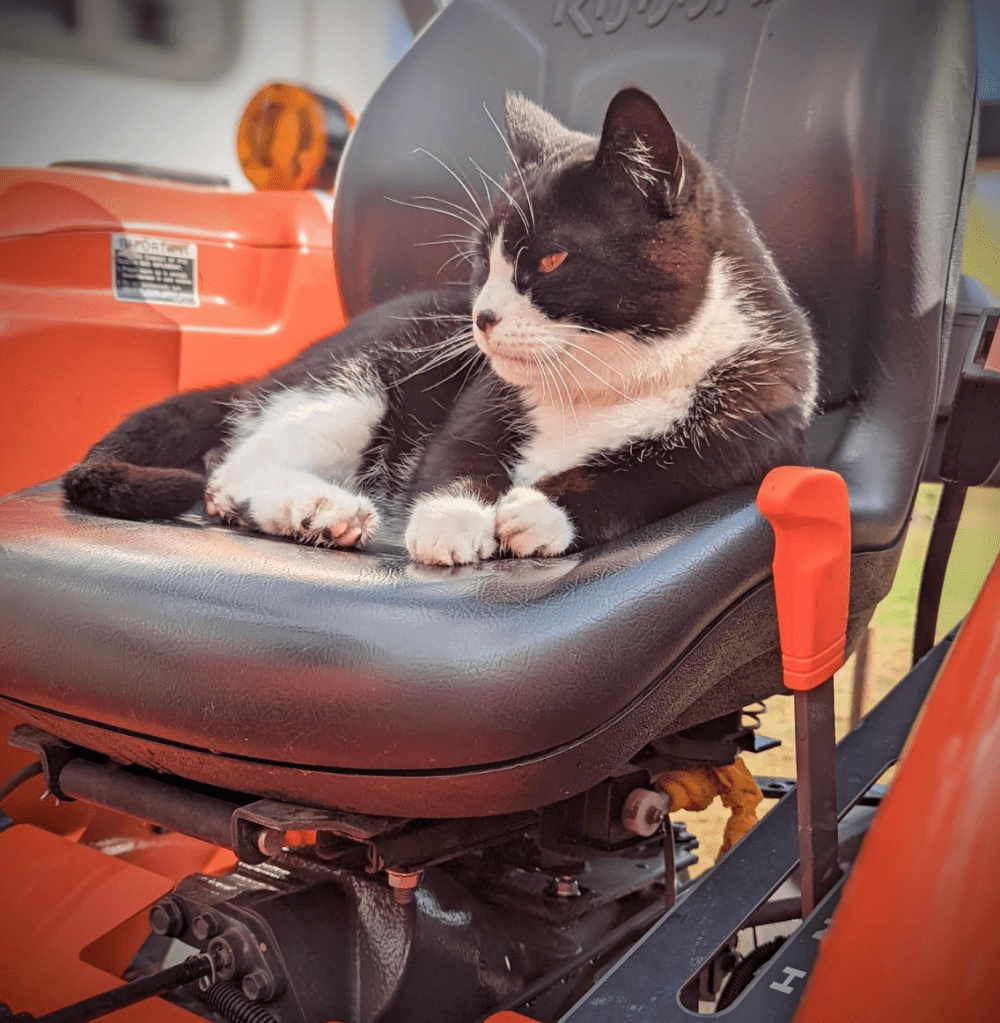
Complicated systems reward precision, specialization, and control. Complicated systems need James and Chicken Fred and a tolerant (if disbelieving) service department.
A complex system is different.
A complex system also has many parts, but the parts interact in ways that change depending on conditions.
A pasture is complex, a flock is complex, a watershed is complex. A farm — the real farm, not the one on a business plan — is complex.
In a complex system, cause and effect are not always obvious and may be related tangentially as well as linearly. Sometimes, we will change one thing and it will cause a cascade that results in a shift somewhere you didn’t expect. Choice is a response, variables are in flux and timelines are fluid. Complexity can rarely be optimized the way they can in a complicated system. As a teenager, I navigated my high school hallways with ease. I knew where I could go, what I could do, who I could talk to, when I needed to be where, how I was supposed to look, what subjects I could talk about, where I was safe, how I needed to behave to move through this intensely complex system smoothly — or at least with a minimum of embarrassment. High school is a complex system. A change in any one of those variables and the entire social matrix of the school could shift — along with my place in it.
Complex systems can’t be optimized for efficiency or primed for a particular outcome the way complicated systems can. They can only be observed, adjusted, and guided and that difference matters more than most people realize.
Complicated systems are very good at efficiency but complex systems excel at resilience.
Efficiency and Resilience — Not The Same. Not.
This is exactly what I was writing about in my earlier post on resilience vs. efficiency.
Efficiency works beautifully when conditions stay the same but resilience matters when conditions change. In one case, when everything is predictable and clicks along in set, repetitive programs, complicated systems can shine.
Industrial agriculture is built on the assumption that farms are complicated systems.
If you apply the right fertilizer, you get the right yield; if you use the right genetics, you get the right performance; if you streamline labour, you get the right profit. Those kinds of assumptions work best when scale is large, variables are controlled, and the goal is uniform output. It where you’ll see a control room and the merest flick sends feed into buckets or fresh water into troughs and you’ll be amazed and the words, “It all looks so easy!” will tumble out of your disbelieving lips and despite all the screens and blinking lights and levers and toggles and buttons, you’ll actually believe that what you’re looking at is just that — easy.
No one looking at a small farm would ever say, “It looks so easy.” That’s because small farms are often complex and complex never looks easy.
On a small farm, everything interacts with everything else. Feed choices affect fleece quality, fleece quality affects income, income affects stocking rates, stocking rates affect pasture recovery, pasture recovery affects winter feeding, winter feeding affects manure accumulation, manure spreading impacts soil health and soil health feeds directly into next year’s grass.
Nothing stands alone. Rather than a flow chart of A to B to C as in a complicated system, a complex system is a series of overlapping circles, a Venn diagram of multiplicity and redundancies which from the outside, can look awfully inefficient.
The Inevitable Questions. . .
Why not specialize?
Why not scale up?
Why not simplify?
Why not run the farm like a business?
The answer is that many small farms are not failing to be efficient simply because that’s not the problem they’re trying to solve. Small farms like mine have intentionally chosen to lean into resilience — to work toward the ability to bounce back from the unexpected, the unanticipated, the fluctuations life has a habit of throwing at us.
That doesn’t mean I don’t work within complicated system — my once-yearly chat with James the Kubota Guy is proof of that. It’s just that the homestead is aiming squarely at flexibility, the ability to absorb and redirect the slings and arrows of outrageous fortune. I have seen what happens to complicated systems when the unthinkable happens. . . On a grand scale; when pandemics strike, when markets tank, when the Chinese buyers decide not to take your canola this year, when a new government in some other country starts behaving badly. On a much more intimate scale; when relationships implode, when illness or injury takes you out, when one bad harvest wipes out an entire line item on that infernal spreadsheet.
I have seen it happen all around me, I’ve watched some of those things walk into my own life. The only way I know how to make a life out of . . . “life,” is to choose resilience. And that choice isn’t accidental. It comes from prioritizing complexity — the willingness to design flexibility and if/then options into the system.
In a complicated system, the goal is control. The complicated system chooses a very specific outcome by meticulously executing a very particular sequence within a narrow range of possibilities. Do it all right and you’ve got a predictable, repeatable, measurable (and often marketable) result.
In a complex system, the goal is stability. The complex system allows tremendous variation at all stages and accepts that the outcome may be other than what was intended — and there’s a plan for that.
As a result only one of these systems functions well “at scale.” The other is much better being left small. In a complicated system, scale makes things easier but in a complex system, scale often makes things harder. Like, so. much. harder.
What This Looks Like Here
My own approach to regenerative land stewardship grew out of learning — sometimes the hard way — that this farm behaves like a complex system, often whether I want it to or not.
The pastures respond differently depending on rainfall, slope, and soil depth, some grasses recover quickly, others need a full season. Sheep prefer clover . . . until they don’t. Alpacas change how the flock moves and let’s not even talk about weather. Weather can undo a season’s worth of planning in a single afternoon.
This is the world I live in and because I know that, I’ve chosen to manage the land using an adaptive, multi-paddock grazing system rather than a fixed rotation. It means more work for me — I don’t just eyeball a calendar and make the move. I have to watch how plants recover, how soil holds moisture, how animals behave, where are there wildlife impacts, what are our wind and precipitation levels, traffic corridors, litter levels, vegetation types, mineral levels and a hundred other levers (possibly I am exaggerating a titch but you get the idea) and THEN I get to make a move.
I am constantly in a state of assessment and adjustment. Sometimes a paddock gets grazed lightly, sometimes it gets hit hard and then rested for a long time and sometimes I leave an area alone entirely.
That isn’t inefficiency — or it is, but it’s intentional. My chosen inefficiency is acknowledging that the homestead is a complex system rather than pretending it’s a complicated one.
I also keep more than one species, grow more than one kind of forage, and pay attention to things that don’t show up on a balance sheet — soil structure, plant diversity, insect life, water movement, animal health over time and I’ll tell you honestly, almost none of those choices maximize short-term output. Much to the chagrin of my accountant, it doesn’t show up on a profit-and-loss statement. Alas.
But they do make the farm more stable.
Resilience lives in diversity.
Resilience lives in redundancy.
Resilience lives in observation, not optimization.
Resilience lives in complexity.
Looking at small farms on paper, we can look like a ridiculous snakes-and-ladders version of agriculture with all kinds of tangents and work-arounds and Plan A/Plan B/PlanLMNOP chaos. After all, many of raise more than one species (we love polyculture!! Polyculture RULES!!), we steward breeds that aren’t the most productive, we grow things and in ways that don’t maximize yield, we value margins, hedgerows and other “unproductive/under-utilized” ground among any number of other practices that don’t make sense when profit and efficiency are the only goals.
Choose Your Hard
You may have seen that meme that was going around some time ago, “Choose your hard.” It’s been adapted to suit a range of scenarios and situations but in terms of farming, it might look like this —
Treating a farm like a machine is hard
Working with a living system is hard
Choose your hard
Chasing efficiency is hard
Building resilience is hard
Choose your hard
Scaling up is hard
Staying small is hard
Choose your hard
Managing inputs is hard
Managing relationships — soil, plants, animals, weather — is hard
Choose your hard
Running a complicated system is hard
Living inside a complex one is hard
Choose your hard
That doesn’t make small farms better people and it doesn’t make large farms wrong, it just means we’re solving different kinds of problems.
Some problems belong to complicated systems and some belong to complex ones. As stewards, shepherds and farmers, we get to choose which one we’re going to live in. But there is one thing everyone should remember. . . Land, animals, weather and people have never been complicated, they have always been complex. Whatever system you choose, remember that and like the knight facing Indiana in the temple at Alexandretta, “Choose wisely.”
And the farms that last the longest are usually the ones captained by those who have learned the difference.
It Takes More Than Money
If we accept that land, animals, weather and people are complex, then we need to acknowledge another truth that doesn’t sit comfortably in our modern headspace — complex systems require something different from the people who work inside them.
Complex systems demand time, they demand attention, and they demand skill.
Money helps — of course it does — but money is not and cannot be the “one size fits all” solution to every problem. Some of complexity’s problems won’t be solved by writing a bigger cheque.
Complicated systems run on money very well. In fact, you could make the argument that complicated systems are designed to make sure money is the absolute indicator of success. If you have enough capital, you can buy the equipment, the inputs, the labour, the technology, the insurance, the backup plan. But if you are choosing resilience over efficiency, the math changes.
No one can buy the instinct that tells you when a field needs rest, when animals need to move, or when a plan needs to change. That only comes with dedicated time and a gradual acquisition of skills. In a complex system, sometimes the only thing money can buy you is the chance to try again.
When it comes to complex systems, we are very often operating with more than one kind of currency — all in the service of resilience. Once you start to see that, you’ll also start to understand why some farms last. And maybe, just maybe, it will give you hope as you make your own choices.
Money isn’t the only thing that keeps a farm going, not in any system. Not in a complicated system and definitely not in a complex one.
That’s the very thing I want to talk about next. Because if farming in a complex world requires more than money, then we need a better way to think about what actually sustains a farm over time.
Not just financially, but practically, physically and humanly.
And that means talking about the different kinds of currency we spend every day — whether we realize it or not.
This is a Living post, a post to share my thought processes, my experience and the philosophy that underpins our activities here at the homestead. It is not a how-to, “expert advice” or meant to reflect a wider experience than just my own, on my farm, here with my sheep.

 Providence Lane Homestead
Leave a comment