What is the measure of wealth? What is the measure of poverty? And why — WHY — does it always come down to money?
There are three currencies that make a life work.
Money.
Skills.
Time.
Every household, every farm, every community runs on some combination of the three. The balance between them determines whether a system feels stable or stretched, resilient or fragile, complicated or complex.
In our modern ways of living, western culture likes to pretend that only one of these currencies matter. We measure success in dollars, we track profit and loss, we talk about efficiency as if it lives on a spreadsheet. If it can’t be contained in those infernal cells, bound and explained by formulas, in the eyes of many — particularly policy makers — it simply doesn’t count.
Money Makes the World Go Round. . .
I’ve been thinking about this a lot. Like many of you, I come from a family that has known its share of deprivation. “Home,” for me, was the Rust Belt of Ontario. It’s a place where factory work was the destination for many of my parents’ generation. If you graduated high school (and even for some folks who didn’t), a working life on the floor at Dominion, Hostess, Artex, Inglis, Babcock Wilcox or Dofasco was your birthright. When the plants went on strike, strike pay in those days was 30 per cent (or less) of your regular cheque which left a lot of families scrambling to feed themselves and pay the bills. My grandfather Harold — a veteran and a (though he would NEVER call it this) raging advocate for the working classes — would hop in his car and truck down to the picket line and let striking workers know that if they cared to make the drive, his garden was full of food and he’d be happy to see them fed. Walking up the Mitchell Street hill on my way home from school, I would see a parade of Pontiacs, Buicks and Oldsmobiles — cars big enough to bury bodies in (it was the 70s) — parked in our yard with people I didn’t know carting bushel baskets of potatoes, corn, squash (yech! I was happy to see them go), watermelon and more out of our acre garden and into their capacious trunks. My grandfather would be standing on our dilapidated back porch — the same porch my Dad’s favourite dog would disappear under to whelp a litter of the most beautiful pups you ever saw — ramrod straight, in his “at ease” soldier’s pose with a wide grin sparking under his David Niven moustache.
The lesson was clear — money could be yanked away — by circumstance, by illness, by the whims of an unaccountable business owner or the actions of a government far away from home. Money was, I understood, not to be trusted.
. . . Or Does It?
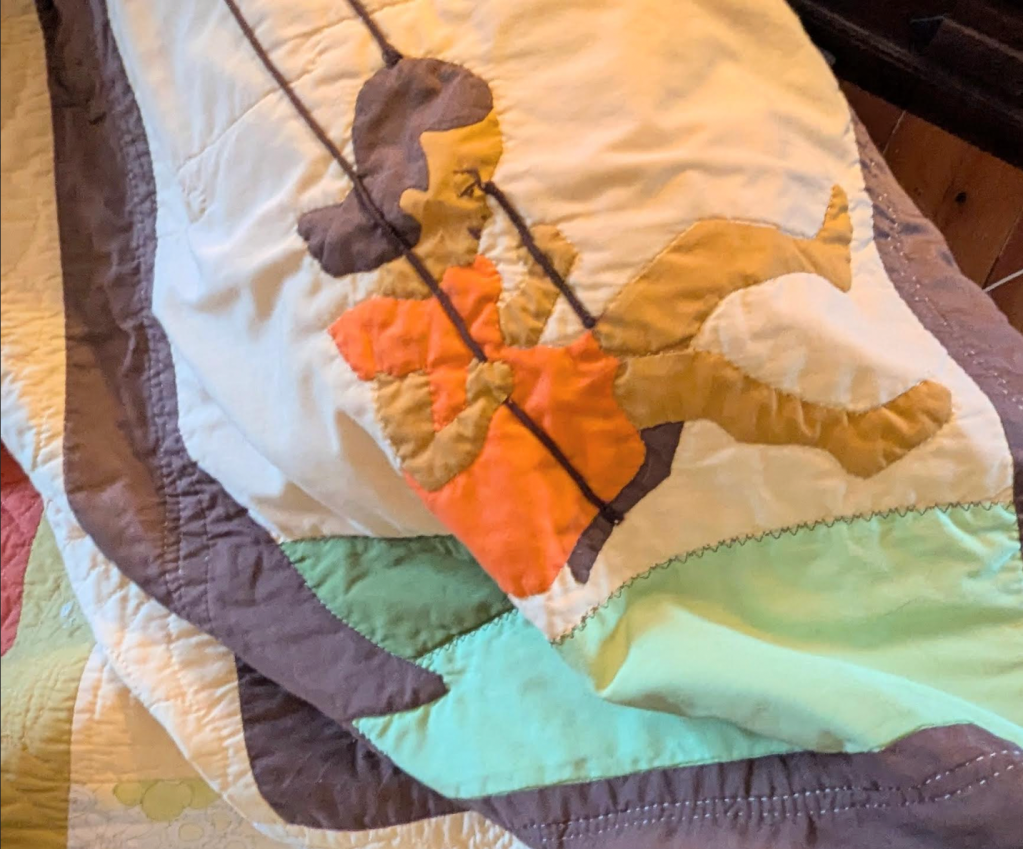
The quilt my Gramma made for me. Yes, that’s me on my swing, based on a photograph. . . my dress on the quilt is made from the same fabric as the dress I was wearing in the photo. Alice was an artist.
Both my grandmothers were highly skilled women when it came to things that involved textiles and needles. Eve (my Dad’s mom) was a knitter of such expertise that Paton used to hire her to “proof” their patterns. She could whip together the most exquisite sweaters, socks, toques and more in about as much time as it took to brew one of her omnipresent cups of tea. My maternal grandmother, Alice, kept us all in clothes diligently beavering away at her old Elna sewing machine with the lever at her knee. We wore our clothes until it seemed there were more tidy patches than blue jean. She made my snowsuits and the quilt on my bed was lovingly stitched — with owls and swans handquilted in the corners — by her nimble fingers. These were women with skills, painstakingly acquired over decades of dedicated application. Years and years of time.
Three Currencies to Build a Real Life
I learned early that skills and time were precious. Money, skills and time, the three currencies that make a life durable, resourceful and resilient. And when money is short, these other two become very important indeed.
For the kind of farming I do, this is obvious. If you don’t have the money to hire someone, you do the work yourself. If you don’t have the money to buy new equipment, you fix the old one. If you don’t have the money to buy feed, you learn how to grow grass. You must.
Skills and time can stand in for money — but only if you have them. . . And so often, this is where trouble begins.
Fireside Chats
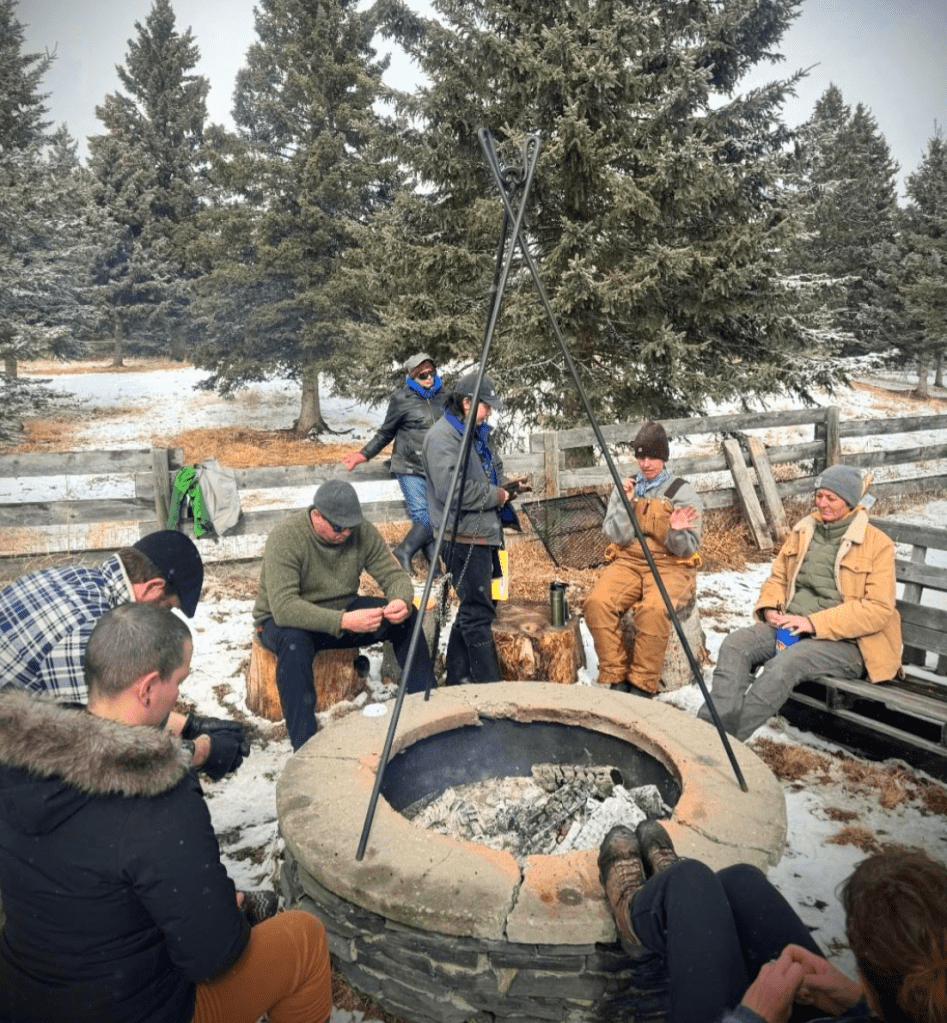
It’s a conversation we started at our recent Shearing Day, around the fire. Our emphasis on scale and profit has had a ripple of unintended consequences: barriers to entry — what our shearer Alex calls a barricade — and government largesse lavished on industrial producers who grow monocultures to ship overseas. (For more on scale and its impacts on agriculture, skip over to Keeping “Voices and Correspondence” and read the transcript of my interview with Dr. Jim Handy from the University of Saskatchewan).
But for those of us — and there are more every day — who look at our family’s and our own lived experience, it isn’t adding up. We know there are more ways to find value than just on a balance sheet.
Modern economic models oversimplify. In this structure, the answer is always “buy.”
Don’t have time?
Buy a bigger machine.
Don’t have skills?
Buy a product.
Don’t have labour?
Take out a loan.
And for a while, this works. In fact, it works well enough that it starts to look like progress.
A farmer with a tractor can do more than a farmer with a shovel.
A farmer with chemicals can do more than a farmer with a hoe.
A farmer with borrowed money can do more than a farmer without it.
But borrowed money comes with a condition — it has to be paid back and that changes the system.
New Equations = Real Value
When a farm runs mostly on skills and time, it can slow down when things go wrong. It can find other legs to stand on. When a farm runs mostly on money, it can’t.
The payments don’t slow down, the interest doesn’t slow down and the bills don’t care if the rain didn’t come. Folks locked into these structures have to keep producing, whether the land is ready or not, whether the animals are ready or not, whether the farmer is ready or not.
This is how a system becomes rigid — not because the farmer is careless and not because the farmer is greedy but because the balance of currencies has shifted.
Money replaced skills, money replaced time and now — as the only currency left in play, money has to keep flowing, or everything stops.
Let’s be clear here, there is nothing wrong with money and a lot of farmers are in fact highly skilled (almost no one seems to have any time these days which might tell you a lot about which currency is the most valuable). Money is a reality in our world — we need it. All of us. From the individual right up to the community as a whole. But of the three currencies available to us, money is the most brittle.
Skills can adapt, a savvy planner can stretch time and while a careful person can stretch a dollar — no one could beat Alice on that front — there is a limit. . . if you don’t have enough, you don’t have enough.
Older ways of farming understood this, even if they didn’t use the same language.
People fixed things instead of replacing them, neighbours helped each other instead of hiring everything done and yes, the work took longer, but the system could bend without breaking.
It wasn’t romantic, it was practical — they were using all three currencies.
Today, many operations are rich in land and equipment and poor in time. They’re rich in debt and poor in skills, rich in production and poor in margin. And when something goes wrong — weather, markets, health, machinery, interest rates — there is no other currency left to spend.
There is only money — the one you can run out of fastest.
Building a truly resilient systems means you must never depend on one currency. All three have to be part of the endless equation, all three must be in circulation. We must leave room for time, make room for skills and build the connections to exchange both. And we must always remember that money, as useful as it is, comes with a cost of its own.
This is true for farms, true for households and it is absolutely true for land. Money, skills and time.
A Crack On The Jaw
In an old Andy Capp (terribly politically incorrect, I know), there’s a comic of Andy’s wife Florrie standing at the bar while some shady customer attempts a pick-up line. Andy, ne’er-do-well that he is, is over playing darts with his best mate Chalkie, cigarette dangling from his lip, cap pulled down over his eyes. “Love makes the world go ’round,” slurs our hopeful swain to Florrie who looks decidedly unimpressed with his overtures. Andy, finally cottoning-on to what’s happening, races over to the bar and grabs the interloper by the collar, “So does a crack on the jaw!” he snarls.
The lure of money isn’t unlike the guy at the bar. It’s a seductive come-on to all of us would-be Florries. We’re trying to make our world work and money offers what looks like a straightforward solution. But we must always remember what we’re trading away in the pursuit of the dollar — our skills (and the opportunity to learn new ones), our time (a finite supply) and the ability to find ways to make them both “pay.” If we lose sight of the big picture, we’ll find ourselves collared and wondering where that crack on the jaw came from.
Money, skills and time. If you have all three? Well, that’s true riches. Two of them and you won’t do too badly. Only one of them — it doesn’t matter which one — and that, my friends, is real poverty.
This is a Living post, a post to share my thought processes, my experience and the philosophy that underpins our activities here at the homestead. It is not a how-to, “expert advice” or meant to reflect a wider experience than just my own, on my farm, here with my sheep.

 Providence Lane Homestead
Leave a comment