Wool is having a moment! . . . Just, not here. Why is that? What have these other places got that we don’t?

At the most recent Olympic Games in Milan, the American Olympic team wore uniforms made with wool sourced by Ralph Lauren from Oregon’s Shaniko Wool Company.
If you’ve been paying attention, you can probably feel it. Maybe you’ve seen Instagram posts from folks like actress Isabella Rossellini or Harris Tweed Authority Maybe you follow fashion influencers like “nickthrowsafit” or Andrea Cheong. It seems that for the wooly-minded, our favourite fibre is everywhere. I see stories in the fashion press, in conventional media, in textile trade publications, in furniture and home-good design magazines and swishing down high-fashion runways.
Objectively, it makes tremendously good sense. There are incredible historical brands and traditions with so much heritage behind them that even the BBC couldn’t resist getting on the wool wagon.
Wool is showing up again — not as a relic, not as a niche craft material, but as something current. Everything about this moment — and all it’s momentum — feels intentional. It feels chosen.
Part of the reason for that is because it’s no accident — what we’re watching is a moment where several broad cultural forces are coming into alignment. There is growing concern about synthetic fibres, microplastics and animal welfare; an increased demand for traceability of those natural fibres — people want to see the entire value chain; a re-evaluation of durability over novelty; and a rediscovery of legacy craft and local materials.
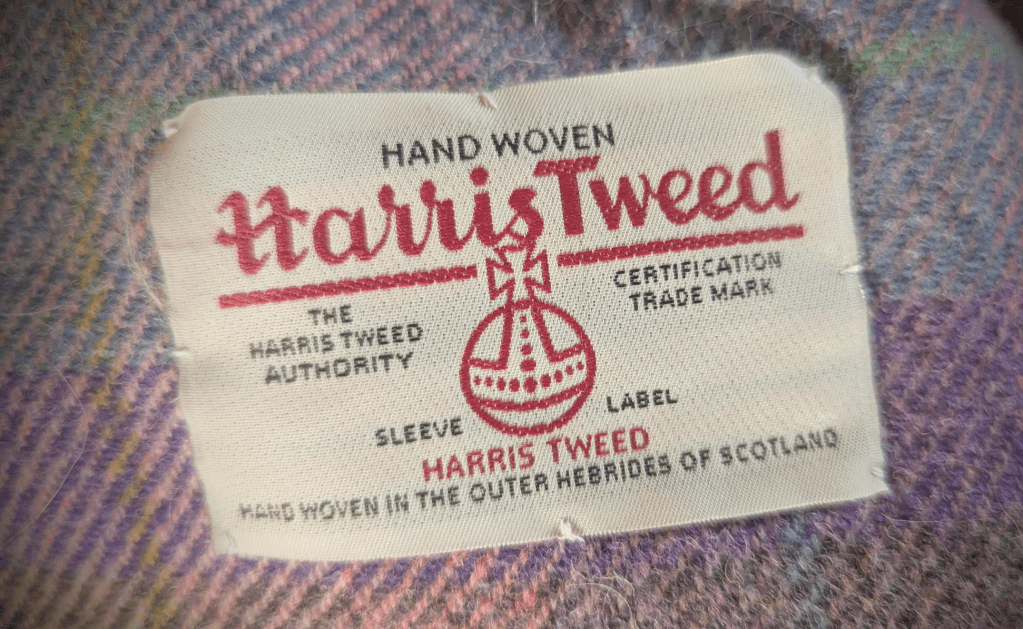
With their deep wool traditions, the UK and Ireland, New Zealand and Australia are all extremely well-placed to elbow their way to the front of the increasingly crowded wool playing field. The United States has robust and very active sheep-centric associations and recently showcased American wool in the US olympic team uniforms. The world, it seems, is happy to show the many ways wool is being put to beautiful use in their various countries.
Wool is having a moment because multiple systems — fashion, agriculture, and culture — are moving in the same direction.
Lagging Behind the Pack
And then there’s Canada.
We are not absent from this conversation — but we sure as hell aren’t in the driver’s seat. Not even anywhere close. We may possibly be standing on the curb watching the wool bus pull away.
That’s not to say folks aren’t trying. There are all kinds of efforts underway. We have campaigns, trade missions. There are innovation prizes, certifications and glossy presentations. There are conversations happening that suggest wool might matter again — not just as a byproduct, but as a material with economic and cultural weight.
But it is still early. And crucially, it’s still fragmented.
We do not yet have a coherent national narrative around wool — in places like the Scottish Hebrides, Harris Tweed has been telling its story for centuries. Australia and New Zealand not quite as long but they’ve got poets, for heaven’s sake. The United States has infrastructure and a unique story of their own — it’s not quite apple pie but it’s pretty close.
And so the moment, while it’s highly visible and coherent elsewhere, here in Canada, things are a little . . . quieter.
The Problem Isn’t What You Think It Is
The instinct is to treat this as a marketing problem. But that’s not it. What’s happening globally isn’t just better storytelling, it’s better alignment.
In countries with functioning (or better functioning) wool systems, you see the same pattern — they have fibre that’s consistently described and prepared; supply chains that deliver predictable materials; manufacturers who trust the material and retailers who stand behind the product.
NONE of that happens by accident — it’s built.
Once upon a time, we did have a national wool buyer/broker. Unfortunately, Canadian Co-operative Wool Growers — essentially a monopoly — has been beset by internal chaos and dysfunction, with allegations of poor practices and a lack of transparency. With a structural vacuum at its heart, small players — often sheep farmers themselves — have tried to step into the breach, building organizations to advocate for domestic wool. They’ve been joined by fibresheds (originally from the US) and Campaign for Wool Canada, an offshoot of the British organization. Boil all the chatter down to its most potent essence and really, they’re all asking the same question.
What’s It Gonna Take??
Going beyond the local yarn store, beyond the craft market (and all of us sheep farmers who do the wool thing CHERISH our local craft folk. Without them, we would truly be up a creek and paddle-less), what would it take to move Canadian wool onto the damn bus?
That question leads quickly to the realities we’ve been skirting for years. It’s time to do a little Truth Telling — strap in, pigeons.
Does anyone know, really, what “good wool” actually means in the Canadian context? What’s our story?
Canadian Identity, Infrastructure and Standards. Take Off, Eh!

Other wool-producing countries have a wool identity, a fibre fingerprint, if you will. Say Donegal tweed, Fair Isle or Merino activewear and consumers know what you’re talking about. What identity have we got to hang our toques on?
Secondly, what are the frameworks we have to organize our domestic wool so that manufacturers can actually use it? Companies aren’t built for variability. Most of them can’t adjust mid-run to take a sudden change of micron, staple length or condition into account. These industrial processes require uniformity and consistency. They need to be able to “set it and forget it.” Grading and classing — the terms used for this kind of sorting — can be done fleece-by-fleece but more often (and for better value), fleeces themselves are separated into parts that are then directed to buyers with those specifications.
There are quite a few different systems for this work — the micron system, from the UK there’s the historical Bradford (just for reference sake, the British Wool depot in Bradford — the historical wool centre of the country and from which the grading system takes its name —currently has 34 dedicated graders at work. CCWG, at last count, had. . . essentially none), the American Blood and others.
Canadians don’t have a dedicated standard. We barely have dedicated graders. Without them, wool can’t be aggregated, mills can’t plan production and designers can’t specify materials.
The work of grading and classing is not peripheral, it’s foundational. So where does that leave us?? Unlike the other big players, Canada has no national story and very few, verging on no, national skills or standards for our wool.
One More Lever
There is one other player in the mix, however. Canadian consumers.
In other countries, shoppers are beginning to ask pertinent questions — “Is this wool? Where did it come from? Can I trace it?”
Retailers respond to those questions. . . because they have to. Here, that loop is still weak. Canadians have been trained for decades to prioritize price before almost every other consideration — if we got it cheap, we think we won. And boy, have we been good students, most excellent consumers.
Additionally, most Canadians are textile illiterate. It didn’t used to be that way and you will still find people who know the difference between twill and satin weave, can show you what a bias is and know what a good gabardine can do. However for the majority of the population, the ins-and-outs of identifying and working with fibres might as well be witchcraft. And thanks to this knowledge gap, most Canadian consumers don’t know how to identify wool by touch, don’t know where it comes from and don’t think to ask. Which means retailers aren’t pushed to answer.
Why Any Of This Matters
Straight talk — if Canada does not organize its wool system, something else will fill the space. In fact, it already has.
Walk into most Canadian stores and you will find wool from New Zealand, from Australia, from the UK — well-prepared, clearly described, ready to be used. Canadians are very accustomed to importing finished goods — and increasingly, the materials themselves — without asking what it would take to produce them here.
In my own direct experience, Canadian manufacturers are reluctant to disturb established supply chains built on imported wool. The mindset is very much, “If it ain’t broke…”
Economically, that makes sense.
Retail sits at the most powerful end of the textile chain, typically operating on margins around 50% or more, while the majority of value in finished wool products is captured downstream by manufacturers and retailers. Wanna know where the value isn’t?
On the farm. Farmers see very little money per fleece, even the very best fleece.
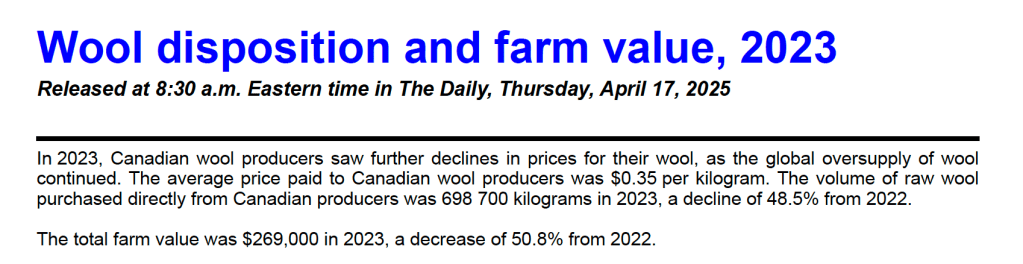
While one-off projects — like custom carpets or capsule collections — may collect feel-good headlines and eyeballs, they exist as islands. They have not substantively shifted production models toward Canadian wool.
Canadian consumers, retailers, and the professions that shape those spaces — fashion, interior, industrial design — have not yet moved in step with producers to explore what Canadian wool could become. And while there is support, it’s largely symbolic.
The Disconnect
The result is a quiet disconnect. Canadian consumers move through retail spaces unaware of Canadian options, retailers and manufacturers continue to source what is consistent and low-risk and Canadian farmers are left trying to respond to a market that asks for scale and specification without offering a stable pathway to achieve either.
Therein lies the bind.
Biting the Hand
What do you do when the system you depend on is the same system that prevents you from changing? Producers are told — correctly — that to participate in modern markets, they need to provide consistent wool in a meaningful volume and prepared to specification.
But at no point are we being equipped to produce at that level.
We simply cannot produce what’s being demanded of us without access to the very market we are being denied.
So nothing changes.
We don’t produce enough volume, manufacturers tell us they can’t use our wool. Manufacturers don’t use our wool so there’s no stable demand. Without stable demand, there’s no investment in flocks, infrastructure, skills or storytelling. No investment means no volume increases or consistency upgrades.
And around and around it goes, ad nauseum.
Pricing Power
Layered over top of this is the economic reality of the supply chain itself. The majority of profit margin sits downstream with retail and branded manufacturing. That’s where pricing power lives, that’s where material choices are reinforced. Which raises a simple question. . .
If the financial incentive to change sits furthest from the farm, what are the farmers that make up the Canadian wool sector actually able to do?
Not everything.
. . . But not nothing either.
Rubber, Meet Road
Canadian sheep farmers and shepherds can build the conditions for participation. The beauty of very little infrastructure is the opportunity to build a system that works for us. We can work with industry to build shared standards that reduce uncertainty. With those grading/classing systems in place, we can then work together to aggregate wool into usable volumes and prepare that wool in ways that align with what our domestic manufacturers tell us they need.
By working together with the next stops on wool value chain, we can shorten the distance between what is produced and what is required. We can make it as uniform as possible. We can build it, teach it, learn it and practice it.
What we cannot do — on our own — is pull the rest of the system with it. We need some help for that.
What might that look like?
To start, manufacturers willing to test and invest. Retailers willing to tell a different story — and stand behind it. Consumers willing to ask better questions and — so important! — leave cheaper and/or less aligned wool products on the shelf.
Without that, might as well go for another round.
The Quiet Truth
Wool is not having a moment because it suddenly became valuable. It’s having a moment because people in other places built or rediscovered the systems that allow it to be used — and told the story that made it matter.
Canada can do the same.
But we’re not going to get there by accident. And we certainly won’t get there by talking about it. (Yes, I’m fully aware of the irony).
Put up or shut up, Canada. We can watch other wool powers pull away and be left behind in a cloud of dust and exhaust OR we can roll up our sleeves, actively seek out the action and get involved. Ask the pointy questions at the retail level, at the manufacturing level. Insist on transparency, accountability and truth.
Canadian wool is awesome — I know it and presumably if you’re still reading, so do you. It’s time. Put up or shut up.
This is a Living post, a post to share my thought processes, my experience and the philosophy that underpins our activities here at the homestead. It is not a how-to, “expert advice” or meant to reflect a wider experience than just my own, on my farm, here with my sheep.

 Providence Lane Homestead
Leave a comment