Can your sheep get the most out of your feeding program? Understanding feed analysis and making the most of what you’ve got.
. . . and why two local fields can feed two different futures.
On our farm, hay isn’t just a winter stopgap — considering that “winter” can happen for basically eight or 9 months, hay is really the foundation of animal health.
Given how much time the flock spends on hay, and all the very important life things that happen during this period (breeding, pregnancy and lambing), paying attention to hay is more than just a case of groceries, it’s foundational for every major milestone my flock encounters.
After years of not knowing much, thanks to some hard work and some wonderful mentors, I’ve come to one unshakeable conclusion –
Hay quality varies enormously — even when it’s grown nearby, bought locally, and looks “fine.”
Like I said, this has been an on-going education for me. When I started – I was only feeding horses then – I didn’t know a forb from a grass from a legume. I’m still not fabulous identifying grasses in the field but I do know some of the basics about identifying nutrition from the values on a feed test – literally, I’ve been getting into the weeds. And now that I’m here, I thought you might enjoy a roll in the hay yourself (sorry! I know. Too easy. My bad.)
Ahem. So moving right along, here are two hay lots we purchased in the same region:
- one from a field along Highway 22
- one from a field just north of Highway 567
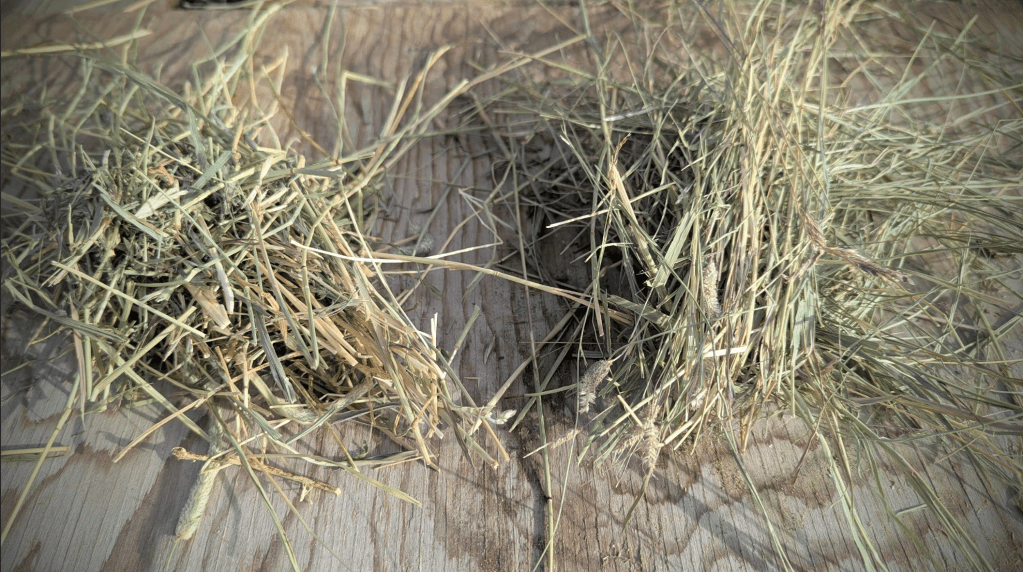
Both were purchased locally. Both look like hay.
But their lab results show very different nutritional realities.
I. Two Local Hay Lots, Two Different Feed Realities.
I’m showing you two different hay analyses for hay purchased from nearby fields – I could drive to both in under 20 minutes. The first lot (Sample A) came from a field west of Hwy 22, the second (Sample B) from a field just north of Hwy 567. A was harvested in the late Summer of 2025, B in 2024 – it’s been fully shedded for the duration. In 2025, we had late rains and in 2024, precious little. I think that pretty much catches you up on Hay Facts.
II. The Three Numbers that Matter Most
When I open a hay analysis, I start with three basics – these are the meat-and-potatoes of the report.
First, Can this hay build bodies (protein)?
Second, Can it fuel bodies (energy)? and
Third, Can my sheep physically eat enough of it? (Fibre/intake)
Then, I check ash and minerals to make sure the hay is balanced and safe.
So. Let’s get to it, shall we?
1) Crude Protein (CP): the “building blocks” number
Protein is the raw material for:
1. growth (especially lambs)
2. fetal development (fleece follicles develop in utero. Good nutrition = good wool)
3. milk production
4. immune function
5. wool production and quality annually
What the two hays show us:
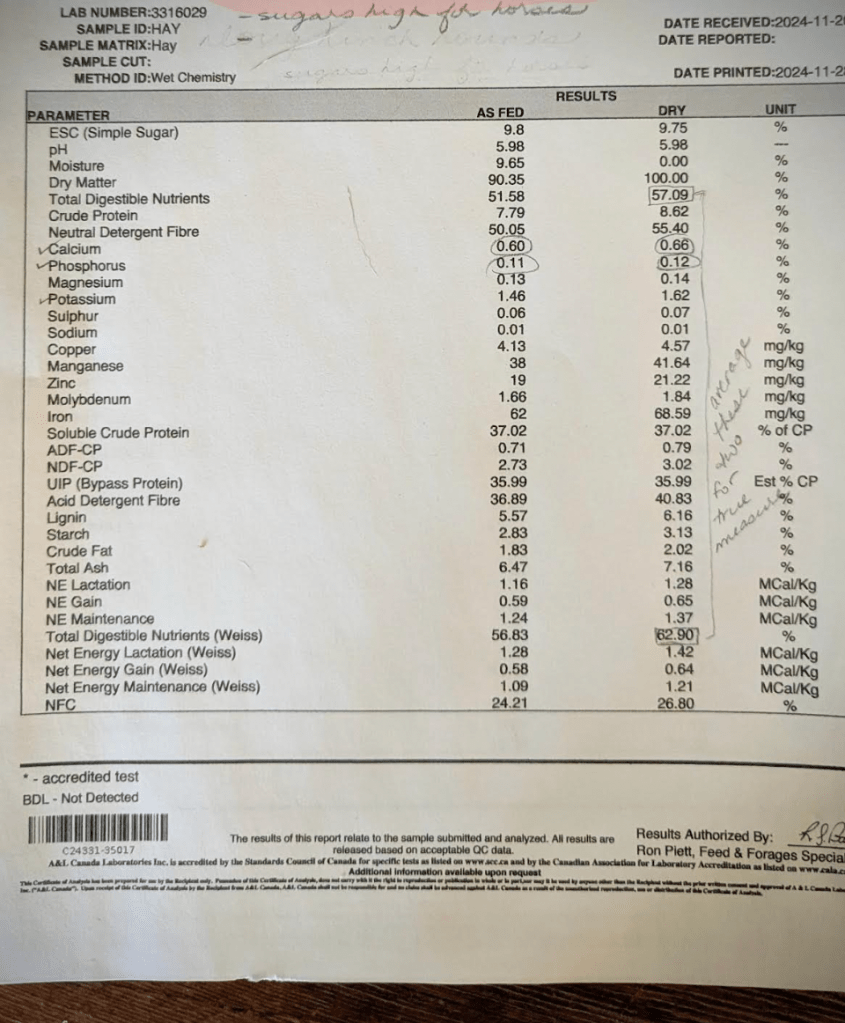
– Hay A (2025/Hwy 22): 8.62 per cent CP (DM)
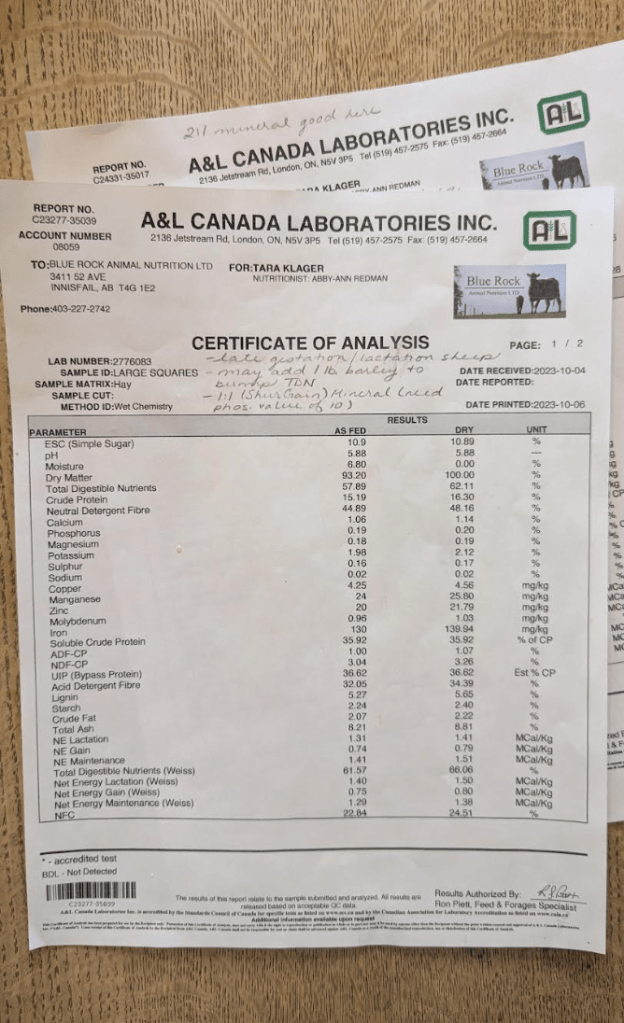
– Hay B (2024/Hwy 567): 16.30 per cent CP (DM)
This is the clearest demonstration of range. Hay A is a maintenance hay — good for keeping adult animals steady, but not adequate on its own for late gestation, lactation or lamb growth when protein demands are higher. Hay B however is a high-protein hay — the kind of feed you can confidently use for those scenarios. Result? For ewes in their last trimester, lactation and growing lambs, Hay B is the way to go. For open ewes, wethers and rams, Hay B would be much too rich, they’re better off with Hay A. Don’t get me wrong, I’m sure they’d all prefer Hay B but we can’t have them waddling out to pasture, now can we?
2) Energy (TDN): the “fuel in the tank” number
TDN tells us how calorie-dense the hay is — how much usable energy animals can extract. Energy determines: body condition maintenance; warmth and resilience in winter (so important in Canada and at elevation!); lactation output; whether animals hold, gain or slide backwards.
What the two hays show us:
– Hay A: 57.09 per cent TDN (DM)
– Hay B: 62.11 per cent TDN (DM)
That ~5 point jump matters. It’s the difference between keeping condition and supporting performance.
3) Fibre (NDF): the “intake limiter” number
NDF is one of the most important values because it predicts how much an animal can physically eat. My sheep are hungry beasties and highly food motivated but they will only eat what actually fits.
Higher fibre = slower digestion = rumen fills faster = animals eat less.
That matters most when physical needs are greatest because of biological processes that are making big withdrawls on an animal’s system – lactation, late gestation, lambs – all stages when critters need dense nutrition fast.
What the two hays show us:
– Hay A: 55.40 per cent NDF (DM)
– Hay B: 48.16 per cent NDF (DM)
So not only is Hay B richer in protein and energy — it’s also more eatable. Animals can consume enough to meet demands without filling up on “bulk.”
III. The Practical Mineral Checks: Ash, Calcium, Phosphorus and Copper
These numbers don’t always get the spotlight, but on sheep farms in the prairies, they’re worth a few extra moments of your time.
Ash is literally that – the matter left behind when the hay sample is burned in the lab. It includes true plant minerals and any soil/dust contamination. In dryland farming, drought, wind, or cutting too low can raise ash — meaning your livestock may be eating more dirt and less nutrition.
What the two hays show us:
– Hay A: 7.16 per cent ash (DM)
– Hay B: 8.81 per cent ash (DM)
Both are within a believable range for grass hay, but Hay B’s higher ash value is a reminder that harvest conditions matter. In this case, 2023 was a much drier year around harvest than it was in 2025. That ash value makes sense in that context. Higher ash can mean less nutrition per mouthful and can distort mineral values making them less helpful.
Calcium & Phosphorus: the balance matters more than the numbers
For sheep, I look at Ca:P ratio because it affects:
1. metabolic function
2. bone health
3. grain compatibility
4. urinary calculi risk in males
Hay A: Calcium .66 per cent, Phosphorus .12 per cent (DM) – Ca:P = 5.5 : 1 (high calcium)
Hay B: Calcium 1.14 per cent, Phosphorus .20 per cent (DM) – Ca:P = 5.7 : 1 (ditto high calcium)
The big takeaway!!
Both hays are clearly high-calcium relative to phosphorus – so mineral choice here matters. NOTE: many sheep can handle a wide value range in this ratio IF NO GRAIN IS BEING FED. Once grain enters the picture, the ratio spread matters and impacts – like urinary calculi risk – need to be mitigated with an appropriate mineral mix. For forage-only diet, this is less of a concern. (For more on breaking down why Cal/Phos ratios are critical, particularly when feeding heritage breed sheep, read a recent article I wrote in my January 2026 newsletter).
Copper: “fine in hay” doesn’t mean “fine overall”
What the two hays show us:
– Hay A copper: 4.57 mg/kg (ppm DM)
– Hay B copper: 4.56 mg/kg (ppm DM)
Copper in both hay lots is low/moderate – not alarming – but with sheep, copper risk is rarely caused by a single ingredient. It’s cumulative and other potential sources matter – consider mineral pre-mix, pellets/concentrates, creep feed (for lambs), mixed species feeds (if sheep have access), pasture and water sources. So hay is only one piece of the copper story.
IV. What The Comparison Teaches Us – Plain English!
These two hay lots were purchased locally — one from Hwy 22 and one from north of Hwy 567 — and yet they behave like two completely different feeds:
Hay A (CP 8.6 / TDN 57 / NDF 55)
A steady, filling maintenance hay:
– ideal for rams/wethers and open ewes
– requires supplementation for high-demand sheep
Hay B (CP 16.3 / TDN 62 / NDF 48)
A high-performance hay:
– supports lactation, pregnancy and lamb growth
– reduces supplementation needs
– may be too rich for some flock members
And that’s why we test – knowing what you’re feeding is essential to keeping everyone in fighting trim. And God forbid a problem should arise, when you know exactly what you’re feeding, nutrition is one variable you won’t have to worry about.
This is a Tending post — a practical look at our methods, routines, and on-the-ground decision-making with the flock. It’s not a one-size-fits-all how-to, and it isn’t meant to substitute for local knowledge or professional guidance. It’s just what we’re doing here on our farm, in our conditions, with our sheep (and alpacas), written down plainly in case it helps. For more about why we do things the way we do them, the philosophy that informs our process, you’ll find those posts in Living.

 Providence Lane Homestead
Leave a comment