
If the ground is frozen anyway, do trees, shelterbelts and partial canopy really matter when it comes to soil moisture?
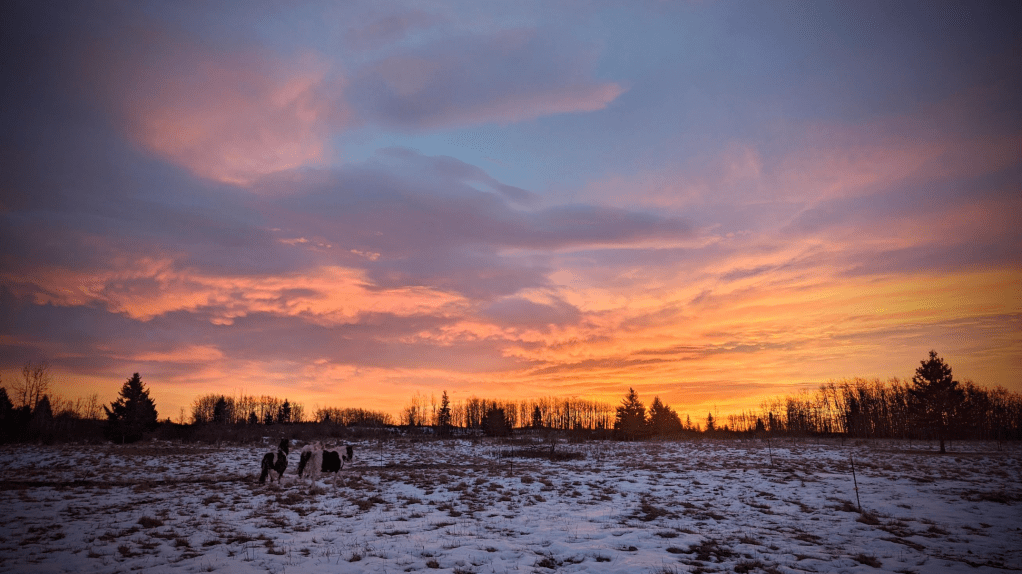
There’s an old prairie saying that snow is the “poor man’s fertilizer.” On the surface it sounds quaint — but there’s real science behind it, especially in Alberta’s cold, semi-arid landscape. However, in order to reap snow’s benefits, first you have to keep it on the ground. To do that here, we rely on shelterbelts and ensuring that wherever possible, we’re maintaining a strong tree-and-shrub canopy.
Now I can hear some of you say to me, “But Tara, that makes it awfully hard to manouvre tractors and stuff. It’s so much easier when it’s wide open!” That’s true – we rarely bring tractors or mechanized equipment into our grazing pods. We don’t haul water, we leave it back in the home paddock – fortunately the sheep have legs and walking is the best form of exercise. To get a better idea of the way we clear – when we choose to do so – please take a look at our previous Tending post, “When Fire Isn’t An Option.”
So rather than clearing land wholesale for pasture, here we’re choosing to focus on intentionally preserving shelter belts, treelines, and partial canopy cover to help catch and manage snow in ways that increase soil moisture and long-term resilience.
Let me explain.
I. What Snow Actually Does
Snow contributes to soil moisture in several ways:
1. Snow as a Nutrient Carrier (Including Nitrogen)
Snow does contain nutrients besides water and air. As snow forms in clouds, ice crystals nucleate around microscopic particles in the atmosphere — including:
- Dust
- Soot
- Organic particles
- Nitrogen compounds (nitrate NO₃⁻ and ammonium NH₄⁺)
As snow falls, it scavenges additional atmospheric gases and aerosols. This process is known as wet deposition. For those of us who lived through the Reagan era, you may remember the debate around acid rain – this is the same thing, we’re just talking about snow. Snow that forms in the upper atmosphere (the troposphere) picks up some of the other stuff floating around up there – good (like nitrogen) and not-so-good (various pollutants). When the snow falls, it effectively scrubs the troposphere and deposits those compounds on the earth’s surface.
2. What’s in Prairie Snow?
Studies across western Canada have consistently found measurable concentrations of:
- Nitrate (NO₃⁻)
- Ammonium (NH₄⁺)
- Sulphate (SO₄²⁻)
- Dissolved organic nitrogen
These are delivered to soil during spring melt.
It is not equivalent to fertilizer application — but in low-fertility or low-input systems, it’s not nothing, either. And it’s important to remember that our native grasses specifically have evolved to tolerate low nitrogen levels in soil. . . the kinds of levels a good winter snow cover could bring. Would it be enough for a commercial grain operation? Not even close! But in terms of native pasture, the nitrogen from winter’s snowfall can be useful – especially if it’s cumulative and measured over years with little sub-surface disturbance. Add in things like forest-edge systems, shelterbelts (more on these in a minute) and natural topographic snow-catches, and you’ve got what can add up to be a solid fertility boost come green-up in the Spring.
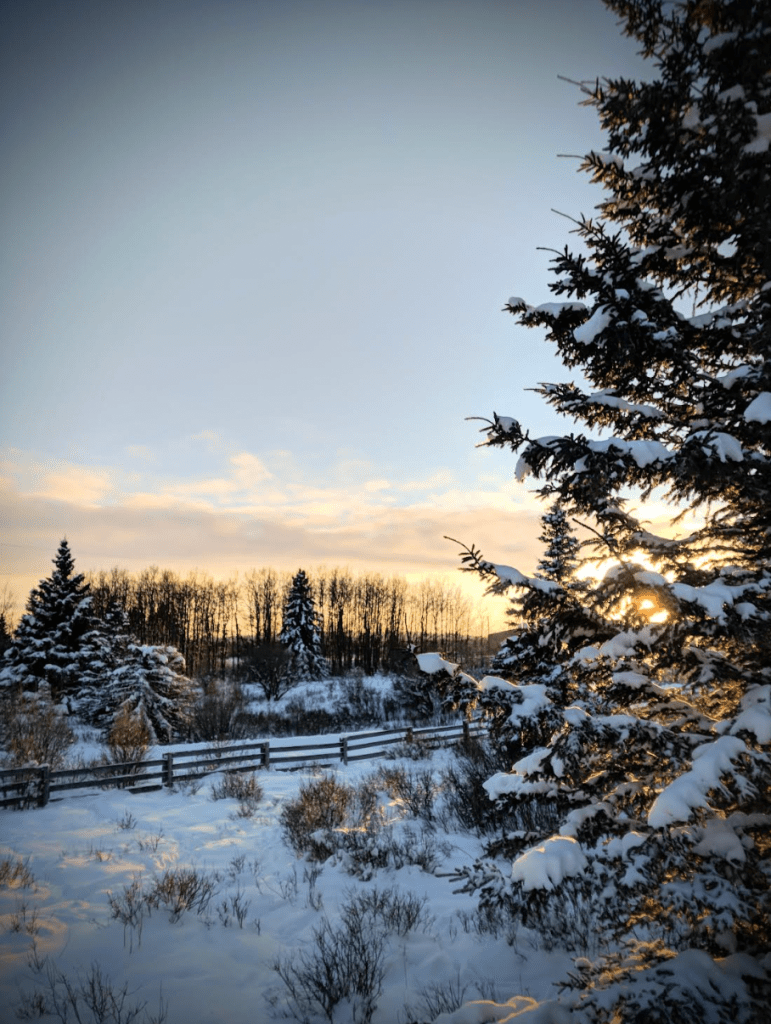
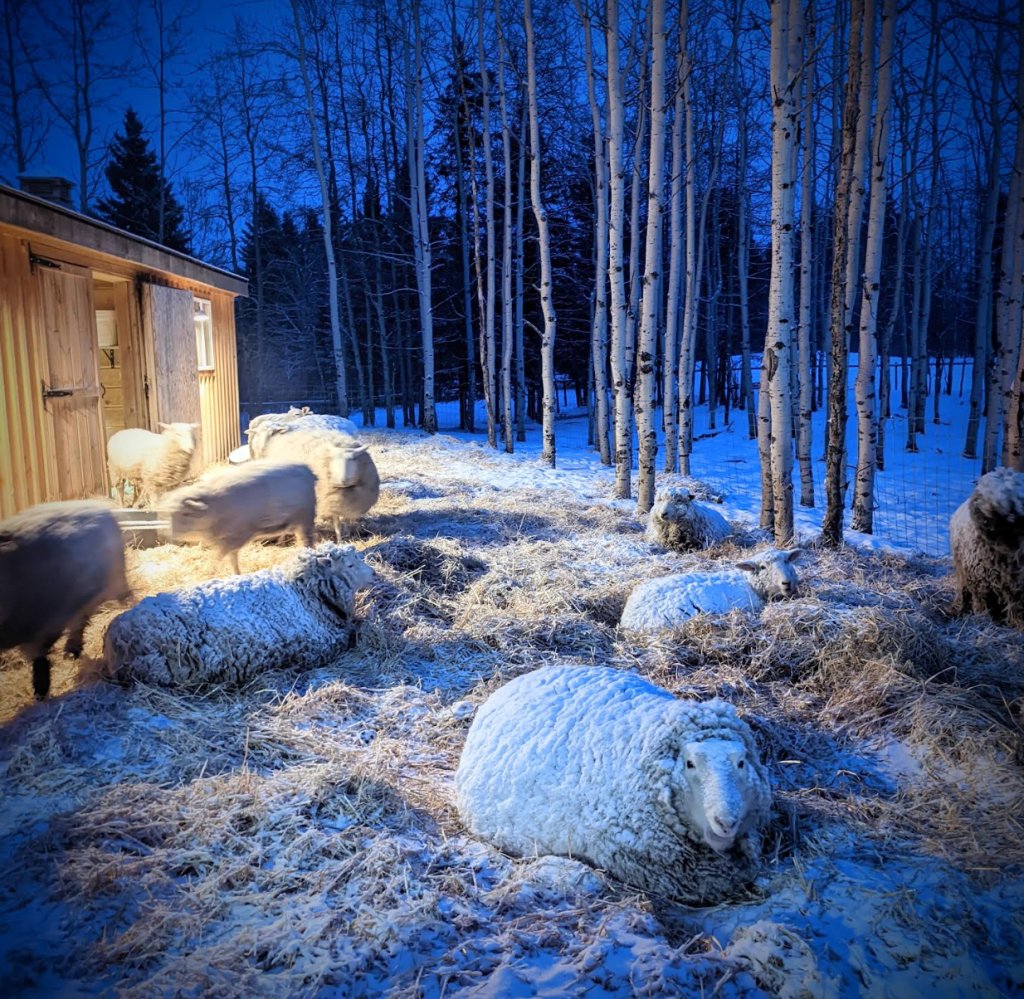
II. Why Trees & Shelter Belts Matter for Snow and Moisture
Now about those trees and shelterbelts.
Trees and shelterbelts:
- Increase local snow accumulation (more gets captured and piled on the ground – that’s why we call it a snow bank)
- Protect snow from wind loss
- Trap drifting snow from somewhere else that may contain nutrients collected along the way
So maintaining a judicious tree canopy is not just about water. it’s also about nutrient interception. If you can hold it, you can use it.
1. Shelterbelts Trap Snow
Well-designed shelter belts change the wind dynamic:
- Landscape research in nearby prairie regions found that areas with shelterbelts had morestored than open fields without snow barriers.
- Snow doesn’t get blown off the field; it gets caught in place, directly where it will melt into the soil.
This means:
- More of the snowfall stays on the land,
- More water enters the soil during melt,
- Less moisture is lost to wind transport and sublimation.
2. Alberta Shelterbelt Research Shows Benefits
The Alberta government has long recommended shelterbelts for moisture and soil conservation.
In drought-prone prairie regions, about half the increase in crop yield attributed to shelterbelts comes from extra soil moisture due to snow trapping — not just wind protection.
That’s a moisture effect, not a fertilizer in the chemical sense — but moisture is one of the most limiting nutrients in this dry region.
II. Ground, Snow Cover and Water
Snow acts like a blanket. Without snow, the soil freezes deeply and uniformly — and deep frost slows water movement.
But with snow cover, frost depth is reduced and the soil remains warmer, which in turn makes meltwater infiltration much more effective in the spring.
How this works:
- Early snowpack buildup insulates soil before deep freeze.
- That insulation means the soil may not freeze as hard or as deep.
- When spring arrives, meltwater enters soil more easily where sediment, pores, and biological pathways exist.
1. Snowmelt Infiltration Is Complex But Real
Snowmelt infiltration into frozen soils can be complicated, and it’s influenced by:
- Soil temperature and prior moisture,
- Porosity and soil structure,
- Depth and timing of snowpack accumulation,
- And how rapidly the snow melts.
Even when soil is partly frozen, meltwater doesn’t just sit on the surface — water and heat move together, causing thaw and increasing water movement into the soil profile if conditions are right.
Scientific studies confirm that snowmelt is an important contributor to soil moisture recharge in cold, semi-arid regions like Alberta.
2. Snow Melt Adds Water to the Soil
So while snow doesn’t “fertilize” in the chemical sense the way manufactured nitrogen fertilizer does, it does provide nutrients as well a water storage that plants and soil organisms rely on in spring.
In Alberta cropping systems, research has found that melting snow does help replenish soil moisture, although the amount that actually enters the soil depends on conditions like soil surface moisture and surface cover.
On average:
- Snow equivalent of precipitation contributes water the following spring,
- And infiltration rates vary greatly depending on surface conditions.
Even though not all snowmelt infiltrates, a meaningful amount does, and it becomes part of the soil water available going into the growing season.
III. Addressing the “Frozen Soil” Argument
Maybe you’ve heard, “Snow doesn’t help soil moisture because the ground is frozen.” I have – too many times to count, actually. And while it’s true that frozen soil alone can restrict infiltration, that’s only if conditions are extreme and snowpack is thin.
To say that frozen soil eliminates water infiltration misses two key considerations:
1. Snow Pack Reduces Frost Depth
Studies show that snow cover insulates soil and slows frost penetration, meaning soil does not freeze as deeply where snow accumulates early.
So, in sheltered zones or areas with good snow cover, deep frost that would block infiltration doesn’t develop as fully. More of the meltwater then has a pathway into the soil.
2. Soil Structure Matters
Soils with:
- Organic matter,
- Roots,
- Soil fauna,
- Macropores
have pathways for water to move even through partially frozen zones.
This is especially true in pastures and mixed canopy systems versus compacted cropland with bare exposed soil – often the kind of soils you see in cultivated fields with high levels of tillage.
In other words, the snow itself influences the soil conditions that make infiltration possible.
Snow both adds water and preserves the physical conditions for that water to enter the ground.
IV. Trees, Clearings, and a Productive Mosaic
What all of this means for our homestead planning is:
- Hold snow on the land — I can’t afford to let the wind steal it.
- Use trees, shelterbelts, and intentional partial canopy to trap snow where and when I want it.
- Balance open grassy areas (balds) with shelter to enhance diversity and increase edges
- Healthy snow capture = healthier soil moisture = healthier plants.
The goal is to creat a working landscape that manages water wisely — from the first snowfall to spring melt. Every drop or flake that lands here, stays here.
Takeaway
Snow isn’t fertilizer in the classic sense but it does contain vital nutrients and the water it stores and the way it is captured by trees and shelter structures becomes one of the most important components of soil moisture I plan for on the Alberta landscape.
In this region, those moisture effects translate into resilience, stability, and long-term soil health.
. . . It’s my snowbank and darn it, I’m going to do everything I can to keep it.
This is a Tending post — a practical look at our methods, routines, and on-the-ground decision-making with the flock. It’s not a one-size-fits-all how-to, and it isn’t meant to substitute for local knowledge or professional guidance. It’s just what we’re doing here on our farm, in our conditions, with our sheep (and alpacas), written down plainly in case it helps. For more about why we do things the way we do them, the philosophy that informs our process, you’ll find those posts in Living.

 Providence Lane Homestead
Leave a comment