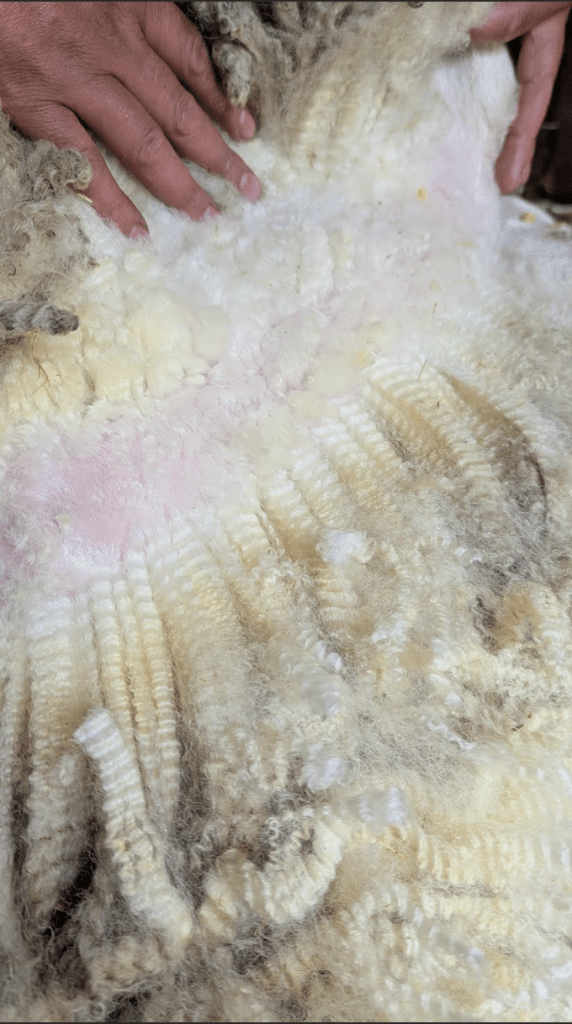
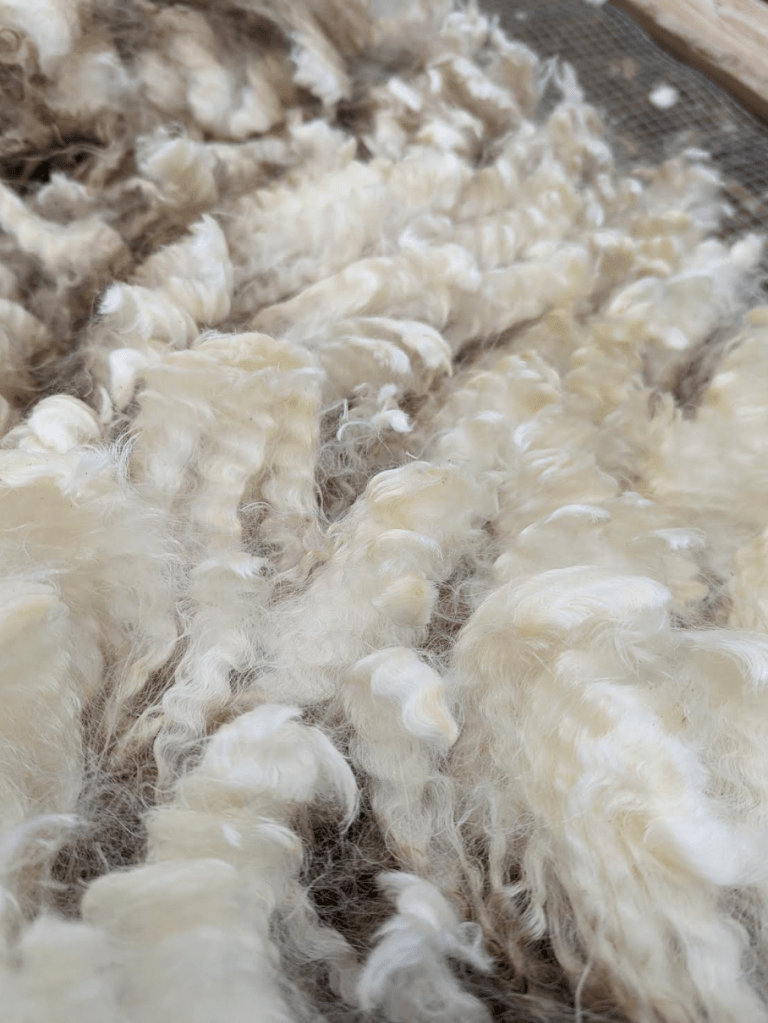
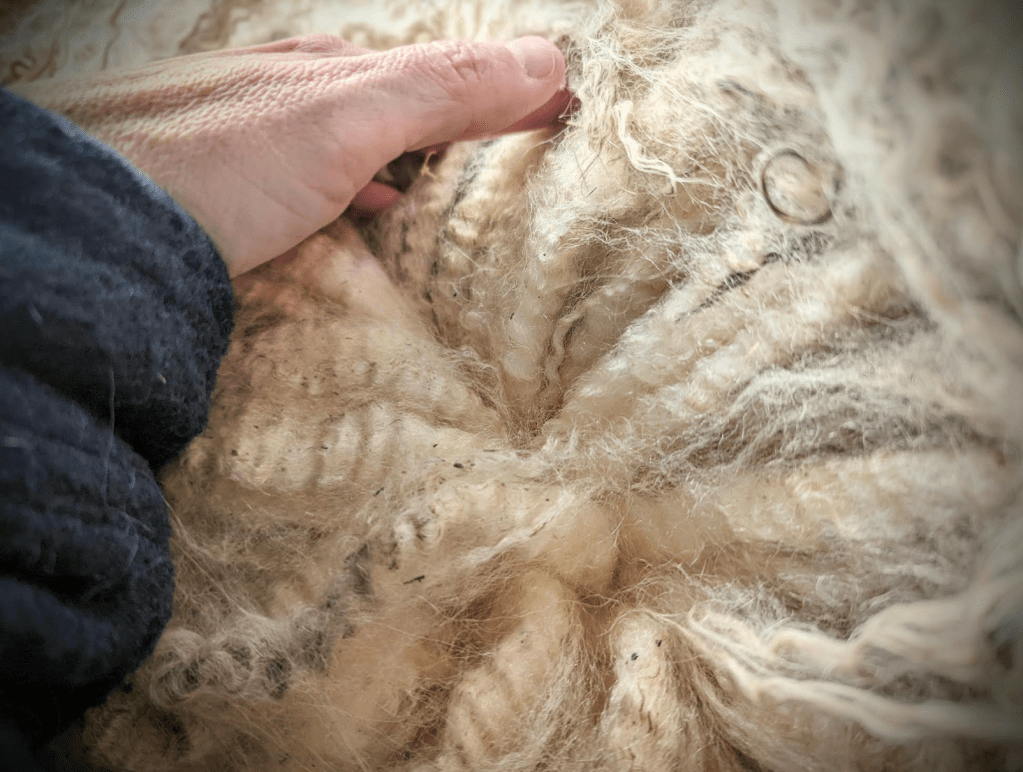
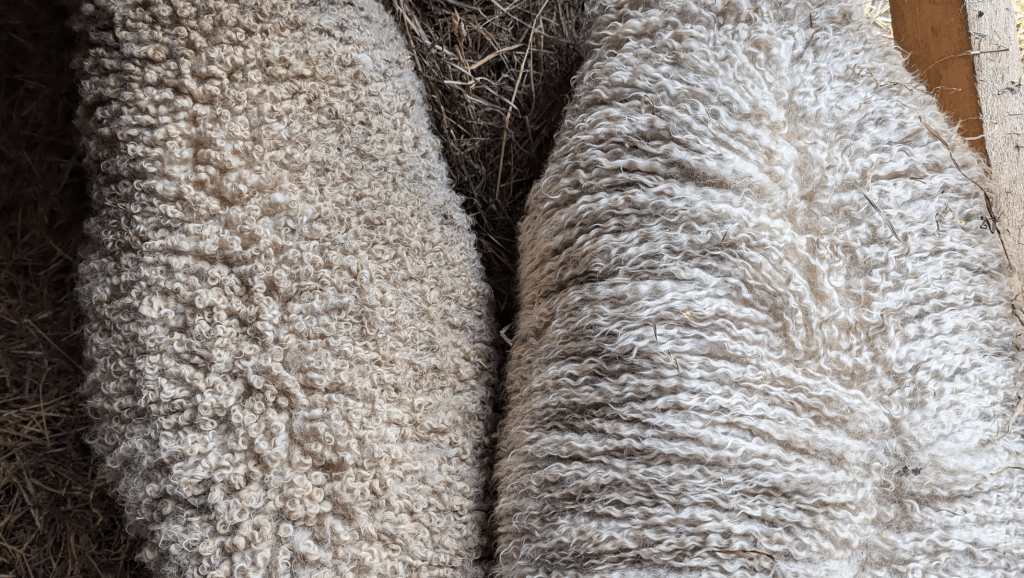
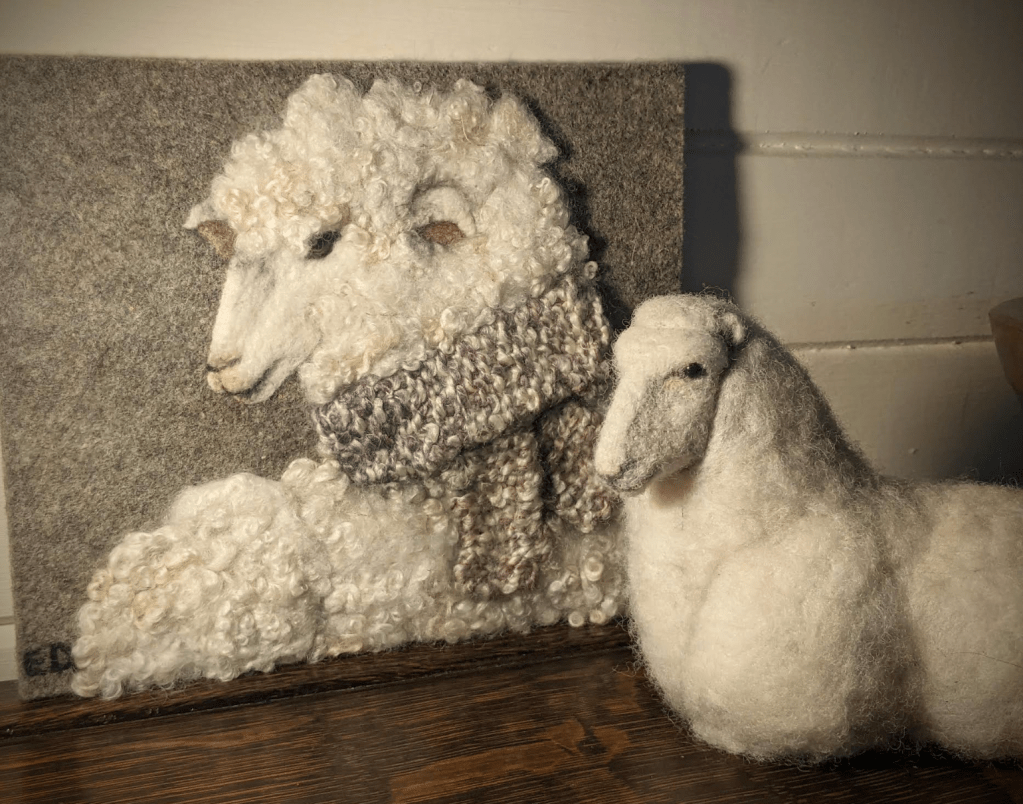
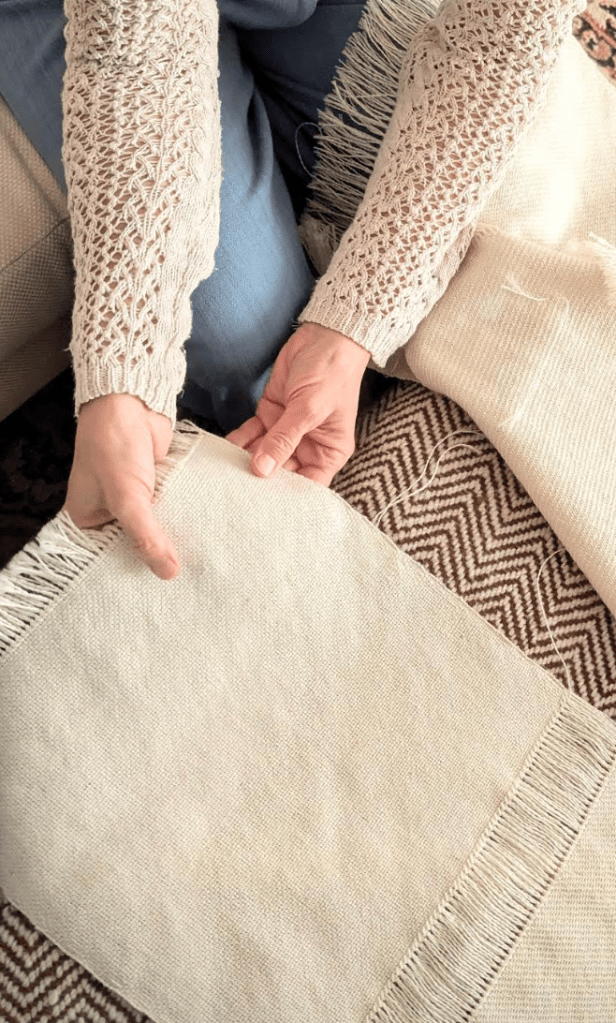
Fleeces at the homestead! From top left — Banjo on the boards with Alex; Castor’s first fleece, cut-side up; Amy, looking a little fuzzy; Banjo on the left beside Levon, two distinct fleece “styles” in my flock; needle felting locks and figures from Erin Davis at Hawthorn Studios; weaving samples from Traceable Textiles in Edmonton using fleece from the homestead.
There is a moment on Shearing Day when Alex makes his last blow and the fleece curls away and lands whole on the boards. It arrives in one piece — warm, still breathing, holding the shape of the animal who grew it. For a second, it looks like something alive.
And then someone asks, “How do I know if it’s a good one?”
It’s a fair question. Most of us were not raised judging wool. Fibre literacy has thinned in our culture. Standing beside a fresh fleece can feel both intimate and bewildering.
So, let’s begin.
Good health = Good fleece
A good fleece — any good fleece — starts with health. It should come off in one piece, like a blanket. That tells you the sheep was shorn cleanly and the fibre has grown with consistency. When you lift a lock from the centre (not the outer edge), it should hold together in a distinct “staple” — the length of fibre grown over the year, from cut end to purled tip. Give it a tug. It should feel resilient. Not brittle. Not papery. Look for consistency from one end of the lock to the other.
While the fleece is on the skirting table and still mostly in one piece, give it a gentle shake. Note any bits of wool that fall through the table slats — these are called “second cuts,” bits of wool that the shearer took off on a second pass. Most experienced shearers will minimize second cuts as much as possible.
While we skirt (remove) the back-of-neck, belly, legs (not applicable to Border Leicesters as their legs are wool-free), britch (back haunches) and tail/bum wool, the wool we’re generally left with comes mostly from the back and sides of the sheep. Take a look at it – is it generally consistent, uniform, of similar length and with a similar wave pattern/crimp? The higher the consistency, the easier it tends to be for handspinners, particularly novice spinners.
Open the lock sideways with your fingers. It should part like pages in a book. Inside, the wool should look bright and clean. Not necessarily white — brightness is different from colour. You may find some discolouration simply due to the build up of lanolin — which is sticky and can hold dirt. This will wash away and isn’t a concern. Other staining, specifically canary staining, will not wash away, may weaken the fibre and must be taken into account for future planning. If you’re considering dying the fleece, canary staining may be less of a concern for you. Wool that has weathered hard sun may be lighter at the tips — particularly in sheep that have naturally-coloured fleeces. That is life on pasture. You are looking deeper than the surface.
Smell it. Truly. Good raw fleece smells like sheep and hay and sunshine. Sharp ammonia or sourness suggests contamination or poor handling. A little vegetable matter — bits of hay or seed — is entirely normal in a pasture-raised flock. Excessive burrs mean more picking work later, but not moral failure. Handpicking the big stuff — like stalks and seed heads — is generally fairly straight forward. Combs, pickers (if you’ve got one) and cards can help to remove the rest.
In other words: you are not looking for perfection. You are looking for integrity.
A note about longwools
Border Leicesters belong to the longwool (also known as “strong wool“) family. They are not fine wools, like a Merino. They are not next-to-skin soft or springy, like a Rambouillet. They are architectural sheep and their fleece is flowing, drapey and strong. Their wool grows long — often five to eight inches or more — and it is prized for its lustre. Not sparkle — lustre, a soft, pearl-like sheen that catches the light when you turn it. It takes dye beautifully and when prepared in a worsted process, it has an incredible drape and strength.
When you pick up a Border Leicester fleece, look for defined locks that hang separately rather than collapsing into fuzz. The staple should be long and even, with good structure from cut end to purl. If you can, watch the shearing process and note the sheen that comes off the fleece as it peels away from the sheep’s body — that glow is one of the signatures of the breed.
Instead of tight crimp, you will see broader wave. Longwool drapes rather than springs — traditionally it was used for rugged outdoor textiles, like military garb, navy pea coats and gabardine (the WWI trench coat is a particularly well-known example — thank you Thomas Burberry!) It shines particularly in weaving, in structured garments, in tapestry, and blending — if you are looking for definition, this is your fleece. It makes warp yarn that holds tension. It makes fibre that behaves with strength and clarity. It does not pretend to be merino — it doesn’t need to.
Because the fleece is long and dense, you may occasionally find sections that have felted together slightly in a wet year. This is called cotting. Run your fingers between the locks, they should separate cleanly. Small areas can be skirted away; widespread cotting will mean fairly painstaking preparation. When cotting occurs over a wider part of a fleece, it can tell me as a shepherd that that particular animal is lower on the totem pole in my flock’s society and they are being crowded and pushed at the feed bunk. As a result, I watch the animal it came from closely to ensure they are meeting their nutritional needs. If cotting is widespread throughout the flock, there may be insufficient room at feeding stations, a management issue that must be addressed.
Wool is a story you can hold
Every fleece holds a year in its fibres. Rainfall. Pasture diversity. Hay quality. Lambing strain. Genetics. Shepherding decisions. It’s all there in the wool.
When you buy a fleece on Shearing Day, you are not just purchasing raw material. You are taking home twelve months of land and care. When you sink your hands in to a wooly pile, it’s not from the sheep, it is the sheep. There is a reverence that comes when you know the full story — from land to sheep to you.
There is no perfect fleece waiting to be discovered, there is only wool that suits the work you hope to do. Each fleece is a process, a story, a series of observations. It is time, response, care, movement and all four seasons. It is changing life, new motherhood, matriarchal society, rambling summer days and hunkered-in-the-straw winter nights. It’s tender aspen leaves and sinewy native grasses. Each fleece is an entire ecosystem you can hold in your hands.
If at Shearing Day there is one in particular that makes you pause because of the way it shines in your hand, or because the locks fall like ribbons, that is not a small thing. That is recognition. Perhaps a voice from the past whispering in your ear — I have discovered those voices are worth listening to.
And if you are unsure, ask.
I know each of my sheep by name.
This is a Tending post — a practical look at our tools, methods, routines, and on-the-ground decision-making. It’s not a one-size-fits-all how-to, and it isn’t meant to substitute for local knowledge or professional guidance. It’s just what we’ve found useful and what we’re doing here on our farm, in our conditions, with our sheep (and alpacas), written down plainly in case it helps. For more about why we do things the way we do them, the philosophy that informs our process, you’ll find those posts in Living.

 Providence Lane Homestead
Leave a comment