How does the feeder you choose impact the wool you sell? A fibre shepherd’s perspective
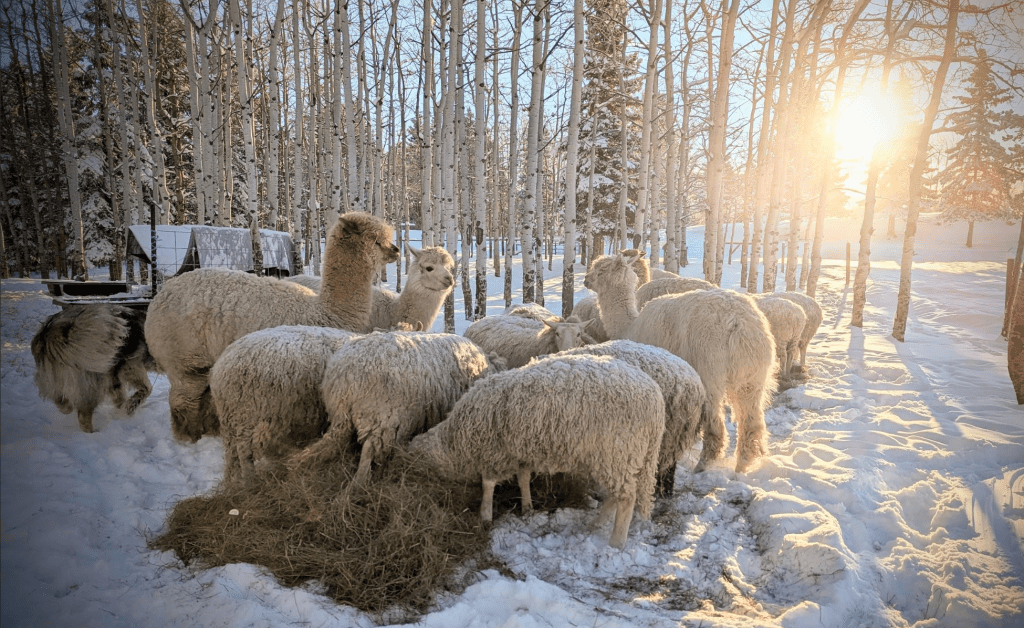
When people talk about hay feeders, the conversation almost always revolves around one thing:
WASTE.
Which feeder wastes the least hay?
Which feeder is most efficient?
Which feeder will stretch the winter feed bill the furthest?
Those are reasonable questions. Hay is expensive, and winter is long.
But if you raise sheep for wool — especially longwools like Border Leicesters with their open character — there is another question that matters just as much.
What will this feeder do to the fleece?
The design of a feeder determines how hay moves through a flock: whether it falls onto sheep, whether animals drag it across one another’s backs, and how much chaff ends up embedded deep in the wool.
Some feeder designs look efficient on paper but produce surprisingly dirty fleeces in practice.
Others — often the ones most criticized for “waste” — can turn out to be much kinder to the wool.
Like most things in shepherding, the reality is a little more complicated than the catalog description. So let’s talk about it.
(And for all of you lovely humans who read our guide on buying a good fleece, you’ll want to read this too. We’re going to get into the nitty-gritty — or maybe itchy-scratchy — of vegetable matter, AKA VM)
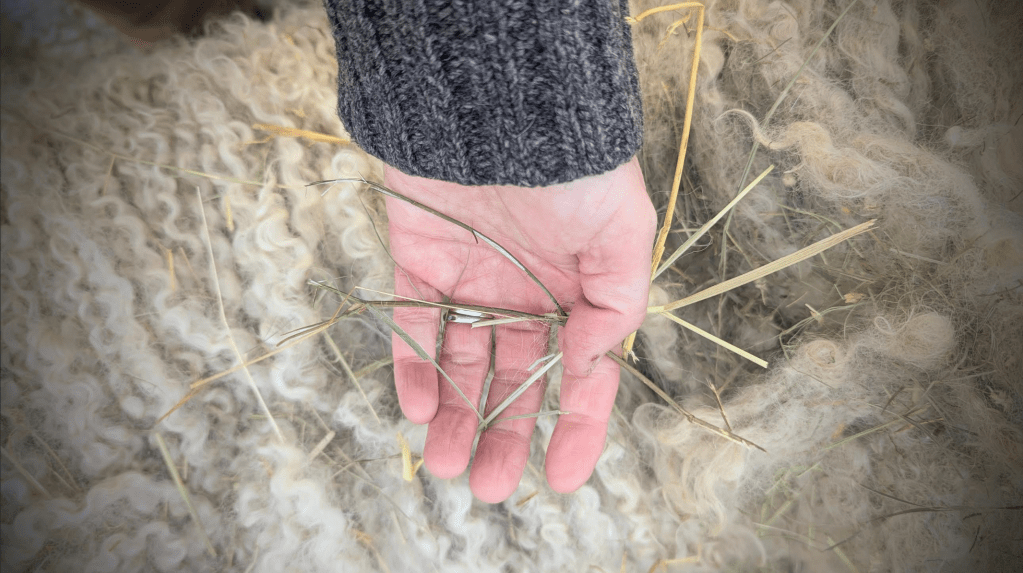
VM is any foreign body in the wool that’s organic – it can be hay, straw, bedding, seed-and-flower heads or poop. It is NOT baling twine, paint or plastics. Some VM is inevitable — wool purchasers need to remember raw wool is an agricultural commodity, NOT a manufactured product.
Ground Feeding
Ground feeding is frequently described as the least efficient method of feeding hay. Sheep pull hay apart, step on it, sit in it, pee and poop on it and leave portions behind (well, duh. Wouldn’t you??).
But for a fibre-oriented flock, it can sometimes produce the cleanest fleeces of all.
Pros
• Sheep eat in a natural head-down posture
• Hay debris falls below the fleece instead of onto it
• Sheep spread out instead of crowding
• Minimal hay dragged across the backs of other animals
• Often results in cleaner longwool fleeces
Cons
• Greater hay waste
• Requires more frequent feeding
• Less practical in muddy conditions
• Sheep like to flip the hay pile with their noses looking for fines and some of them do tunnel which can deposit hay bits mostly on faces and necks
• Can accumulate debris if used indoors over bedding
The key difference is how hay falls.
With ground feeding, loose pieces generally fall away from the animal. With racks or ring feeders, hay often falls onto the animals standing nearby.
For longwool breeds with open staples — like Border Leicesters — those falling fines can become deeply embedded in the fleece.
What looks inefficient from a feed-management perspective can sometimes be very efficient from a fibre perspective.
Ring Feeders
Ring feeders are extremely common because they allow a full round bale to be fed with minimal labour.
Unfortunately, they are often one of the worst offenders for fleece contamination.
Pros
• Reduces hay waste compared to ground feeding
• Multiple rings are an efficient way to feed large flocks
• Low labour once the bale is placed
Cons
• Sheep pull hay loose and toss it
• Hay falls onto neighbouring sheep
• Fine particles accumulate in wool
• Sheep frequently drag hay across each other’s backs
• Manure/urine concentrations around the ring feeder which can lead to higher parasite loads
What tends to happen is that one sheep pulls hay from the bale while others stand nearby collecting the falling debris.
In a dense winter fleece, those fragments work their way surprisingly deep into the staple.
Wall-Mounted and V-Rack Feeders
These feeders are widely used in barns and are often recommended as a tidy, efficient feeding system.
For fibre flocks, however, they can create some high-VM fleeces.
Pros
• Efficient hay use
• Keeps hay off the ground
• Simple to build
Cons
• Sheep feeding below collect falling fines. This can be mitigated somewhat by ensuring a very steeply-angled feeding surface, not greater than 30 degrees
• Hay constantly rains down onto necks and shoulders
• Sheep pull hay out and drop it on other animals
• Vegetable matter accumulates quickly in longwool fleeces
Because animals feed directly underneath the rack, any loose hay or chaff falls straight onto the topline and shoulders, often the most valuable parts of a fleece and exactly where longwool fleeces are most vulnerable to contamination.
Which bring us to. . .
Feeders and Animal Welfare
While feeding the animals is a non-negotiable, whatever feed delivery system you choose needs to be considered thoughtfully and with your specific animal in mind. Sheep with horns present challenges if nets or other kinds of grid-style feeders are used. Some sheep can be quite goat-y when provided with sufficient motivation (we had one Dorset cross ewe who enjoyed swimming her way to the top of a round bale in a ring feeder. Suffice to say, her fleece was a disaster and that ring feeder was sold PDQ). Some further things to think about —
- Bunk space. Each adult animal needs at least 20 inches at the feed bunk if this is the style you decide on. This will ensure adequate space while also preventing any fleece lost to “cotting” — the semi-felted fleece that results from friction against other animals or infrastructure when insufficient space is allotted. Cotted fleece can also tell you that some of your animals may not be getting enough to eat. Body Condition Scoring can help determine if your sheep are thriving or being pushed off their feed.
- Entrapment risk — horns, feet, necks and ear tags can all be caught in netting or any feeder option with smaller openings. Yes, your sheep absolutely will attempt to smush their heads through gaps you think are too small. They will find a way. Ears very easily slick back against skulls to push a noggin through but aren’t nearly as accommodating when your explorer decides they want to pull their head back again. Feet can be caught and I have seen lambs caught inside the collapsible-style panel feeders — it was an unhappy outcome. Try and think sheep thoughts and anticipate the issues in advance.
- Abrasion/Laceration risk — if your feeder has any poke-y bits (think nails or screws), rough edges, dangling wire of any kind, loose hardware or other bits-and-pieces that can catch, someone will get caught. I promise you. Ensure these are dealt with promptly and save yourself a (literal) bloody mess later.
Finally, for my farmer friends, I want to say something very directly and I’m going to get a bit shouty. If your sheep dealing with heavily compromised fleece chock full of VM, I encourage you to TAKE A HANDFUL OF HAY AND DROP IT IN YOUR UNDERWEAR OR YOUR BRA. Go ahead. How do you like it??
It’s fundamentally no different for sheep.
If your animals are driven to distraction doing the itchy-scratchy dance, they are dealing with both physical stress and irritation, both of which can compromise fleece quality and integrity. Rubbing against trees, door frames or feed bunks can break fibres and cause abrasions/lacerations on the skin surface leading to potential infection from opportunistic bacteria.
Whatever feeder style you choose, you must consider the overall health and comfort of your sheep. Everything else is secondary.
What the Skirting Table Reveals
One of the easiest ways to evaluate feeder systems is simply to look at the fleece on the skirting table.
Fleeces from flocks fed heavily in racks or ring feeders may more often contain high levels of:
• short hay fragments
• brittle leaf pieces
• dust and chaff embedded deep in the staple
These contaminants can be difficult to remove and significantly reduce the value of spinning fibre.
For fibre shepherds, feeder design becomes less about convenience and more about protecting the clip.
Now. About Hay Waste
Ground feeding is often criticized because sheep trample hay into the ground but from a land stewardship perspective, the picture looks different.
What animals leave behind becomes:
• soil armour, protecting bare ground
• organic matter, feeding soil microbes
• moisture retention, helping soil hold water
• seed dispersal, introducing new plants
In other words, what looks like wasted hay may actually be future pasture.
Many regenerative grazing systems intentionally use hay feeding as a way to distribute fertility and build soil carbon because feeding locations can be moved through the winter, spreading nutrients across the landscape rather than concentrating them in one spot.
Whether this works well depends partly on the hay itself — if hay contains undesirable weeds, the calculation changes but when feeding clean forage, the residue can function as a kind of broadcast reseeding event.
From that perspective, hay feeding becomes more than a chore.
It becomes a tool.
If you’re curious about how this fits into broader grazing systems, I’ve written more about this approach in my post on Adaptive Multi-Paddock grazing.
The Other Factor: Hay Quality
Feeder design matters — but so does the hay itself.
Brittle hay shatters easily, creating more chaff and fine particles that lodge in the fleece. Leafy, well-made hay tends to produce far less contamination.
Understanding what you are feeding can make a surprising difference in fleece cleanliness.
If you’ve ever wondered how to interpret a forage test, I’ve written a guide on how to read a hay analysis, which walks through the basics.
The Real Secret
The cleanest fleece rarely comes from a perfect feeder.
It comes from a system that prioritizes good hay, thoughtful-and-appropriate feeding methods, and an understanding of how sheep actually interact with their food.
For fibre flocks, the goal is not simply to waste as little hay as possible, the goal is to ensure a high level of comfort, protect the wool, steward the land, and to respect the sheepness of sheep.
When those pieces come together, the fleeces flung out and picked through on the skirting table tell the story in ways words never could.
This is a Tending post — a practical look at our tools, methods, routines, and on-the-ground decision-making. It’s not a one-size-fits-all how-to, and it isn’t meant to substitute for local knowledge or professional guidance. It’s just what we’ve found useful and what we’re doing here on our farm, in our conditions, with our sheep (and alpacas), written down plainly in case it helps. For more about why we do things the way we do them, the philosophy that informs our process, you’ll find those posts in Living.

 Providence Lane Homestead
Leave a comment