Sheep and humans have been interacting for thousands of years but it’s only relatively recently that humans began using “systems” to manage the regular tasks that are part of sheep care. For those of us without them — no chutes, no crowding tubs, no panels — how can we handle sheep the “olde-fashioned” way? What are the implications for handling on wool quality? Why does it matter?
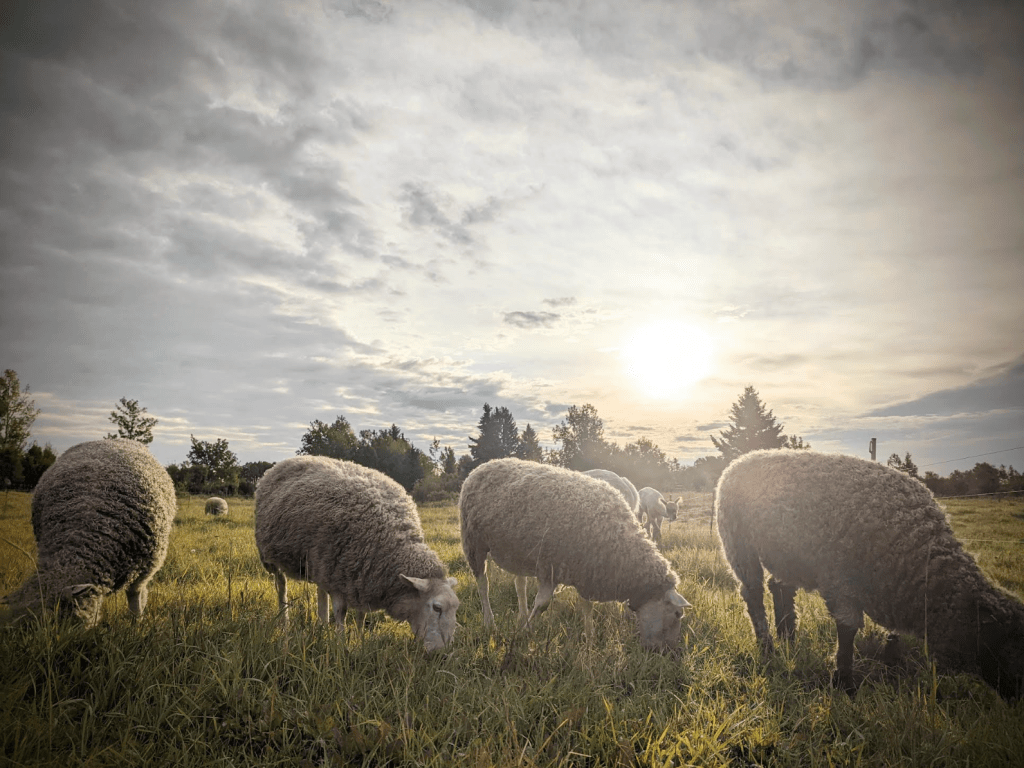
One of the hardest things for new shepherds to understand is that sheep are always reading you. No, they’re not listeing to you or obeying you. They are reading you.
Sheep are prey animals, and their survival depends on noticing small changes in posture, movement, and intention. In the wild, the difference between life and death often comes down to recognizing a predator half a second sooner than the sheep beside you.
Top Of The Food Chain
Humans, unfortunately, move like predators.
We are primates, and our instinct is to use our hands. We are forward-facing hunters and stare at what we want. We are accustomed to walking in a straight line toward our goal, and we move fast. When we’re frustrated, we’ll make noise. We are reachers, grabbers, pointers-and-wavers — and none of that looks like safety to a sheep.
When I first started learning how to handle what we call livestock — anything not a dog or a cat, really — I learned with horses and horses are not masters of subtlety when it comes to expressing themselves. A remarkably tolerant species (for the most part), horses can be very clear about what they’ll accept and when you’ve crossed the line, and because of their size relative to most humans, the risk to us for ignoring that communication is exponentially greater than anything your average — even very feisty — sheep is going to visit on their handler. As a result, we tend to treat the bigger animal with more respect. That’s just basic Darwin — most of us don’t want to die.
Horses were a great way to learn some basics for sheep. Learning to handle horses safely helped me build a set of guidelines for the much quieter, much more timid, much more watchful floof nuggets that came to the homestead later. Where a horse may stomp a hoof the size of a dinner plate, rear, buck, shake their heads, run away, bite, pin their ears, swing their butts around, flatten a human against a wall (now only a couple of these have happened to me, to be clear. I’m making a list for anyone who may not have seen horse negotiations in action) among other antisocial behaviours, a sheep is just. . . gone. Poof. All a sheep can do is run and he doesn’t usually waste too much time thinking about where. A sheep has a sole focus when threatened — escape — and one direction in mind — away, just about as fast as possible.
Now before we get too much further, let’s just stop right here and tackle a big misconception, one that makes me a bit feisty myself.
Sheep are anything but stupid. You put that out of your head entirely.
Sheep Smarts
Sheep are not stupid — there’s quite a lot of good research outlining just how clever they are (about which, more later) — but their intelligence is social, spatial, and perceptual rather than confrontational or problem-solving in the way predators are. Sheep are damn smart but their smart is different from our smart. So, as promised, let’s count the ways sheep are smart, it’ll matter for how we handle them.
- Sheep can recognize human faces from photographs. Scientists trained sheep to recognize specific human faces and choose them correctly from photos, even when shown at different angles. Researchers noted their ability was comparable to primates in some tests.
- Sheep remember dozens of individuals for years. Research showed sheep can remember up to ~50 individual sheep faces and retain those memories for more than two years, using specialized brain regions similar to those used in human face recognition. I once sold a vast Dorset ewe — a beautiful girl I called Truvy — to another farm. Five years later, I happened to be in the area and went to visit. Far away in the field, I saw Truvy’s unmistakable profile and called, “Trrrruuuuuuuvy!!” her head popped up and she waddled about as quickly as possible in my direction. It was heartwarming to see.
- Sheep recognize both sheep and humans socially. Studies on visual discrimination show sheep can distinguish between familiar and unfamiliar animals and people, and perform better when the individual is socially meaningful to them. While it might be a simplification, in everyday language, I think this study highlights an important foundational truth for sheep — trust. A sheep must trust the human in their world to perform at their best. That is one example of how the human and the sheep behavioural venn diagrams overlap.
- Review of sheep cognition research (2025 scoping review). Recent review papers summarize studies showing sheep can learn tasks, remember reward locations, adapt to new environments, and make decisions based on past experience.
- Spatial learning and maze studies. Sheep can learn to navigate mazes and remember routes, and stress levels affect how well they perform — showing links between emotion and cognition similar to other mammals.
- Sheep show measurable cognitive capacity in neuroscience models. Because of their brain structure and learning ability, sheep are used as models in neurological research, indicating relatively high cognitive capability among livestock species.
- Scientific reviews conclude sheep show personality differences, emotional responses, social bonds, and individual learning styles, contradicting the stereotype of sheep as simple animals.
- Research also shows sheep display: optimism/pessimism responses to stress; social preference patterns; different levels of fearfulness and different learning speeds.
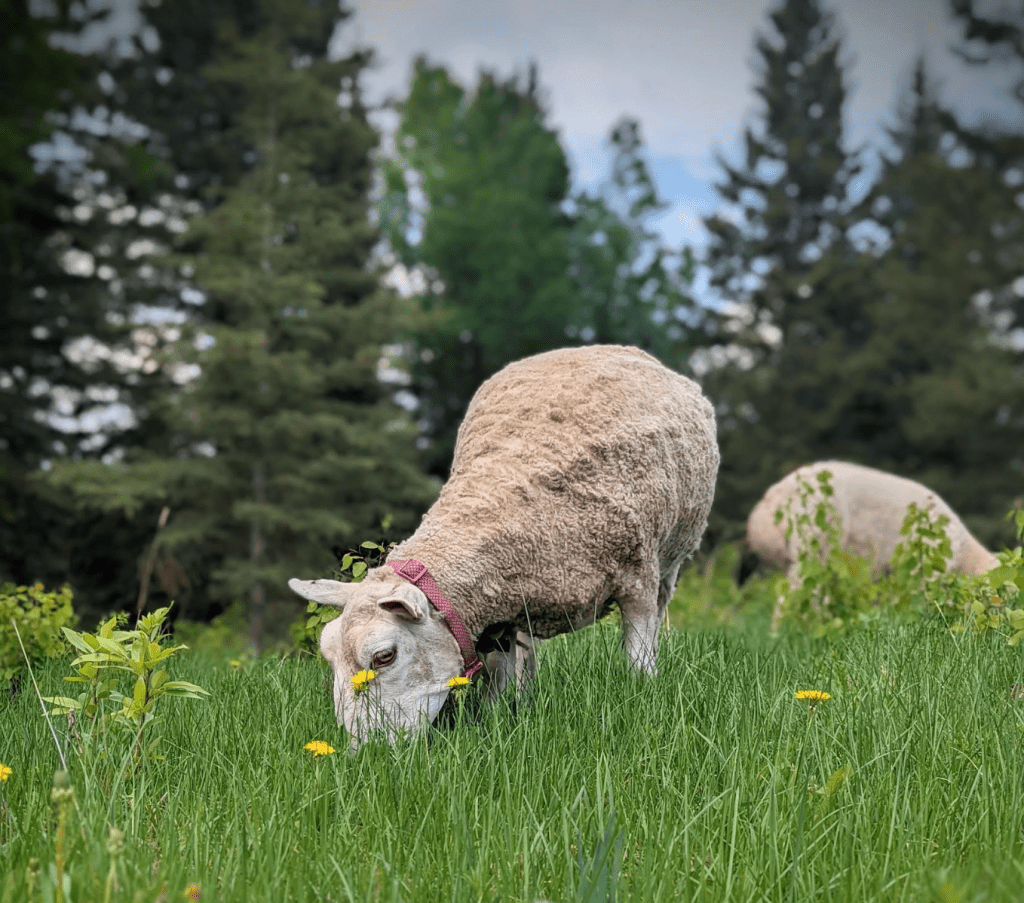
What a wonder is a sheep! The next time you’re at a social gathering and someone accuses you (or anyone within hearing) of behaving “like a sheep,” I challenge you to whip out some of these studies and go over the finer points. At the very least, that nincompoop is unlikely to bother you at parties ever again.
Most people base their understanding of intelligence on the frameworks they know best — their own. Now, that’s a wide range of capacity but for many humans, we understand and prioritize our own intelligence above all others. There are good biological reasons for doing so — it’s helped to keep our species alive. However, in order to handle other species, other beings, we need to set aside our own preferential bias and try to think the way they do. In order to safely handle horses, I needed to learn how to think like a horse. When it came time to expand my horizons and we brought sheep to the homestead, handling them without all the fancy bits-and-pieces many people use to corral and channel sheep, I had to learn to think sheep thoughts, to answer their concerns and establish trust so that when handled, the sheep would (as much as possible) be willing to cooperate.
Most of the time, when sheep flash from placidly living a sheep life to barreling away from their hopeful shepherd standing in the paddock with a (pick one) pair of gloves, pair of hoof trimmers, annual vaccines or shearing equipment, they aren’t being stubborn. They’re reacting to environmental stimuli that says, very clearly, something wants to eat me.
The good news is that once you understand this, you can change the way you move — and the flock will change the way it responds.
Move Like You’re Not Hunting
Predators move straight toward what they want. Case in point — last Summer, I and a young friend (from Scarborough!!) wandered through a pasture at our place and scared up a grizzly bear. He came at us at a full gallop — moving fast, in a straight line, roaring like a lion. I understood two things immediately — he meant business and this was not going to end well. I am not nearly as quick off the mark as a prey animal, accustomed as I am to my spot on the top of the food pyramid. But this was a message my lizard brain immediately absorbed and decoded and suddenly my possible demise became very real indeed. (Obviously the bear decided I wasn’t worth the trouble. If this story had ended otherwise, I wouldn’t be relaying it to you now. Silly). As already discussed, sheep are hellaquick on this front — they’ve had to be — and while it might take screaming bruins to get through to me, a sheep doesn’t need nearly as many clues to take prompt, evasive action.
If you walk directly at a sheep, stare at its head, and reach with your hands, you will almost always trigger a flight response. Even quiet, friendly sheep will tense up when approached that way. Let’s put it this way, in sheep-speak, it’s very rude.
Try moving in curves instead of straight lines, approach from the side, angle your body instead of facing them head-on, walk past and then turn back. Give them space to choose the direction you want instead of forcing it. Does it take more time? Indubitably. Will you get there with greater cooperation and goodwill on all sides? I’ve found that you will. As one of my first lessons with horses, as the shepherd you want to make the right answer easy and the wrong answer hard for the flock. You don’t need to eliminate all the choices, you just need to make the right choice the easiest one and then watch the sheep, like water, flow.
Except in emergencies, there is very little reason to move fast and directly with sheep. Slow, circuitous movement reads as safer, and safer sheep are easier to handle.
Shut Your Howling Screamer
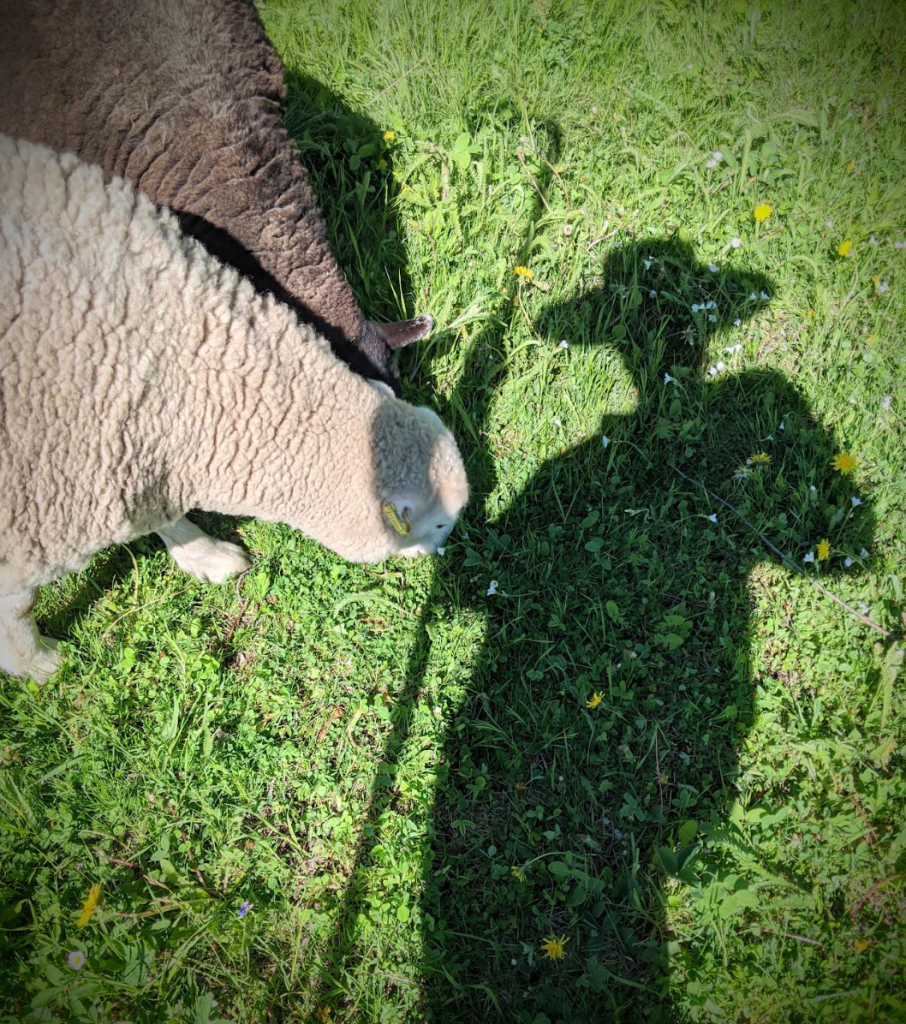
Humans talk when we want something to happen. So do sheep, they just don’t yell about it (except for food. They yell quite a bit when it comes time for food to happen.)
Shouting, clapping, or sharp commands can sound like alarm calls to a prey animal. Even when the noise isn’t loud, the tone can feel like pressure. This can be useful when it’s carefully calibrated and used to get the flock moving but continuing to use it once the goal has been achieved just feels like harassment and increases the tension. Watch a flock being managed this way and you’ll see what I mean — heads high, eyes wide, ears quivering at 10-and-2 like antenna looking for messages from space. The sheep will be tightly bunched and look like a coiled spring. One step too far and this is a flock primed to react rather than respond.
I have found that when it comes to getting my sheep’s attention, when I want the flock to gather and move, I’ll resort to something the young David knew when he was tending Jesse’s flocks — I’ll sing.
A steady, familiar voice doesn’t sound like panic.
It sounds like background.
I talk to my flock all the time, but rarely in sharp bursts. Long, even sounds seem to keep them calmer, especially when moving them from one place to another.
They may not understand the words, but they understand the mood.
Keep Your Hands to Yourself
Do you have that Georgia Satellite song in your head now, too? Excellent. Consider it a candidate for singing to the flock — it’s a good reminder for our next handling note.
Because we’re primates, our first instinct is to reach.
We grab halters.
We push shoulders.
We pat heads.
We try to steer with our hands.
To a sheep, a reaching hand looks like claws and the more you wave your arms, the more pressure the sheep feels.
Most of the time, you don’t need your hands at all, you need your position — your body. Sheep are very sensitive to where a body is placed in relation to their own. This isn’t unique to sheep, of course, talk to any woman and they’ll tell you the same thing. When we are dealing with someone who uses their body to communicate our position, we take that message in and to heart. Like sheep, we know what this means and many is the woman who regretted not taking sheep-like evasive action.
A step forward can push.
A step sideways can turn.
Standing still can block.
Opening a space can draw them through it.
Once you start using your body instead of your hands, the flock begins to move more smoothly, and with much less stress. They aren’t being forced, they’re being guided — this is the work of the shepherd.
Position Is Everything
Sheep read angles the way we read facial expressions. Where you stand matters more than what you say. It’s the sheep equivalent of “I don’t like your tone!!!”
If you stand behind them, you create pressure. If you stand ahead of them, you create hesitation. If you stand to the side, you can shape the direction they move.
When I’m moving sheep, I usually don’t drive from straight behind unless I have to. Instead, I guide from the front, contain from the side, and only move to the back to encourage the stragglers — gently. When I have someone with me the sheep don’t know, I’ll put that person at the side, closer to the back and further from the flock. It is essential that sheep be able to take the time they need to acclimate to new hands, new voices, new smells and new movement patterns. Humans like to assume that the other being in their exchange “Know what I mean.” Ask any longterm relationship couple and these kinds of assumptions are fertile ground for all kinds of misunderstandings and resentments. Sheep need time to assess and read any new being in their midst if low-stress handling is the goal. Everyone has their own “personal space” and sheep are no different, both on a flock and an individual level. It is a wise shepherd who counsels humans to give a wide berth, especially in the early stages of an acquaintance.
If the flock breaks into a run, the push has been too hard and remember, running sheep are frightened sheep, and frightened sheep don’t make good decisions. They bunch, scatter, crash fences, leave lambs behind, stumble and fall and forget where they were supposed to go.
Calm sheep, on the other hand, will often move exactly where you want them to, as if it were their own idea.
That’s the goal.
Not control.
Not force.
Guidance.
Animal Handling and Wool Quality
There’s another reason quiet handling matters, especially for those of us raising sheep for wool. Stress shows up in the fleece. When a sheep is frightened or handled roughly, the body releases stress hormones that can interrupt normal fibre growth. The result can be weak spots in the staple, uneven fibre, or breaks in the fleece that reduce its value and usefulness. A calm sheep grows better wool — and that’s not just an economic concern, it’s a welfare one. Animals that feel safe eat better, rest better, mother better, and stay healthier overall. Gentle handling isn’t about being sentimental. It’s about understanding that the way we move, speak, and position ourselves has real physical consequences for the animals in our care, right down to the fibres they grow on their backs.
Steward, Not Predator
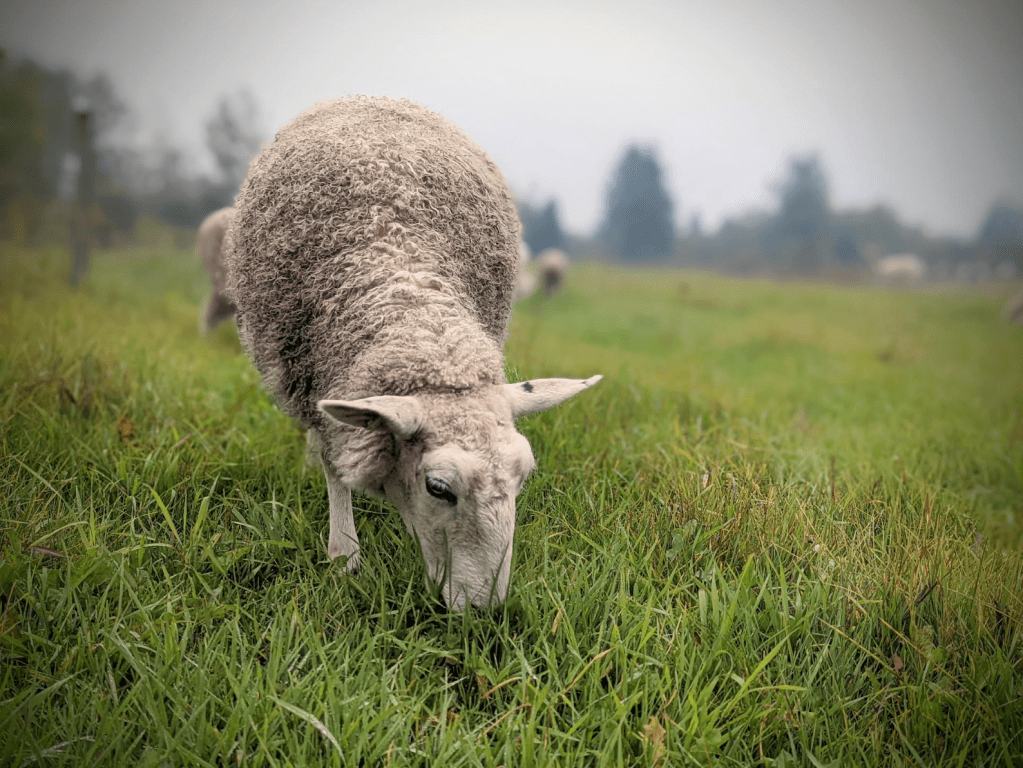
The longer you keep sheep, the more you realize they don’t just react to what you do in the moment, they remember how you usually behave. To paraphrase Maya Angelou, sheep remember how you make them feel.
If you rush, grab, shout, and chase, the flock will stay wary of you but if you move steadily, handle them quietly, and give them room to think, they begin to see you differently.
You’re not a threat, not as another sheep but you are part of the landscape, a presence that means feed, water, shelter, and safety.
That’s when sheep become easy to manage — not because they’re trained, but because they trust the pattern of your behaviour. You’ve built and then carefully reinforced a trust relationship.
And trust, with prey animals, is never loud, it shows up in small things. . . Like a flock that keeps grazing when you walk into the field, a ewe that lets you pass between her and her lamb or a group that follows your movement without panic. This can be vitally important when life circumstances dictate a change no one saw coming. A flock that is inclined to trust their shepherd is a flock a shepherd can keep safe — from wildfires, from predators, from extreme weather.
Those are the moments when you know the sheep are reading you. . . and what they see is not a predator.
It’s their shepherd.
This is a Tending post — a practical look at our tools, methods, routines, and on-the-ground decision-making. It’s not a one-size-fits-all how-to, and it isn’t meant to substitute for local knowledge or professional guidance. It’s just what we’ve found useful and what we’re doing here on our farm, in our conditions, with our sheep (and alpacas), written down plainly in case it helps. For more about why we do things the way we do them, the philosophy that informs our process, you’ll find those posts in Living.

 Providence Lane Homestead
Leave a comment