Rewilding is making a lot of noise in land stewardship circles. What is it? Will it work in Alberta? How different is rewilding from restoration?
In recent years, the word rewilding has become popular in conversations about land care. It carries a hopeful feeling — the idea that if we simply step back and let nature take over, damaged landscapes will return to what they once were.
There are many varieties of “rewilding,” it’s a movement with a lot of layers and nuance. For some, rewilding means a hands-off, let-Nature-do-its-thing course of action while for others, rewilding is a process that begins with intensive initial stages before graduating to a self-sustaining equilibrium. At one end of the rewilding spectrum you basically have abandonment while at the other, you have intensive and prolonged management.
Whichever way you look at rewilding, whichever version you adhere to, will it work in Alberta? For our native grasslands, could rewilding be an approach that might hold some promise?
Time and Impact
Grassland ecosystems didn’t appear overnight, and it stands to reason they won’t rebuild overnight, either. Developed over centuries under very specific conditions, the grasslands of the Canadian prairies were midwifed by a very particular cast of characters; deep-rooted perennial plants, grazing animals, long rest periods, fire, drought, and cold winters. These forces shaped not only the plants we see, but the soil beneath them, the way water moves through the ground, and the relationships between species.
When settlers first moved into these prairies, they began farming using wooden plough. As you can imagine, these primitive tools were no match for the thick thatch of the grasslands — not all the stems and leaves above ground and certainly not for the thick, branching root systems below. With the advent of the steel plough however, things took a turn and suddenly, the prairie native grasslands were falling, opened to the sky like a gutted fish. Students of Canadian history know what happened — repeated ploughing (or tillage) led to soil breakdown and when the drought years of the 30s crept across the prairie, all that lovely black topsoil, with nothing to hold it down and as fine as powder, simply . . . blew . . . away.
It’s this kind of apocalyptic history many rewilders are trying to avoid. Recent world events — visions of deer and foxes strolling through abandoned COVID-era city centres — have captured imaginations and many rewilder believers hope that by doing nothing, Nature will eventually take matters into her own hands. After all, since human intervention brought the dust bowl to pass, perhaps human inaction might lead naturally to a reversal? They envision a world restored.
But are rewilding and restoration interchangeable?
In my opinion, no. These are two different words used to describe different goals, different methods, and different expectations about what land can become.
What Is Rewilding?
If we agree that rewilding generally means allowing natural processes to return with minimal human intervention — if land is no longer plowed, grazed, sprayed, or developed, and native species are expected to come back on their own — then, as with any form of land stewardship, the outcome depends entirely on place.
Context, as they say, is everything.
In some environments, rewilding can work very well. Forests often regenerate this way, and wetlands can recover surprisingly quickly once drainage stops. Around the world, advocates for rewilding have been busy with glossy films and promotions, and there are some very persuasive stories coming out of places like Ireland and New Zealand, for instance.
But Alberta isn’t Ireland, and recovery here is not so simple.
Once our native grassland has been broken, the system that existed before may no longer be able to re-establish on its own. Introduced species move in quickly, soil structure changes, water behaves differently, and the balance between plants shifts. Left alone, the land will change — but it is unlikely to return to the native prairie that was there before. The past becomes a memory, and without extensive help, it stays in the corridor of what used to be.
Rewilding often puts its emphasis on a return to the way things were by reducing human intervention on the landscape. In a western Canadian prairie context however, with all the variables now present on the land, Nature on her own cannot always put Humpty Dumpty together again. For us, restoration is more often the better way forward.
What Is Restoration?
Restoration accepts that damage has occurred and asks a different question: not how do we go back, but how do we rebuild function from where we are now?
In grassland ecosystems, restoration often involves active management — sometimes very active management. It may include reseeding native species, adjusting grazing patterns, reducing disturbance, rebuilding soil organic matter, or controlling invasive plants. It can involve re-orienting water courses or slowing, spreading, and sinking water. It may mean prescribed burns or changes to wildlife pressure.
The goal of restoration is not to recreate the past exactly, but to recover the resilience and ecological function that made the original system stable.
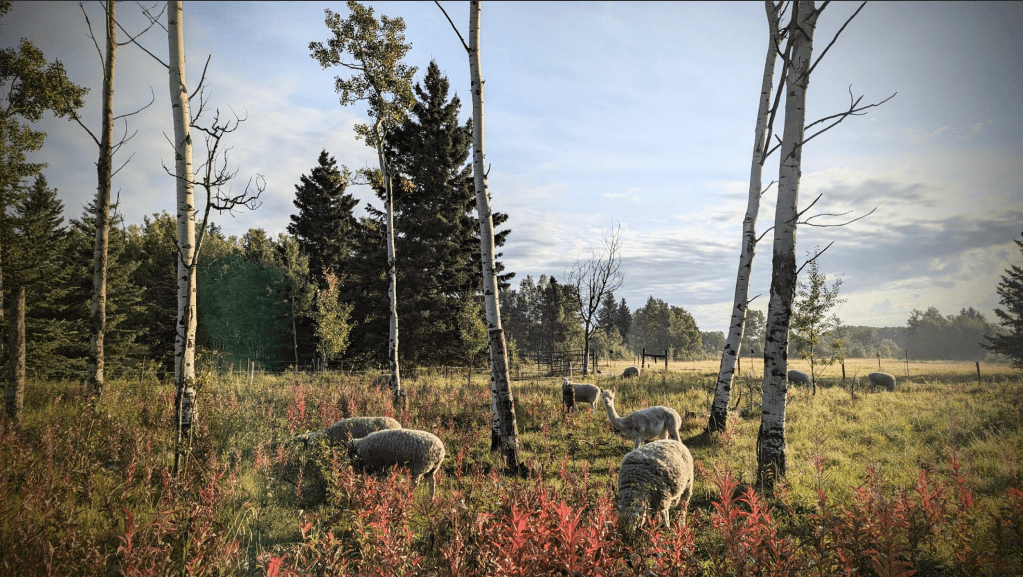
On our farm, I can’t get rid of every blade of Kentucky bluegrass or smooth brome. I can’t root out every Canada thistle — though I’m sure trying — and I know that if I got rid of the introduced clovers that swaddle parts of our pasture, my sheep would be very cross with me. These parts of our landscape are here to stay now.
For me, a return to those years pre-contact isn’t possible. That’s not an admission of defeat, it’s an acceptance of reality. Restoration is the more flexible, more dynamic option — it’s also the only option, but I digress.
The simple fact is that restoration, while slower than rewilding and sometimes less romantic (we’re short a few Irish lords), is often more achievable on land that has been farmed, cultivated, or heavily used.
I can’t go back. All I can do is go forward.
After generations of tillage, the prairie itself is no longer the prairie of the past.
Soil Is As Soil Does
Recent research is beginning to show that disturbance changes more than what we can see at the surface.
A 2026 study using seismic monitoring equipment at an experimental farm in England found that repeated plowing and heavy machinery traffic weakened the physical structure of the soil itself. Unlike past studies, this one used earthquake technology to measure how vibrations moved through the soil via fibre-optic sensors underground.
What they found was striking — fields that had been tilled for many years transmitted vibrations differently than undisturbed soil, indicating that the internal pore network had broken down. Those tiny gaps and channels — we chatted about them in our Tending post about Poor Man’s Fertilizer — are what allow soil to hold water, resist erosion, and support deep root systems. Once damaged, the soil behaved less like a sponge and more like loose materials that shed water quickly.
This matters for prairie restoration. Because our native grassland soils have been taken so far from their original state after decades of tillage, decades of fertilizer applications and compaction from ever-growing tractors, even when native plants are seeded back later, the soil can no longer functions the way it once did. Put simply, the good stuff just isn’t there — it’s been ripped, sprayed, drained and smushed into something . . . else.
This is one reason restoration and rewilding are not the same thing. Rewilding assumes that if we step back, the system will return to its former state. Restoration recognizes that the system itself may have been altered, and that rebuilding function can take years — sometimes decades — of careful, deliberate management.
For me, it means I play the hand I’ve been dealt. In euchre terms, I might be staring at a couple of nines and queens, but dammit, I’m going to play my nines and queens. If I’m smart, and the game goes my way, I might do better than I have any right to expect.
Succession Is Not A Straight Line
All ecosystems change over time. This process is called succession — the gradual shift in plant communities as conditions change. While change is inevitable, it’s the pace that can make the process easier or harder to navigate.
In native prairie, succession moves slowly because the plants are long-lived and deeply rooted. In disturbed ground, succession can move quickly, often toward species that tolerate shallow soils, repeated disturbance, or excess nutrients.
If we assume that succession will always lead back to native prairie, we misunderstand how these systems work. Sometimes it does, sometimes it doesn’t. The outcome depends on soil condition, moisture, seed sources, grazing pressure, and past use.
Understanding succession helps us decide when to step back — and when to step in.
Working With The Prairie I Have
In Alberta, much of the original grassland has been altered in some way. Some areas remain intact, some have been cultivated and reseeded, some sit somewhere in between and — like here on the homestead — sometimes native and non-native zones border each other. Each scenario is different, each is subject to what’s happening today and each is a result of what happened decades or even millennia ago.
Good land care means recognizing those differences.
In intact prairie, the best management may be very light use and long rest (check out Land and Place in our Keeping archive for more on this). In previously cultivated land, careful grazing and soil rebuilding may be needed to restore stability while in heavily altered areas, the goal may simply be to create a healthy, functioning pasture rather than a perfect reconstruction of what once grew there. For our farm, I prioritize the preservation of the natives plant communities I have. Where there are mixed native/tame plant species, I try to make sure conditions favour the natives. Where tame grasses are the norm, I manage to ensure resilience and growing levels of biodiversity.
None of these approaches is wrong, they are responses to different starting points.
At its best, rewilding reminds us to respect natural processes. Conversely, restoration reminds us that those processes sometimes need help — maybe even a lot of help.
On the prairie, both ideas have a place — but no, they are not the same thing.
This is a Tending post — a practical look at our tools, methods, routines, and on-the-ground decision-making. It’s not a one-size-fits-all how-to, and it isn’t meant to substitute for local knowledge or professional guidance. It’s just what we’ve found useful and what we’re doing here on our farm, in our conditions, with our sheep (and alpacas), written down plainly in case it helps. For more about why we do things the way we do them, the philosophy that informs our process, you’ll find those posts in Living.

 Providence Lane Homestead
Leave a comment