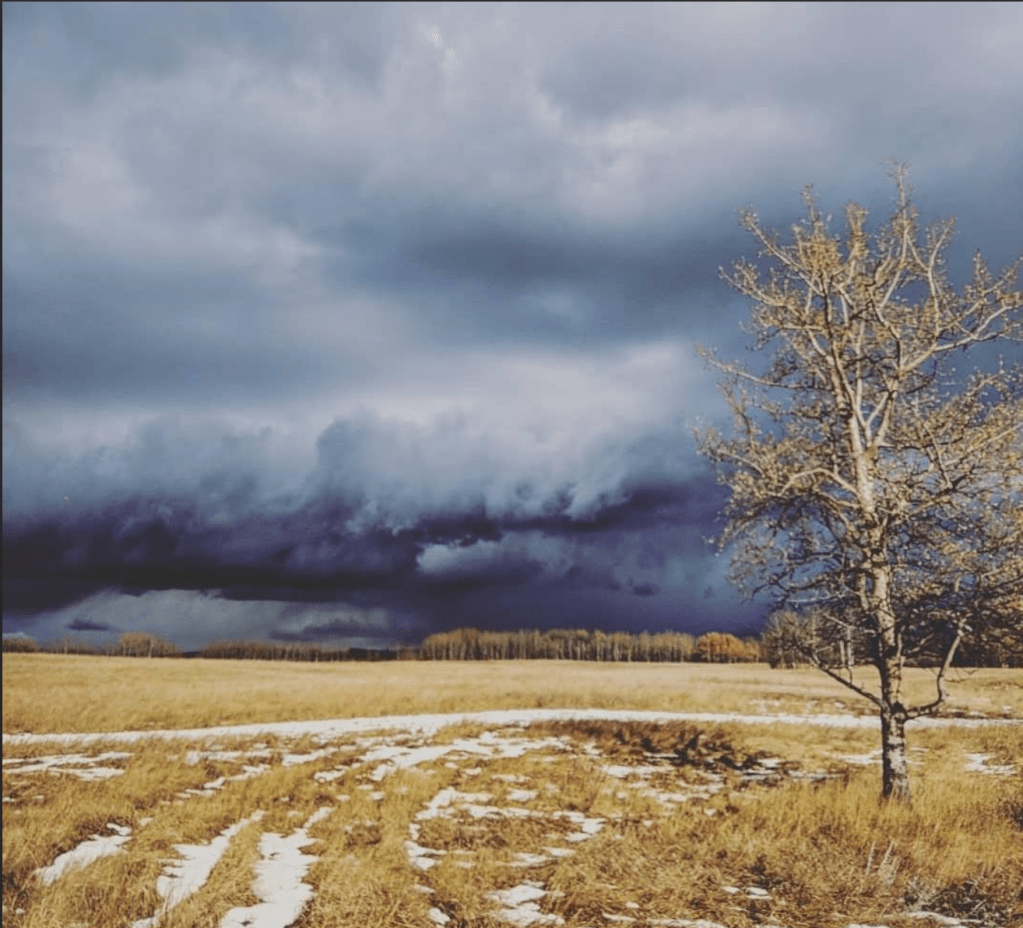
For years I have been collecting as much data as I could about the land I’m on. If it could be eyeballed, I eyeballed it. I’ve crawled on my hands-and-knees, dug holes, fought my way through thickets and learned (at the most basic level possible) to ID plants. But my grazing reports had a major gap. How would this fancy instrument array help close them?
I thought I was buying a weather station.
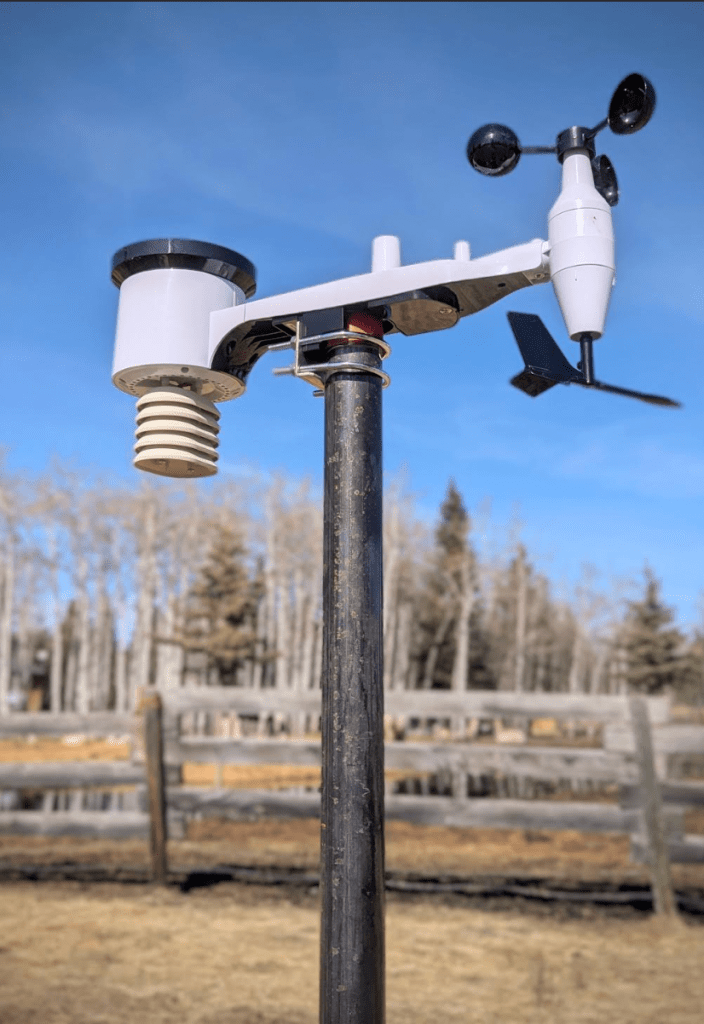
That’s what it says on the box, after all. A sleek thing, it looks like it could be a spaceship in a Star Trek movie. The unit was smaller than I expected when I first took it out of the box on Christmas Day 2024. I had asked my slightly confused husband for something that would let me become part of the citizen-led weather collection service Wunderground. One look at the arrows, words, images and many, many pages in the accompanying manual and I put the whole thing on a shelf where it lived until I felt a little less intimidated.
Let’s skip to yesterday, April 11, 2026. A brilliantly sunny day, the snow melting, the birds singing and naturally, I woke up and decided that the only way it would be a successful day would be if that weather station found its place in the yard and began transmitting data.
It took all day and multiple trips to the local plumbing supply store where I rummaged in assorted bins and buckets for materials like some kind of near-sighted gopher. Fortunately, by day’s end, the array was up, the console was glowing in the house with reported data and I felt like I was one step away from those meteorologists at the beginning of Twister (the OG).
Wind speed, rainfall, temperature, barometric pressure — useful things. The sort of information people glance at in the morning before deciding whether to wear a jacket.
But that’s not what this is.
What this is, I’m beginning to understand, is context.
Filling In The Gaps
For years now, I’ve been writing grazing reports the same way I move through the land — by observation. By feel. Sentences like “ground was firm but damp,” or “moderate humidity” or “light breezes from the northwest.”
All good observations, true and verifiable (as much as you can be with a licked finger stuck up into the air). I collect them from being present and paying attention, by using observation as a discipline built up over 20+ years as a professional writer. I watch my animals move through our different grazing pods, watch to see what they prefer, where they prefer, when and how they prefer. I watch wildlife, wind, water and the sun as it arcs across the sky.
But everything I was watching for was, at its best, a snapshot of a moment. I could work out for myself what IS. I was a little vague on why it was and what it might mean a year from now, or how it tied into what I saw a year ago.
A Page Out Of History
Take that “damp but firm” ground. When I wrote that down, that was the sum total of my capacity to observe. Now, I’ve got a new range of tools I can use to interpret the why behind the fact — the ground is damp from a recent rain. What happened to the water?
In dryland farming, “What happened to the water” is one of the MOST important questions you can ask. Did it all come down at once, or was it slow and steady—those almost mythical “million-dollar rains”? What happened after? Did the wind pick up? Did the humidity drop or the sun come out? Did the water infiltrate the soil surface or did it evaporate? How much of the rain that fell there, stayed there?
That piece of ground doesn’t just exist anymore — it has a story.
Wind, Water and Pressure
I’ve been routinely underestimating the impacts of wind. Part of that is because it’s damned difficult to see unless it’s acting on something else — if the trees sway, if the grass is flattened against the ground, if my hat goes cartwheeling off my head resulting in an undignified chase across the yard.
Often, we focus on the sun when we talk about drying. Bright days, blue skies, that feeling of things crisping up underfoot. But here on the foothills, in our specific bit of geography, the wind is a much more active presence and the station speaks the truth — most of the real work is happening when the air is moving.
A steady wind with dropping humidity will dry a paddock or a pasture faster than a hot, still afternoon ever will. The horses especially are sensitive to this — they shift with it, turn their backs to it, tuck their tails in tight and low and follow it in ways I’ve seen but never quite measured.
The weather station puts hard numbers on all those more pastoral observations. And while I’m certainly no slave to number work (there’s a retired math teacher back in Ontario somewhere who gets twitchy at the mere mention of my name and “cosign” in the same sentence), they are useful tools, sequential representations of conditions that, when collected over time, help me understand the real-world and longer-term impacts of specific scenarios.
I can track the conditions that drive ground moisture, tie it back to wind speed and direction and map the presence of that most essential — and sporadic — element. I can watch water.
Humidity is another one. I come from the land of “It’s not the heat, it’s the humidity.” I get what humidity means in a way most of my Alberta-born-and-raised compatriots just don’t understand. I’ve always recorded it in a general way — usually by how uncomfortable I am — but that’s not particularly useful beyond giving me something to complain about. Knowing how much moisture is sitting in the air is useful but knowing what it’s doing — is it building? Dropping? Sitting heavily overnight?
Knowing what the humidity levels are doing means I can work out what our available forage is doing — is it drying fast? That impacts when the sheep get turned out, particularly in early Spring. Is it thick and soggy with rising humidity? If it is, that impacts the ground surface and raises the risk of pugging and compaction.
When it comes to buying hay — easily the heftiest expense here — knowing when the hay was cut and what the humidity levels were the days around that event lets me know, no matter what the hay seller may tell me, what conditions were wrapped up tight into that bale, conditions I may not find until much later in the year. Anyone who’s ever unrolled a hay bale and discovered a miasma of dust and mould knows what I’m talking about.
Tracking the moisture data gives me more information and more information can mean better decision making.
Then there’s pressure. I have an inkling of what’s happening on the pressure front because, like so many, parts of me ache when it’s changing. I can tell you something is afoot when my front teeth or my hands hurt. Clio, our chief guardian dog also feels pressure keenly. So while I’ve always been able to say that something was happening, now I’m able to work out exactly what’s going on up there in the big, blue sky.
Alberta specializes in “sudden swings.” She likes to throw weather phenomena at us no one saw coming. I can’t even begin to tell you the number of times the unforecasted snow started falling and, once it was obvious that we were getting significant accumulation, that’s when the weather warnings started bubbling up on my phone. Very useful, those weather warnings after the fact. . . sigh.
Barometric pressure drops are a signal, it’s weather’s way of saying, “Heads up, folks.” Add our own specific location quirk — we sit on a high ridge that splits two river basins — and what happens here may be wildly different than what’s happening just a few kilometres to our north or south. The pole-mounted spaceship gives gives me information as specific to this place as my thumbprint is to me. And while up until now I’ve been reacting to weather, with some time and practice, maybe I might be able to anticipate it.
Ground Shift
The real shift isn’t any one metric. It isn’t the console display at all. It’s all in the layering. The gradual compilation of information that builds the story of here. This fabulous little unit, spinning and measuring and logging, is feeding all the data it collects into a record that will show me, as I get more proficient, the most important information anyone can collect over time. . .
The patterns. Every decision I’ve ever made has been rooted in observation and capacity. Now, I can add pattern to that mix, a way to peer through the clouded future and, with some careful reasoning and planning, perhaps make decisions that will build resilience over a longer timeline than has been possible to this point.
In the near term, I can look back and see how much rain actually fell, what the wind did then, whether the humidity held or dropped and how quickly things dried or didn’t. I can layer that over my grazing observation and build a story that is more accurate — and hopefully more useful.
And one day in the future, I will look back at the data I collected over the years and map it onto the data coming in and I’ll be able to layer all of that onto the world I’m in and connect the dots. I will have a nuanced and highly-specific “lay of the land” I haven’t had before, a clear feedback opportunity to which I can respond.
Reality Check
Observation is always going to be the foundation for what I do. I love doing it for one thing and as important as numbers are, nothing beats being on the ground and in the moment. I don’t expect that the weather station is ever going to replace observation as my primary tool but I do hope that as we go forward, getting more knowledgeable about the immediate impacts of weather — what it looks like in the moment and how the numbers correspond — as well as the trends over time will help me be a better steward of the land I’m on.
It’s going to take time to dig through the data, to learn what it all means and how it relates to on-the-ground phenomena. Fortunately, time is the one currency I have that I am more than willing to spend if it will gain me the kinds of skills I need to help build a more resilient future.
I’m going to figure out how to weave the numbers and the nuance, the data and the details, into something useful.
Out here, the better I understand what happened and what’s happening, the better I’ll be able to map what might happen. Wish me luck!
This is a Tending post — a practical look at our tools, methods, routines, and on-the-ground decision-making. It’s not a one-size-fits-all how-to, and it isn’t meant to substitute for local knowledge or professional guidance. It’s just what we’ve found useful and what we’re doing here on our farm, in our conditions, with our sheep (and alpacas), written down plainly in case it helps. For more about why we do things the way we do them, the philosophy that informs our process, you’ll find those posts in Living.

 Providence Lane Homestead
Leave a comment