Easily my most favouritest permaculture principle!! And look! Just now, the Real World has provided a high-profile example. Let’s dive in! What is feedback and how does the World Bank’s recent mea culpa fit into feedback and agriculture??
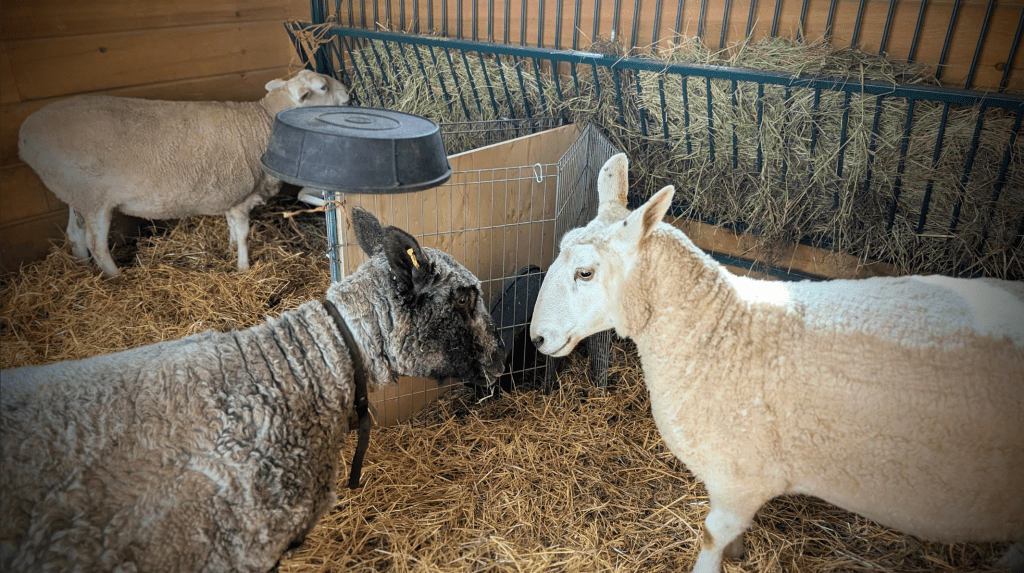
Juniper (right) and Charlotte (left) are having the kind of discussion that precedes “feedback” in the sheep sheds.
I am a journalist in recovery and among my very many less-than-sterling personal habits is a raging inability to keep my mornings doom-scroll free. Can’t do it. I am a slave to the news aggregators, alas. However, every once-in-awhile, the algorithm does throw a magnificent fish onto my early-hours shore, a newsy King Salmon just for me to pick over and chew on like some kind of rumpled raven.
This morning, I’m hopping around one such offering, from The Atlantic (one of the last remaining hold-outs for long-form journalism, I can’t recommend The Atlantic enough. They give their writers the scope and the time to truly unpack world issues in a way that’s so rare in the news sound-bite landscape of today), “A Pillar of the Economics Establishment Admits That It Was Wrong.” (read the original report, “Industrial Policy for Development.”)
Anytime a pillar of anything admits it was wrong I am going to be intrigued. Colour me simple but true mea culpas are so exceedingly uncommon that when one of them is unearthed, I feel a little like Gollum, “What is it, my precioussss??? Is it crunchable?”
Boy howdy, is it ever.
Feedback – INCOMING!!
Let’s begin with the tiresome definitions – what’s feedback? For Permaculture Principle 4, feedback is based on Permaculture Principle 1 “Observe and Interact.” Everything we do from a permaculture perspective must be based on simple observation (eyeballs on the ground) and interaction with our environment. Feedback is what happens when our observations and our expectations either align – voila! Confirmation!! – or . . . . don’t. Without skilled and disciplined observation, feedback is easily misinterpreted, or worse, ignored. So that’s the ground level.
After decades promoting a model — open markets, deregulation, fiscal restraint — as the path to development, it would appear the World Bank has some further thoughts. Years and years of application has led to years and years of data and guess, what? The results (the feedback for our purposes) and the permise don’t. . . exactly. . . line up.
That original model — what became known as the Washington Consensus — played a huge role in global economies. For years it was canon, the price of admission for countries seeking funding from the World Bank. If developing economies wanted money, they had to adhere to the Consensus. No unfettered capitalist market access? No money.
Now, so many years later, the chief economist of the World Bank Group, is all “Erm. . . “
Indermit Gill writes, “. . . policymakers seeking to follow similar paths in other developing economies have often met with failure.” One set of preconditions was especially elusive: “macroeconomic stability and low inflation.”
. . . That advice has not aged well—it has the practical value of a floppy disk today.”
What’s that again? Yes, you read correctly! According to Gill, it would seem that free markets and unfettered capitalism may not be the reason for the Asian Miracle’s success after all.
This Is Captain Obvious Speaking
What changed?? Feedback happened. After 30 years of observation, the conclusion is… not what we said it was.
This happens on the homestead all the time. I get feedback — often relentlessly — about choices I make. Left behind piles of hay? Feedback — hay isn’t palatable. Consider that money wasted. Pasture slow to bounce back? Feedback — we haven’t been able to take the best advantage of the soil, water and photosynthesis resources available. Crunchy back and early-morning muscle pain? Feedback — you don’t bounce the way you used to, Tara. Work smarter.
Feedback is the system telling the truth despite preconceived notions or biases. Feedback is telling you “You got it right,” “You got it wrong” or “Nuance!!” Crucially, feedback does NOT tell you what to do next. Feedback is a way of eliminating possibilities, not necessarily a simple, direct line prescription for success.
And to their credit, at least according to this article and Mr. Gill’s report, it would seem that The World Bank is accepting feedback. In the 30+ years since the Washington Consensus, economists have had a chance to really see if it could bear the weight of scrutiny. Turns out, not so much.
World’s Collide
Agriculture has some pretty tight parallels. In the years since WW2, farmers have been told “Get big or get out.” The focus has been on expansion/scale, efficiency metrics and increasing specialization (think vast fields of waving, cloned monoculture, whether on the hoof or in the soil). The deregulation the World Bank was so fond of has resulted in increasing consolidation of critical food infrastructure (think slaughter/meat processing).
And what has been the result? We have seen a loss of mid-sized farms, fragile supply chains (highlighted by the COVID pandemic), ecological strain and escalating rates of farmer burnout. We have seen a growing reliance on ever-more-expensive inputs like fertilizer and greater exposure to global volatility as in fuel costs. The UN’s Food and Agriculture Organization estimates that 30 per cent of the world’s soils are severely degraded, Canadian farmers are carrying sky-high rates of debt to stay on the farm and for the ones that do, it’s coming at a greater personal cost than ever before — farmers contemplate suicide at a rate roughly double the general population. These are not isolated problems. They are patterned outcomes.
When Systems Don’t Listen
Accepting feedback is more than just a note on someone’s annual review. Accepting feedback often starts with “We were wrong.”
Whether it’s the World Bank or a government or a farmer, it takes real gravel in your guts, balls of steel and a healthy relationship to humility to admit when the mark was missed. But for farmers specifically — just like those countries who went to the World Bank for investment — often they were sold a faulty premise. Scale, efficiencies and a free market (co-operatives that used to protect some farmers — like the Wheat Pool — from lean years were largely scrubbed and often by individual farmers who believed they could play on international markets to better advantage without a “middle man”) were dangled in front of them as the “right” way to grow their business. Going to the bank for a loan to be able to afford the new equipment or infrastructure that made scaling up possible, farmers built plans and value propositions. They took on the debt and worked harder to be able to pay for it. They kept one eye on the weather and the other on debt-servicing interest rates. Some did well. Many more disappeared.
Gradually rural communities hollowed out. Schools in rural districts closed and families and young people moved away. Supply chains stretched across borders, vulnerable to shocks that had nothing whatsoever to do with the poor fella standing in the middle of a now practically worthless crop of canola.
This is all feedback. It’s saying something very clearly — the floppy disc phenomena is not limited to the World Bank.
The Definition of Insanity
So what happens if feedback is there but nothing changes? Farmers today are vastly more educated than a few generations ago. They collect and use data effectively and are far more connected to producers across Canada and the global markets than they used to be. We are not short on information, we aren’t short on tools but we sure don’t seem to have much alignment to spare. There’s a gap between what we’re doing and what we’re seeing as a result.
Despite all evidence to the contrary, government policy still rewards scale as the default solution, efficiency over resilience and consolidation is treated as inevitable. While the years post WW2 have drastically changed the face of farming, policy, government, agriculture, markets and farmers are still focused on a model that rose to prominence when Elvis was on the charts.
The definition of insanity is to keep doing the same thing while expecting different results. It’s not just individual farmers, it’s a system-wide problem — farmers are trying to live within a system that’s been designed for a world that no longer exists and it is costing us.
When will it be time to accept the feedback and change our minds?
New Direction for New Outcomes
The World Bank said they were wrong (or at least, not exactly right) about free market capitalism and deregulation but there have been others who tread the “Oops” path before them. Health researchers told us in the 80s that fat was bad — ever so bad!! — but many more studies later and we now understand that sugar intake is the bigger concern. Oops!! We were wrong.
The banking industry was “too big to fail.” The consensus was that markets could be trusted to self-correct (accept self-regulation? Wall Street??? This strains credulity) and work efficiently. Then 2008 happened and one country’s financial dumpster fire turned into everyone’s dumpster fire. Oops!
The point is, the feedback is there. It’s coming from farmers, from consumers, from land and from markets. When the actual outcomes don’t measure up to the promise, when costs are off-loaded onto people, animals, communities or land, when the system requires bigger and bigger accommodations just to sustain itself, not changing is not a strategy. Not changing is suicide.
What Next?
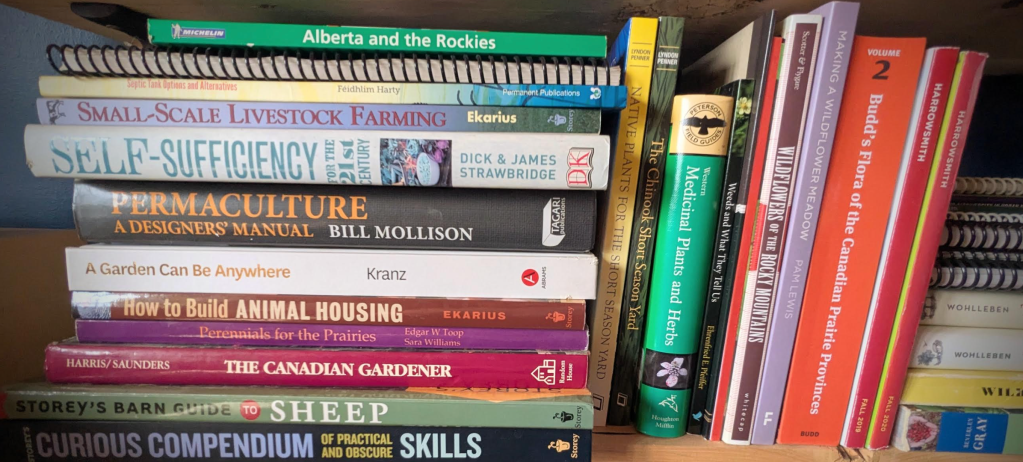
David Holmgren, one of the founders of permaculture, wrote,
“It is not the project but the living process that will be the measure of our actions.”
What we plan and intend — “the project” — is just one of the many possibilities to choose from. The “living process” is what actually happens and “the measure” is the standard of truth. Holmgren is pointing out something any terminally-married person comes to understand — time will not judge us only by our intentions. We will be judged by what actually happened — what it does in and to the world we and our fellow beings inhabit.
We can’t say, “Well, it works on paper.”
If what we’re doing has been shown — repeatedly — to cause harm, to increase instability, to demand more inputs or adds to human strain, it is unsustainable. It is untenable. It is unconscionable. Trying harder isn’t going to fix anything.
If the World Bank has to capacity to admit it was wrong, so do we. We must change our minds.
This is a Living post, a post to share my thought processes, my experience and the philosophy that underpins our activities here at the homestead. It is not a how-to, “expert advice” or meant to reflect a wider experience than just my own, on my farm, here with my sheep.


Leave a Reply