Recently, I got a message from a former mentor in the permaculture space I had approached looking for feedback on The Commons. What he had to say made me very – very! – angry. What did he say? And most importantly, how am I going to respond?
When I was building The Commons, I had a very clear vision in mind. I wanted the homestead’s website to feel like a community, an echo of Mohkinstis, the original name for the land that has become known as Calgary. I wanted The Commons to feel like a place, more than just some virtual territorial marking exercise or marketing effort.
Not Good At This
The hardest part for me as I built the website was — no surprise, I’m sure — the actual nuts-and-bolts of building the damn thing. I am not technical. My brother is a code person and for him, this kind of fiddling is second nature. He seems to have a natural skill in this department while I most definitely do not. The only way for me to work through all the incomprehensible bits-and-pieces of website building was to crack open ChatGPT and, with an abundance of screenshots and dumb questions, eventually The Commons started to take shape.
Once that was done, I could get down to business, my real raison d’être — writing.
If anyone asks me, I’ll tell them I have exactly one marketable skill — just one. It’s the only thing I’ve felt bulletproof about in my entire life — everything else is up for debate (though I do back a trailer pretty well, if I do say so myself) but I have always felt pretty confident that writing was mine to command.
Very Good At This
Now I’m not telling you this as a way to pat myself on the back — given the state of my trapezius muscles just at the moment, I couldn’t if I tried — but rather it’s a way to give you, dear reader, some idea of just how highly I value my capacity to write. It’s the one thing (the only thing as far as I can tell) about my own personal self that I will defend with every bit of my being. You can say what you want about my farming, my mothering, my personal hygiene and believe you me, I don’t give a rat’s ass.
But question my skills as a writer? I’ll have your eyes for that.
(O relax. I’m strictly non-violent. Mostly)
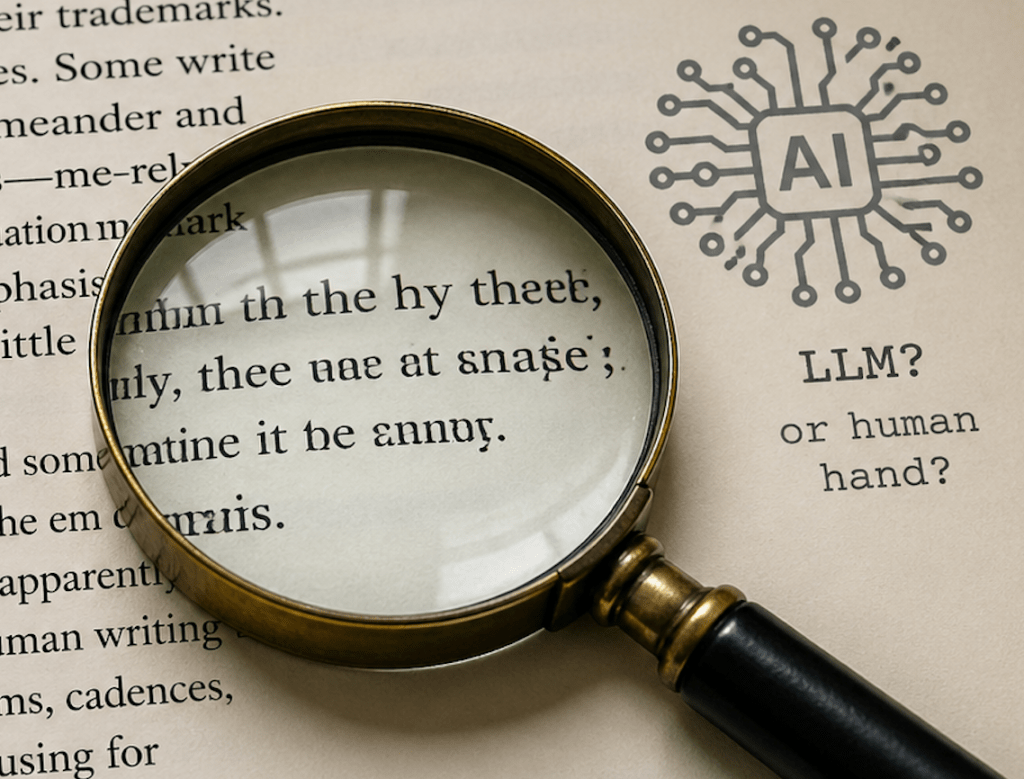
So when my erstwhile mentor came back to me, his words hit me a body blow. “You’ve clearly run all this through an LLM (Large Language Model — an AI writer in regular-people speak),” he said. “Look at the em dashes.”
He went on to say he hadn’t read anything else on the site. He didn’t visit the Keeping page with all its first-person sourced interviews, hadn’t read any of the content on the Writing page with samples of the work I’d done for paying freelance clients, some from well-before the advent of AI. He didn’t visit my Living or Tending pages where the sheer number of highly-functional em dashes would have really rattled his cage. He read the homepage and stopped there, delivered his views in a pithy little video message and washed his hands of me. He had charged, convicted and sentenced me and in his view, all that was left to do was to turn off the lights.
Not so fast, buck-o.
AI’s Poker Tell
Lately, much has been made of the use of the em dash as a “tell” for AI-generated writing. But is that fair? The em dash is, after all, a much-beloved punctuation mark, foundational for those among us who tend to write the way we think — a linear style of writing, I have not. What I have is a writing style — a voice — that jerks-and-jogs this way and that, as crooked as a dog’s hind leg. That’s the way my brain works and it all comes out my fingertips. The only way I can include all my tangents and digressions is with an em dash . . . also, ellipses. O!! And parentheses. I’m a fan of them all, they’re so much more fun than semicolons. Gawd. I hate semicolons.
Anyway, the em dash — a lavish deployment of my most-cherished em dash — had somehow tripped a wire in his permaculture brain and he was convinced that I had done all my writing with Artificial Intelligence and he told me so. Cue cranial fireworks.
All thanks to an em dash?
What Happened To Observation??
Now lest you think this is me being resistant to the Permaculture Principle “Accepting Feedback,” I assure you there’s something else going on here. Now that I’ve had some time to dampen the temper that quite threatened to swamp me — yes, this is me calm. Be afraid — I think the thing that disappoints me most about this exchange is that permaculture builds everything that follows on a discipline of observation. Keen observation skills are not just suggested, they are required. Observation, done well, requires time, attention and a willingness to go beyond first impressions, to hold off on interpretation and analysis. Observation, on its own, is the key skill.
It would seem that precious-little observational skill went into his assessment of my website.
That’s disappointing because even a cursory viewing of my other writing — and there is a lot of it now — would show that the em dash and I are intimate acquaintances. . . As Jane is to Bingley, so the em dash is to me. We have a long and fruitful history. We understand one another, the em dash and I.
Never Gonna Give You Up, Never Gonna Let You Down
So no, like others of the ink stain’d, I will NOT be giving up my em dash. (For more examples of writers defending their own em dash habits, here, here and here. Come at me, bro. I’ve got more.) If AI wants to fight me for it, I’ll go down swinging. This IS a hill I’m prepared to die on.
(I feel quite confident that AI isn’t going to come for me yet and if needed, I can call a couple of former editors who knew I used the em dash as a semicolon substitute and despaired of ever getting me to include that pernicious bit of punctuation in my copy. Phil, I know you’re reading this and twitching.)
But it did give me pause, once I got yet a little bit more calm. Maybe what I need here is a policy, like The New York Times. . . Maybe not so grand as that. Still, in the interests of transparency, how do I use AI in my writing?
So let’s get into it.
Artificial Intelligence On The Commons
All the content on The Commons is written by me. I love to write — it’s as necessary for me as breathing.
I write so I’ll know what I think.
That said, I do use AI for some very specific tasks, the same sorts of things that my beleaguered former editor used to do for me. I use AI to –
- outline — easily one of the biggest time sucks for brains like mine when building a story. Pulling together a cogent outline can be made a much quicker process if I blurt my headings to AI and it re-arranges them into a logical flow.
- editing – stoopid semicolons.
- fact-check support — ensuring I haven’t inadvertently opened myself to charges of slander and/or libel. I will occasionally fact-check myself via AI because in Canada, the number one defence against a charge of libel is the Truth. If it’s the Truth, you’re protected.
- challenging assumptions — I am always on the hunt for confirmation bias (I don’t always make the suggested changes for the simple fact that The Commons is not a news site and I’m allowed — nay, encouraged! — to have a point of view. It’s nice to know where bias may be lurking however — it can help me plan my response should I be challenged)
- research — this is THE big one. AI is much faster than I could ever hope to be when it comes to sourcing research materials — studies, interviews, archived materials, subject matter experts, peer-reviewed publications — and supporting documentation. Prior to AI, finding these materials could take days. With AI, I can find what I need usually within an hour or so. You’ll see that in my posts, most of my sources are included in the text as hyperlinks. You can read the sourced material yourself — it’s part of my commitment to transparency.
So yes. All the work you see here is my own. I stand by it. Yes, I write a lot. I also tend to write pretty fast. It is — presumably — why I’ve been paid to do it for so long. I use em dashes all. the. time. I hope you’ll join me in a keen appreciation for this handy little punctuation mark.
Thanks for being here — read (and write!) on!
AI Use & Editorial Policy
Providence Lane Homestead is a human-written (Hi!! It’s me!!) publication. Within the website, I use AI the way earlier generations of reporters would have used editors, research assistants (well-funded newsrooms are rare beasts these days) and colleagues — sometimes as sparring partners, sometimes to challenge assumptions, fact-check and expedite research.AI may assist in outlining, editing, or research support, but the observations, conclusions, lived experience, and final written voice are all me. Nothing gets published here without my fingerprints all over it — in review/revision and ultimate accountability. Any accolades? Mine all mine!! Any screw ups? Also mine.
Whatever insight or value that may come from the work itself – either for me in the writing or for my readers, that’s all down to the work itself — to the land, critters and a shared lived experience that shaped it.
Welcome to The Commons.
Final tally — 29 em dashes, nine sets of parentheses and two ellipses. And I barely broke a sweat.
This is a Living post, a post to share my thought processes, my experience and the philosophy that underpins our activities here at the homestead. It is not a how-to, “expert advice” or meant to reflect a wider experience than just my own, on my farm, here with my sheep.


Leave a Reply