Mentors are those folks who’ve already made the mistakes you’re thinking about making. The number of people I speak to who want mentors – but don’t want to listen to those same mentors – never fails to astonish me. So let’s talk about mentors. Do you really want a mentor? If you do, how do you get the most out of that relationship?
A mentor can be an advisor, a role model, or a coach and generally they help their mentee work through decisions, develop skills and build confidence. Mentors can be active and on-site and mentors can be remote and more like sounding boards. As in any healthy relationships, a mentor/mentee relationship is built on value alignment, trust, respect, communication and care.
Baby Steps
Probably one of the first sheep mentors I ever had was a much-younger shepherd named Niki. A fellow Ontario-to-Alberta transplant, Niki has forgotten more about sheep than I’m ever going to know. Unlike me, she grew up in this world and navigates it with the ease of a salmon returning to its ancestral waters. Me? I flounder and scramble and splash around generally making a huge mess and causing myself all kinds of extra anxiety. In my early days of shepherding, I pestered and poked and called and texted and waved my hands in the air. I am a huge proponent of the “squeaky wheel” theory and I squawked all over the place. Poor Niki.
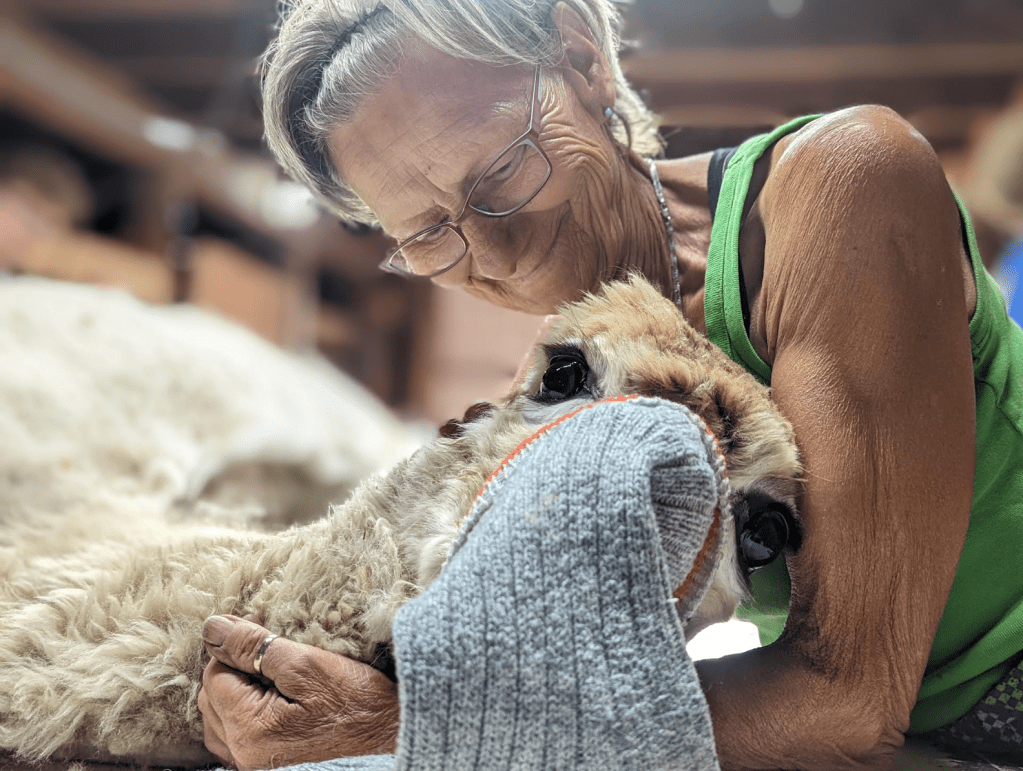
Then there was Barry and Shirley, my alpaca mentors extraordinaire (that’s Shirley up there in the photo comforting Freya Warrior Princess, Queen Of The Damned at Freya’s last shearing — that sock on Freya’s snout is for our protection, trust me. It was not in that condition when we removed it and without Shirley’s wisdom, I would have been covered in revolting alpaca gob). They have watched my progress with what I am sure has been belly-hugging laughter on occasion. I find alpacas to be. . . a not-at-all intuitive critter and am frequently mystified by their behaviours. I remember the very first message I sent was a photo of a placidly masticating alpaca with the caption, “Do alpacas chew cud??”
I knew nothing.
I was lucky. In both cases I was treated with far more patience and kindness than I had any right to expect. Without knowing anything at all about me, these lovely humans took a tremendous amount of time to answer my questions, provide insight and guidance and walked me through my early days as flerd steward. I am grateful to them every single day.
Now it’s important to note that not every lesson was comfortable. There were a couple that were really very difficult — difficult in the “Do I really want to do this?” kind of way. Which brings us to our first point.
What You Need
Honesty.
In order for a truly valuable mentor/mentee relationship to flourish, both sides need to be committed to honesty. For the mentee — the focus of our cheerful little post today – this means a very clear view of what you’re looking for. Do you want to learn? Do you want to avoid mistakes? Do you want to listen?
When looked at with bone-scraping honesty, often I find the answer to those questions is. . . “No.”
“What??” I can hear you spluttering. “Why would anyone go through the work of finding a mentor only to disregard the mentor’s guidance?” An excellent question!! One I often ask myself while observing people, particularly on the various message boards and social media platforms where these relationships have migrated. Still, after watching the back-and-forth debates, the justifications, the stung reactions to well-intended (and solicited) advice, the rebuttals and refusals, I think it’s true and I think I know why.
I believe it comes down to a pretty simple disconnect — people say they want mentors but what they really want is approval. They’re after affirmation. A “good job!” from someone with sufficient social media cachet to make that valuable in the community. It’s the opportunity to look good while not doing much at all to grow.
But this is a fundamental problem — it’s not a mentor’s job to approve. It’s a mentor’s job to compress the mentee’s timeline by shortening the learning curve, reducing avoidable mistakes and increasing competence faster than would be possible otherwise. Affirmation may happen but it’s more often incidental, particularly in the early stages.
Mentorship is borrowed pattern recognition.
In its most potent form, that’s what experience is: earned pattern recognition — often the hard (or expensive) way. It’s a mentor’s role to make that available to you, the mentee. You may not always like it.
Find Your Mentor: Wisdom AND Discernment
So let’s assume you have done a thorough personal inventory and have decided that yes, you really do want a mentor, not a cheering squad. How do you find one? Not all mentors are created equal, not every mentor is going to have the kind of experience you’ll find valuable, not every mentor will agree with your goals and values. So how do you take all the proffered wisdom and sort through it to find what’s going to be best for you?
First, screw social media. Seriously. If you’re wondering about someone with a lot of followers, a lot of gorgeous photos, remember to keep your gaze critical and your sceptical eyebrow raised. Yes, me too. Maybe even especially me too. Read through the comments on posts and see how they engage with people – obviously there are trolls but sometimes, commenters are not trolls but people with different experience and goals who are sharing them the best way they know how. How does your prospective mentor engage? Are they curious and respectful? Are they defensive or dismissive? Do they have clear boundaries, do they ghost?
I think that speaking to shearers, veterinarians, nutritionists, your provincial sheep association, ag colleges, extension services or fibre-arts guilds are great places to get connected with people who can point you in the right direction. Have some screening questions prepared, a quick summary of your situation and goals and be flexible. Be respectful of everyone’s time and get to the point. I suspect you’ll be amazed at the goodwill this engenders.
Never forget that mentors are most often doing this because they want new entrants to succeed – and they’re doing it for free. Do you know pretty well what you’re looking for? Do you want to work on their farm and see how it operates from the inside? Are you hoping to participate in Shearing Days or grazing practice? Do you want marketing or branding help? Perhaps just some Sheep 101? Are you content with text messages/emails and the occasional phone call or zoom? Are you trying to fill in a gap that your local veterinary landscape can’t? And just so everyone is coming at this with the same expectations, do give some thought to a timeline for how long you think you’ll be popping in and out of view.
Good mentors will teach principles, not just procedures.
Remember, not all experienced people are wise and not every kind of experience will be valuable to you. What you need is wisdom and alignment — of values and practice. That’s how you’ll get the most out of the relationship.
Don’t Do This
Now, having said all of that and assuming you’ve found yourself a mentor that’s got what you need, the one thing I don’t want you to do is ignore what they tell you. Even when it’s not presented in the most tactful way — remember, not everyone is blessed with elegant communication skills – your very first job is to keep your feelings in check.
When you’re challenged or when a flaw in your approach is pointed out to you, pull your horns in, dig up some humility and listen. Your first instinct may well be to defend or explain – don’t. Instead, ask questions and get curious. “What am I missing? What do you see that I’m not?”
Some experts are gentle and conciliatory. Some experts wouldn’t know gentle if it jumped up and bit them on the ass. Whatever the response, learn to separate tone from content and find value in feedback either way. Now obviously we’re not talking about browbeating abuse — that’s a different post and presumably you haven’t engaged with someone who envisions themselves as some kind of wooly cult leader. Hopefully that goes without saying. When you do put something in front of your mentor however, be very clear about what you’re looking for and equally open to whatever comes back.
And if you don’t really want an answer — if you’re just looking for a congratulatory pat on the noggin – don’t waste anyone’s time by asking the question. Sometimes you’ll lob out a half-baked query to the universe — or a crusty mentor — and they hit that sucker. Just sayin’.
Context!! Nuance!!!
There is no such thing as a “perfect fit” mentor. There are just better fits and worse ones. Your particular context — your soil, your climate, your setting, your sheep, your infrastructure, your ratio of currencies — is intensely personal. Don’t get upset if a mentor can’t relate exactly to what you’ve got going on but at the same time, don’t dismiss their experience if their reality isn’t identical to yours.
And above all, remember that no one is holding a gun to your head. If it’s not working, if the relationship has morphed into something you no longer feel comfortable being part of, if the mentee isn’t listening or the mentor isn’t available — if your circumstances have changed, then so can you.
Final Thoughts
There’s an old saying, “Advice is free and worth what you pay for it.” For mentors, remember that mentees are not asking for advice, they’re asking for your experience and feedback. Once upon a time, you too were a learner.
Maybe you remember the vulnerability that brought with it? Do your best to answer the questions they know how to ask as well as one or two you wish they would — the questions you wish you’d had answers to.
For a mentor, this is your chance to pass along wisdom gained over a lifetime of application, of trial and error, of costly mistakes and unexpected wins, of good planning and bad twists of fate, of glory days and trials by fire. A receptive and eager mentee is an opportunity to put all those hard days and good days to excellent use, to see those stories inform and encourage someone else on their way.
For mentees, a weathered and experienced mentor is an opportunity to develop the shorthand necessary for your chosen work in a condensed period of time. Mentors are your best chance to smooth out the bumps misfortune, misadventure and inexperience can so often throw in our way. So show up like it’s serious business — it is! Do your homework, be curious, don’t get defensive and listen. Above all, say thank you. This is your chance to get the perspective without the pain. A good mentor will gift you time, save you money, teach you skills and save you sleep. Priceless.
I hope you have as much good fortune as I did with mentors. I am grateful for every moment I get to spend with Barry and Shirley. They’re good people. The best of mentors . . . and friends.

This is a Tending post — a practical look at our tools, methods, routines, and on-the-ground decision-making. It’s not a one-size-fits-all how-to, and it isn’t meant to substitute for local knowledge or professional guidance. It’s just what we’ve found useful and what we’re doing here on our farm, in our conditions, with our sheep (and alpacas), written down plainly in case it helps. For more about why we do things the way we do them, the philosophy that informs our process, you’ll find those posts in Living.


Leave a Reply