There. I said it. The provinces of Alberta and Saskatchewan have been granted an emergency permit to use strychnine “to support integrated pest management of Richardson Ground Squirrels.” What can the public expect? What has been the process to this point? And given the rampant and indiscriminate killing power of the poison, are those procedures enough?
Please Note: Every few years, the conversation around Richardson Ground Squirrel control comes back around to strychnine. For generations, strychnine was a tool many crop farmers relied on. In this column, it is most definitely not my intention to go after farmers – past or present – who made use of a pesticide to deal with real losses. This isn’t about them, it’s about a tool and whether or not in the context of today’s agriculture, strychnine still has a place.
Introducing The Richardson Ground Squirrel
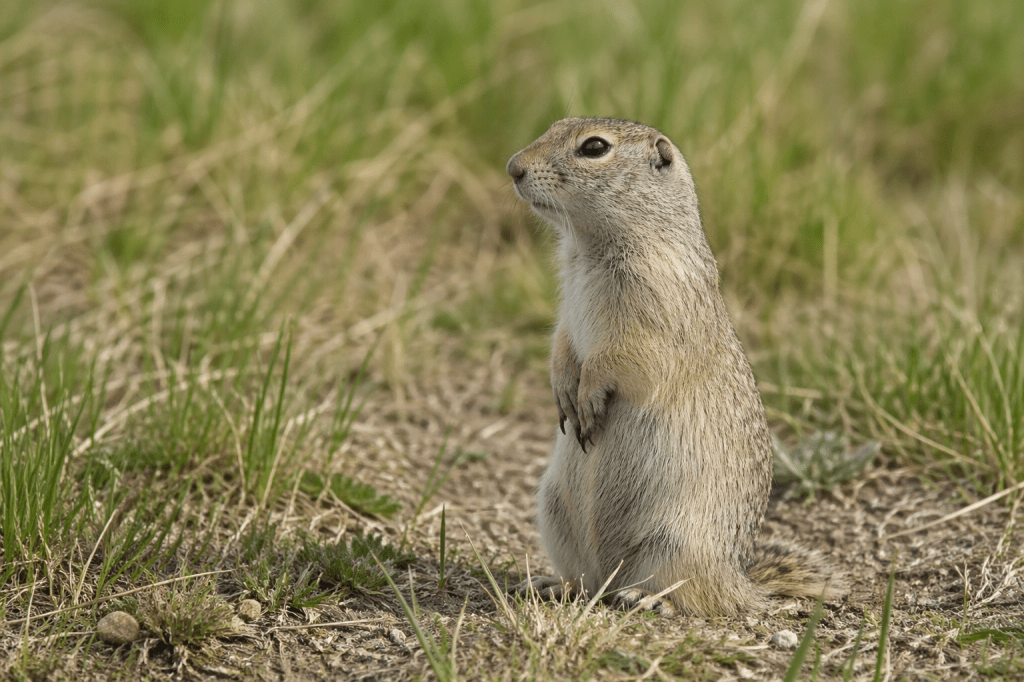
With their preference for open habitats – best to see death coming, I suppose — Richardson Ground Squirrels have been an active part of the prairie ecosystem for more than 10,000 years. For those who aren’t familiar with them, they’re about the same size as a red squirrel but lack that animal’s luxuriant tail. Intensely social, Ground Squirrels live in large underground community-and-family groups and hibernate for seven to eight months of the year. They are most active at dawn and dusk and, like their burrowing cousins prairie gophers, pocket gophers and voles, they are an important food source for predators like raptors, owls, coyotes, foxes and more.
The tunnelling behaviours of Ground Squirrels has benefits to the prairie – “Disturbances by burrowing mammals create a heterogeneous landscape that can provide suitable above- and below-ground habitat for numerous species, modify and promote water infiltration into soils, increase soil organic matter, enhance plant nitrogen uptake, and control woody vegetation (Benedict et al. 1996).” They are considered “ecosystem engineers” — like the beaver — and are keystone species because their impact far outstrips their itty-bitty physical status.
Which is where the Ground Squirrel runs into trouble. While their burrowing shapes landscapes in mixed and native prairies, they unfortunately haven’t confined themselves to those regions and are a common sight in grain fields and livestock pastures in western Canada. For prairie farmers, Ground Squirrels have become a major pest raiding cereal crops (barley, wheat etc), pulses (peas and lentils) and oilseed (canola). They are voracious in order to sustain fat reserves during their long hibernation periods and their holes can cause injury to livestock and infrastructure.
Since 1928 and until a ban in 2020 and a complete phase-out by 2024, Canadian farmers have been using a 2 per cent strychnine to control Richardson Ground Squirrel populations. Losses due to Ground Squirrel activity aren’t a matter of just a few dollars here and there — in some parts of Alberta, lost crops and acres tally into the millions of dollars.
Strychnine – What It Is, What It Does
Strychnine is derived from the plant, Strychnos nux-vomica, a native of southern Asia (India, Sri Lanka etc). It is bitter, odourless and incredibly potent — you only need a little bit to do a lot of damage. The toxin works by essentially causing the muscles in a body to go into a prolonged and intensely painful spasm leading eventually to cardiac and respiratory convulsions and death. Animals in the throes of strychnine poisoning arch their backs and extend their legs to grotesque angles. Symptoms of poisoning come generally within a few minutes of ingesting strychnine and death follows within an hour or two. Carcasses remain toxic after death which means secondary poisonings are a risk to scavengers.
No matter how you may feel about Richardson Ground Squirrels, strychnine is a terrible way to die.
. . . But Does It Work?
Yes.
Strychnine poisoning is almost always effective when ingested and untreated. For Ground Squirrels, strychnine was the preferred tool for many years because it worked well to wipe out colonies. But there is a proviso — and it’s significant.
The Montana Department of Agriculture notes that, “It is misguided to rely on population reduction alone to resolve conflicts with Richardson’s ground squirrels. If population reduction fails to remove at least 90 percent or greater, their reproduction rate will quickly restore the population in a season or two.” (Montana Department of Agriculture, “The Richardson Ground Squirrel, Its Biology and Control”, 2025)
So if you do manage to take out even the vast majority of the rodents, give them just a year or two and you’ll be right back where you started.
. . . Perfect.
Private Property, Public Consequences
The crux of the problem for many isn’t that they disagree with Ground Squirrel control efforts necessarily, it’s that strychnine in particular is a non-discriminatory tool — whatever eats it dies and whatever may come along and take an experimental nibble of a strychnine-poisoned body is ALSO at severe risk of a painful death. These associated and unintended deaths —accidental poisonings in official parlance — may include mice, coyotes, foxes, wolves, black bears, ravens and crows, endangered owls and birds of prey and pet cats and dogs.
On social media, those advocating for the use of strychnine often contend that dogs in particular shouldn’t be allowed to roam off-leash on private property. Controlled pets, goes the argument, will not encounter agricultural strychnine. Unfortunately, strychnine poisoning can take effect quickly but not always immediately. In some cases, animals may move from the site of exposure before collapsing, particularly if the dose is sublethal or ingested indirectly. That movement can carry risk beyond the original treatment area onto someone else’s property or public areas.
Simply put, this is not a poison that stays put. Which is at least part of the reason why it was banned.
It’s Baaa-aaaack. . .
So how did we get here? Why is strychnine back in the conversation? Why was the emergency application by Alberta and Saskatchewan — after initially being denied — approved?
Canada’s two largest grain-growing provinces reapplied for an emergency permit which was approved in March 0f 2026 and has been extended to November 2027. The provinces were under pressure by farmers and ranchers for help to deal with Ground Squirrel populations and the resulting financial losses.
While strychnine has been approved on a time-limited basis, inventory isn’t expected to be immediately on-hand for some time. I spoke to an Agricultural Services employee at my local county office who told me he didn’t expect there would be any strychnine in the area for months.
Pick A Side
Historically, strychnine was controlled both in its availability and its dispersal. Voluntary compliance was the norm and best practices were provided but with limited or no follow-up. As a result, officials acknowledged it was difficult to know where and how strychnine was actually used in the environment, that carcass clean-up and monitoring at scale was almost impossible and they weren’t certain if protocols were followed. Accidental poisonings were also likely very under-reported which left officials with no clear data of collateral damage — very literally – in the field. Certain myths remain — that the Ground Squirrels die underground or that they take the poison into their burrows to eat it, both proven false.
It’s important to point out that not all producers are happy about the approval. While some farmers and ranchers were upset about the strychnine ban, others were happy to see the poison removed from the environment and oppose its use. There are alternatives, ranging from chemical pesticides like Zinc Phosphide products as well as environmental controls including encouraging greater predation by providing owl and raptor habitats and managing grazing to discourage the establishment of colonies.
The debate may be framed as Farmers vs. Everybody Else but that’s an inaccurate and over-simplified take on the situation. We don’t have any public data on how many farmers are expected to use strychnine during the allocated period nor does anyone have a good idea about which parts of the provinces are most impacted. What this debate shows is that there is, even within agriculture itself, a diversity of opinion regarding strychnine and its use.
So How’s This Supposed To Work?
Honestly? As of writing, that’s a question that’s very much up-in-the-air. My handy county Agricultural officer gave me the verbal equivalent of a shrug and admitted that they’d found out about the strychnine allowance the same way the rest of us did — on the news. At this point, no one is entirely sure what the governance, approval, tracking, dispersal, certification (if any), field application, clean-up process or disposal is going to look like. We’re all just looking at each other with far more questions than answers.
So, in the absence of anything better to do while I stare at sheep backsides, I started thinking about how a system could be designed that would make strychnine the much-less-attractive pest control option. Join me as we wander back to our incentives drawing board.
Let’s think this through. If strychnine is going to be a temporary (and one might argue, long-term ineffective) tool for the control of a keystone species and environmental engineer that’s going to bounce back in record time anyway, what can we do to mitigate, as much as possible, the damage?
A Three-Pathway Model
What can we put in place to make strychnine as unattractive as it is ineffective? If it’s going to remain in the toolkit for even a limited amount of time, how can the system around it be set up to reflect the outsized scale of its impact? Farmers will tell you that for a little critter, Richardson Ground Squirrels do a lot of damage. Strychnine is the same — just a little tiny bit packs a wallop — so how can we reorganize agricultural policy to reflect a culture that has moved on from pesticidal carpet bombing?
1. Controlled use (with accountability)
- PID-linked — Premises Identification numbers can be assigned with each strychnine purchase. Producers already do this when they purchase dewormers. This would allow strychnine use to be tracked to each landowner’s unique number.
- mapped — strychnine use should be mapped with specific locations marked on publicly-available maps with provided, high-visiblity signage
- traceable — in a perfect world, each batch of strychnine would be traced to individual properties. Should an accidental poisoning or some other monitoring (drone? In-person inspections?) effort uncover a violation of the protocol, batches could be traced back to individual landowners for compensation.
- neighbour-aware — all neighbours within a set radius would need to be informed of strychnine use.
- auditable — batch or lot numbers would be recorded and then checked against any mapped locations as well as any strychnine returned at the end of the permit window.
2. Targeted compensation
Instead of a blanket permit, producers would be allowed to purchase a set amount of strychnine based on acres and proven/monitored Ground Squirrel populations. Strychnine dispensing would be capped according to a predetermined acreage total and limited to high-pressure zones. As well, crop insurance and the rebate programs currently offered in Alberta and Saskatchewan would be expanded but any claims would be capped up to a certain number of acres and would steeply decline for any acres above. This would have the happy benefit of encouraging producers to both carefully choose which acres to treat as well as provide them with meaningful support for some portion of their losses.
3. Conservation / land-use incentives
Rather than continuing to encourage the conversion of prairie into crop land, producers would be incentivized to convert crop land (with high Ground Squirrel populations) back to appropriately-managed pasture land. Incentives would take the form of a meaningful and long-term annual conservation payment. This could also include such things as improving and expanding predator habitat, implementing grazing practices that prioritize retaining grass growth and minimizing over-grazing (over-grazed grasslands are a prime location for a Ground Squirrel colony).
Farmers could also be incentivized in a similar way to adopt even higher levels of no-till and inter-cropping practices — particularly in dryland environments — which has been shown to have a dampening effect on Ground Squirrel populations.
Design principles
By making a few, carefully-considered and means-tested adjustments to some of the current programs available to producers, over time strychnine could become the less-preferred control option. Farmers are a practical bunch — if they’re given tools that work and supports to help see them bridge the transition, they will make the best stewardship choice available.
From the Fenceline
Yes, strychnine works to control Ground Squirrels, at least for a little while. Yes, farmers are experiencing real pain and loss thanks to these little stubby-tailed pasture bandits. However, while strychnine is effective, it’s also non-selective and can be difficult to contain with disastrous results. The question isn’t whether or not strychnine works and it isn’t about who’s right or who’s wrong.
The question in front of us is whether or not this particular tool is one that suits the agricultural sector as it is now. Is strychnine a good tool for Canada’s modern agriculture? It’s a tricky problem beset with not just ecological and economical interests but also emotional and, increasingly, political forces.
This isn’t about taking tools away.
It’s about making sure the tools we use match the realities we’re working within — economic, ecological, and social.
Wherever we land on this problem, I have faith in my fellow farmers. I truly believe that if they’re given options, they will choose the right and best one. Let’s give them a chance to do the work they love to do the best way with the best tools.
This is a Living post, a post to share my thought processes, my experience and the philosophy that underpins our activities here at the homestead. It is not a how-to, “expert advice” or meant to reflect a wider experience than just my own, on my farm, here with my sheep.


Leave a Reply