Economics is one thing, physics is another. . . What happens when both systems fail under pressure? Let’s take a closer look at Monette Farms – massive Canadian corporate mega-farm – and see what their current situation can tell us about precariousness, size and misalignment.
Let’s just be sure we get one thing worked out right away.
If anyone comes at you, clutching their pearls and moaning, “Agriculture is doomed!!” tell them to relax. What’s happening to Monette Farms is not a canary-in-the-coal mine scenario. It’s a Fezzik scenario.
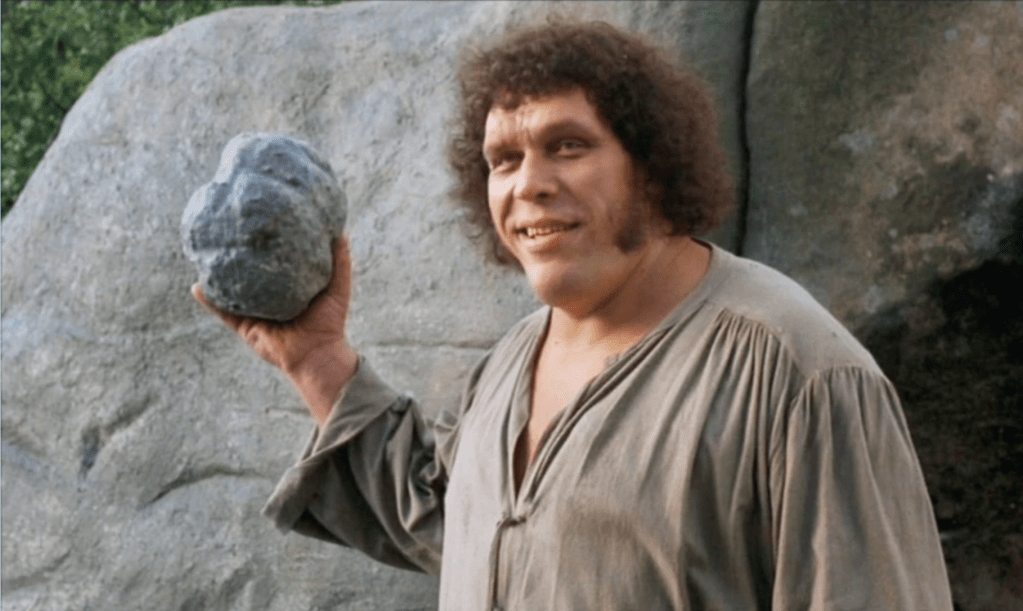
Inside the heart of every Gen X – and not a few Millennials – there is a small corner reserved for this movie, the pinnacle of cinematic perfection, “The Princess Bride.” I can have entire conversations using nothing but lines quoted from the script.
Andre the Giant played the lovable, not-at-all bad guy, Fezzik. In one of the film’s most memorable scenes, after single-handedly carrying Inigo, Vezzini and Buttercup up the Cliffs of Despair and smashing a boulder like an egg, Fezzik is brought low by the mysterious “Man In Black.” Fezzik, “the biggest and the strongest,” is defeated not by greater force, but by something smaller, faster, and more precise.
Monette Farms is a Fezzik.
Monette Farms is a gigantic land-holding operation: fleets of combines, hundreds of thousands of acres, employees by the score. They bought and sold and leased land the way I rearrange Tetris bricks. And as long as everything worked — if every moving part stayed aligned — it held together.
But systems like that don’t fail gradually, they fail when they meet their “Man In Black.” They don’t crash into a Waterloo, they’re infiltrated by a Wesley. And it turns out, Monette has met theirs.
Let’s break this down.
Who Is Monette Farms?
Monette Farms is NOT a “family farm but bigger.” Monette Farms operated more-or-less like a land-based conglomerate with holdings in both Canada and the United States. A large-scale grain and oil-seed producer, the company made their money growing and selling crops at scale — at a massive scale — and managing their yield per acre. Thanks to the hundreds of thousands of acres they owned, they leveraged this land against the purchase of additional land — land as collateral for money to buy more land. And so on, you get the idea.
If you peel back the layers, what Monette Farms really is (or was, depending on how this next chapter plays out) is a physical representation of a particular vision of farming. The company was symbolic of bigger means more efficient, scale means stability and professionalization means resilience. It all seemed to make perfect sense. . . Until April 21, 2026 when it filed for court protection. (Important Note: Monette Farms is not bankrupt and has not filed for receivership. It has filed for protection which is a way of buying itself some breathing room to sort out their problems without creditors calling in their loans or seizing assets).
Monette Farms was built to be big – and to get bigger.
The Biggest and The Strongest
When Fezzik stepped out from behind the rock, the Man In Black took one look at his opponent and gulped. You could see the mismatch, in his baggy pants and wide belt, his head as massive as a lion’s and a bouncing a boulder in his catcher’s mitt of a hand, Fezzik towered over the Man In Black. At first, the battle — “sportsmanlike, as God intended” — went very much the way you’d expect. The Man In Black hit Fezzik as hard as he could in the belly and Fezzik didn’t even flinch, “I want you to think you are doing well!”
Until the Man In Black got on Fezzik’s back and wrapped his arms around Fezzik’s throat.
The Man In Black didn’t have to take out the entire giant, he just had to apply pressure at precisely the right spot – or the wrong one, if you’re Fezzik.
Monette Farms had a throat — not physically but economically. It was wrapped up in things like fixed costs and a systems-wide adherence to scale and efficiency. They had debt payments, wages and infrastructure costs that did not change, did not take “the current economic circumstances into account” — lenders and investors generally want to get paid and employees expect a pay cheque, no exceptions.
In order to protect their throat, they’re trying to offload some of those leveraged acres though it’s not clear how successful they’ve been to this point.
Who Is Monette’s Man In Black?
The Man In Black isn’t like a colossal collapse. He’s not a subprime mortgage fiasco. The Man In Black is more like a single domino, knocked over at precisely the wrong/right time causing a cascade of reactions that gradually gets faster, bigger and more unpredictable. I don’t know what precipitated the initial domino — probably the only people who do are sitting in the Monette Farms boardroom — but I do know that at least some of the dominos on the table were well outside the company’s control. Things like weather, labour availability, international trade tariffs and market conditions. No one can make it rain, no one can convince another government to buy their canola when that government has an axe to grind with yours and no one can make people take jobs they’re not interested in — if Kevin wants to be a dentist, you’re going to have a hard time getting him into a combine.
However, for a company that was already managing financing cycles while continuing to borrow, leverage, expand, hire and operate for those acres, even a ripple in one of the non-controllables would have felt like an earthquake. This was a complicated system, each additional layer built on the stability of the previous one. It wasn’t built to be resilient —Monette’s designers built an efficient system, one with super-lean margins so as to best capture every drop of profit that might be available. Unfortunately, a single-minded devotion to efficiency at this scale brings with it an unfortunate side-effect — brittleness. A profound inability to absorb or adapt to change.
Just to be clear, this is not a “Big is Bad!!” screed. Size is NOT the enemy here – “big” didn’t make this happen. Fezzik isn’t a bad guy, not really. He did exactly what he’d been trained to do. It. . . just didn’t work out the way anyone expected.
There was an unexpected development, something no one planned for because no one saw it coming. Monette’s Man In Black could have been any number of things — interest rates, a legal ruling, timing or a land deal gone sour. The entire point of the Man In Black is to be mysterious. It could be anything.
Physics And Economics
And no, not all large corporate farms are fragile. That’s missing the point. The point, pigeons, is that it’s not the size of the operation, it’s whether or not that operation can adjust when the Man In Black shows up. Because, show up, he will.
Some systems stretch naturally – economics is one of them. We see economic systems stretch all kinds of ways — do you remember “Quantitative Easing?” HUGE government-mandated stretching!! Land values stretch or shrink, businesses expand or retract. All stretchy.
Physics though. . . physics doesn’t stretch. Load, interdependence, systemic weakness, compounding fragility — this is the physics of Monette Farms. And like pressure on a vulnerable airway, the physics of the operation is showing itself. Constriction reduces capacity, in lungs and bottom lines.
Andre The Giant played Fezzik with great panache and personality. He was — quite literally — one of only a handful of people who could have played the role. His physicality was an obvious match but even more, his humanity and his humour made him the ONLY person who could bring Rob Reiner’s vision to life. Andre was enormous — over seven feet tall, more than 500 pounds. No one would call him weak.
But the very thing that made him extraordinary also made him vulnerable. Over time, the strain on his body caught up with him.
He died at 46.
From the Fenceline
By itself, “big” isn’t inherently a risk. But big is risky, inherently.
“There’s no such thing as a free lunch” is one of the oldest ideas in economics – every gain comes with a cost, whether we recognize it or not. Physics adds something a lot less negotiable to the mix – every system has a limit, whether you can see it or not. Just because you don’t know exactly where it is doesn’t mean you won’t hit it — rather the opposite. The only variable is how much you’ll be surprised.
Monette didn’t fail because farming stopped working. That’s why we can say that Monette’s issues aren’t Big A-Agriculture’s issues, rather, they’re a symptom of some agricultural systems. No, Monette Farms was in court in Calgary today because a system built on continuous alignment ran into a boundary it couldn’t see. . . and couldn’t move.
Economics built it but physics set the limit. Very Sportsmanlike.
UPDATE: The Western Producer, in a story filed May 4, included details from the court-appointed monitor overseeing Monette Farm’s filing. It included this snappy little sentence, “Significant expansion, primarily funded from debt, has resulted in significant levels of indebtedness.” I do believe this qualifies as a “No Shit, Sherlock” level analysis.
This is a Living post, a post to share my thought processes, my experience and the philosophy that underpins our activities here at the homestead. It is not a how-to, “expert advice” or meant to reflect a wider experience than just my own, on my farm, here with my sheep.


Leave a Reply