I was recently at an Agritourism workshop hosted at the Cochrane Ranche House Stockmen’s Museum. As we sat surrounded by the assorted artifacts and talismans of earlier eras, we discussed what it would take to grow agritourism in our area — how we might facilitate the reconnection of people with place.
. . . And I started to get uncomfortable.
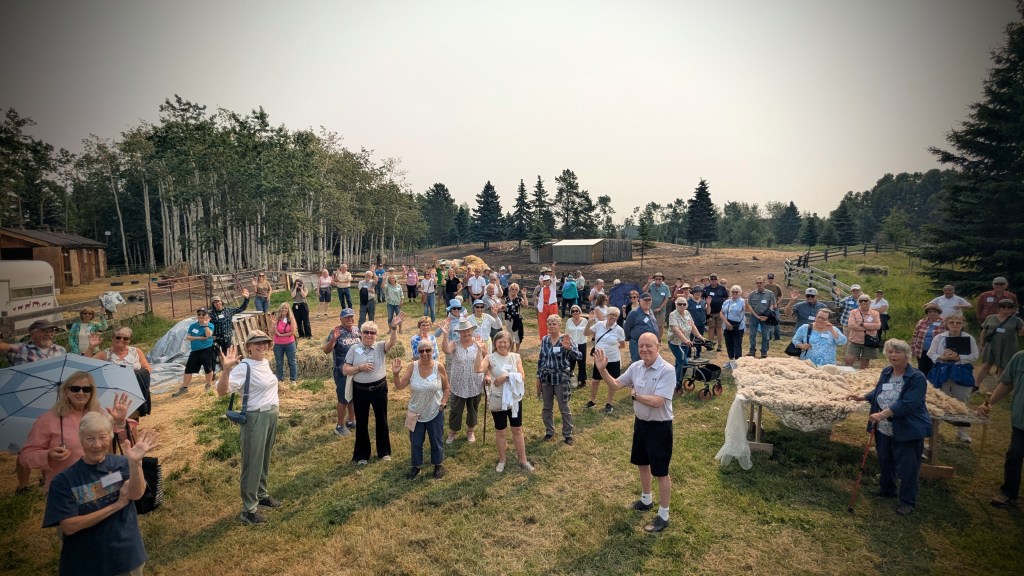
Our guests from the Rocky View Agricultural tour in 2026. Super fun and would definitely do again!
First, let me begin by saying that I’m an outsider here. I moved to the farm in 2015, after moving to Alberta in 2010. I have now lived here longer than I’ve ever lived anywhere else as an adult so I’m as close as I’m going to get to a lifer — I also don’t have any intention of going anywhere else so I’m about as invested as it’s possible to be.
But I have lived in a lot of other places. One of them was the Maritimes. I spent several years in both the Saint John and Kennebacasis river valleys and one thing I experienced repeatedly after introducing myself to my local community was a long, slow speculative look and then, “Tell me, what was your father’s name?”
This particular second-stage greeting was always intended as a way to place me in the world. No matter how often I smiled and said, “You don’t know him,” my inquisitor would always respond, “O, I may. I may. Now then, what was your father’s name?”
Howdy
Here in Alberta, there’s a variation on this although it usually is offered by the person introducing themselves — “Hello, my name is XYZ and I’m a fifth/fourth/third generation Albertan,” or maybe “Hello, I’m ABC and I’m a born-and-raised Albertan.”
How very curious.
As someone who has been away from home for a very long time, and someone who’s choosing to deeply root myself in a place that is manifestly not where I’m “from,” I find these kinds of statements bemusing. What exactly are we laying claim to? Belonging, obviously. But it begs the question — is belonging inherited. . . or cultivated? Am I — as a cultivator — less of an Albertan than someone who was born here?
When it comes to agritourism, this is more than a notional or esoteric concern. Done right, agritourism isn’t “agri-tainment” our hosts told us. We are all still actively farming, still engaged in agriculture as our day-to-day reality. Agritourism businesses are selling — in a very real way — connection. We are offering our guests a chance to be part of something. To come and see us and join us and be, perhaps for just a short time, a participant in our world. We want our visitors to share our experience, to cultivate value for the things we value, to appreciate the vistas and interactions and environment and lifestyle we appreciate. We want to showcase an authentic and genuine chance for people who come from somewhere else to slow down, sink roots and — as the kids say — vibe. This is what we’re selling, our facilitators told us. Without that authenticity piece, it’s Disneyland.
And with that, an elephant landed in the middle of the museum.
The Elephant We Need To Talk About
Alberta has a reputational issue when it comes to “welcome.” Particularly in rural Alberta, headlines and recent events have done a lot to throw buckets of cold water on the idea that this is a genuinely welcoming place to be. Contentious conversations around visible minorities, diversity and participation have not gone unnoticed. As all the inspiring and exciting slides flashed on the screen, eventually I got uncomfy enough that I put up my hand and asked the question I’d been trying not to ask, If we’re selling connection, authenticity and hospitality, how do we reconcile those promises with the reputation our communities have developed? What responsibility do we bear for closing that gap? And with that, my face turned a colour last seen on the sun and I couldn’t meet anyone’s eyes. I do awkward exceptionally well. It’s a gift.
But lest you think I’m alone on this, the conversation that immediately followed offered a perfect example.
One of the facilitators answered by telling a story about some potential interns from Ontario she had been expecting. One day she opened her email to find a note from one of the university students saying that after some recent headlines, they’d very nearly changed their minds. They weren’t sure they would be welcome in rural Alberta, “That’s redneck land!” The one thing that changed their minds was a careful reading of our facilitator’s website where they discovered, at the bottom of each page, a thoughtful land acknowledgement. That land acknowledgment affirmed for them that the headlines and the stereotypes weren’t — at least theoretically — uniform.
But it begs the question — can rural Alberta offer hospitality to potential visitors when our reputation suggests something very different?
The Work Of Welcome
As I contemplate a year ahead, I love opportunities to engage with people. The homestead is a place of true welcome and respite — at least, that’s how I’ve always seen it. Whether for Open Farm Days or our annual Shearing Day, we have opened our gates and shared hospitality with Ukrainians fleeing war, Syrians and Iranians trying to leave conflict behind them, immigrants from Rwanda, Nigeria and Zambia, buckets of Brits (I think they travel in packs), German and Dutch guests and a slew of folks from other parts of Canada. I have heard accents that whipped my head around and, when I heard they were from New Brunswick, I immediately asked “And what was your father’s name??” I didn’t know him but it was still fun.
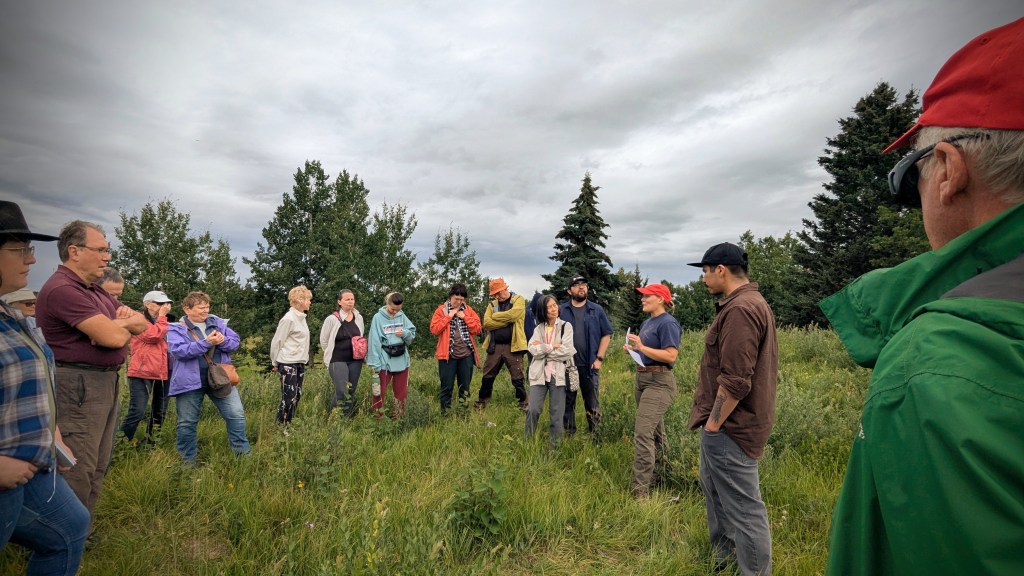
Archaeologist Sam Judson with Siksika member Brendan Many Bears, lead a tour of a recent dig on the homestead during Open Farm Days, 2025. Together, Sam and Brendan were able to provide a wonderfully nuanced picture of the history of the land here for our guests.
One of the things we like to highlight here is our historic connections. At an Ag-Tour put on by Rocky View County, we welcomed 200 guests and I had a chance to tell them about our home, ordered from a catalogue, flat-packed, brought out to the prairies on a train and assembled in 1910. I shared about our time with the wonderful Dr. Lindsay Amundsen-Meyer and her bendy archaeology students (you’ll be able to read a lot more about that adventure in my book). History is a huge part of my love for this place — the sheep story in this part of Alberta is deep, nevermind the emphasis on cow culture, “bovine propaganda” I call it.
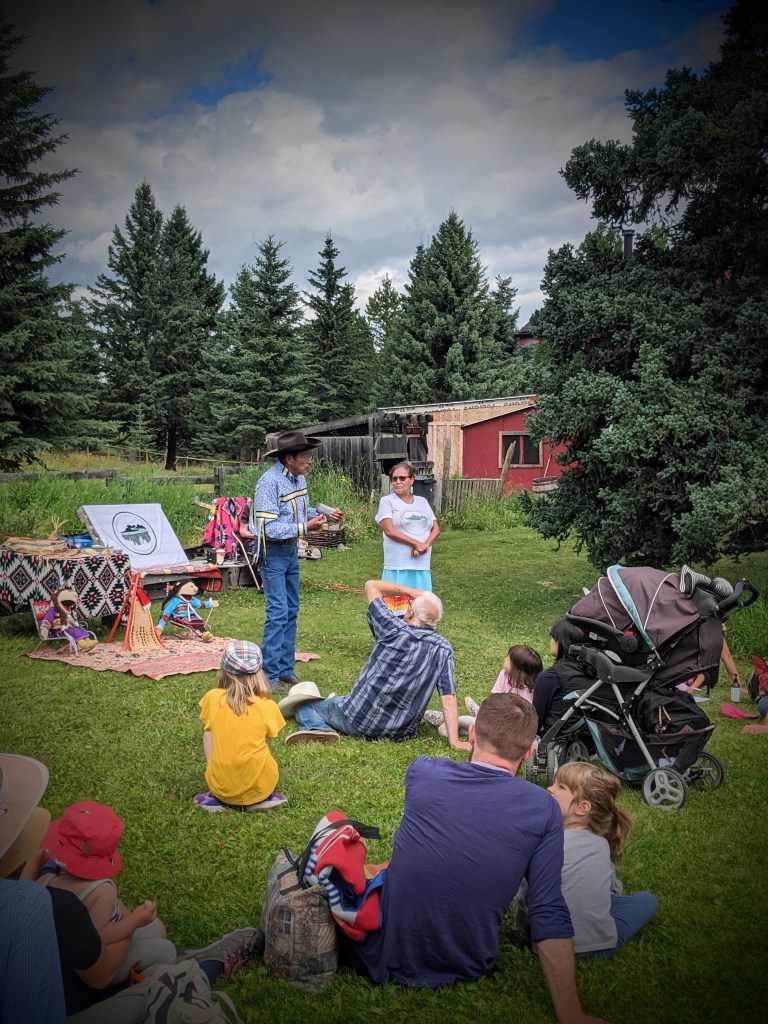
It’s wonderful to share these stories myself but it’s even better when I can step away and someone else takes their rightful place.
Whenever we can, we invite our Indigenous community partners to directly engage in the work of storytelling and, as they choose and as seems best to them, the work of reconciliation. Being part of the “public” on those occasions is always fulfilling, hearing those stories is a privilege.
(l) Bryan Little Chief and Alanna Many Bears sharing Blackfoot creation stories.
The Truth, The Whole Truth, And Nothing But
Storytelling, whether it’s me or someone else, is one of the best ways humans have of bringing others into our world, letting them share in our experience. The words, “Once upon a time” can cast a spell. But in our modern world of unending communication, we must be on our guard against a very particular kind of sleight-of-hand trickery — there is a temptation to swap nostalgia for truth. It can masquerade as “the good old days,” or “tradition.” But if authenticity is the value, nostalgia is the poison.
Let’s consider, just for a second, the famous Alberta cowboy John Ware. For many years, his exploits as a rancher, a consummate horseman and a pillar of the community — a true rags-to-riches kind of story — have been shared across so many platforms, from films to novels to children’s books to historic place cards. It is, after all, a great story.
But we cannot celebrate John Ware’s achievements while quietly setting aside the racism he and his family contended with. His accomplishments are all the more remarkable because of the obstacles they faced, obstacles imposed by the very society that now claims him as one of its great historical figures. To celebrate his success while obscuring that struggle is not merely to tell an incomplete story. It is to appropriate his achievements for our own comfort, to make his life a testament to Alberta’s greatness while diminishing the experiences of the man, his family and his community. We cannot claim the glory of his accomplishments while refusing to reckon with the injustices he endured. That isn’t heritage, that’s historical erasure.
Likewise, celebrating multi-generation ranches without also acknowledging how the land came to be part of their holdings, the dispossession and in some cases, outright theft that allowed those names to be on those titles does a disservice to this place we so want to share. Including these stories, as ugly and as uncomfortable as they are, is the only way to truly be authentic. To allow the voices of those who have been wounded by the past to speak in our present, to tell the truth about this place we call home, is the only way to offer something real.
Roots And Relationships
One of the words I heard most often during our afternoon was “rootedness.” The idea was to share our sense of roots with our guests, to offer them an experience that would allow them to find their own sense of rootedness in this most remarkable place. But roots do more than anchor — roots also sustain. Roots connect a plant to its surroundings. Roots draw nourishment and roots allow a plant’s influence to spread. A plant’s entire relationship to its environment largely happens underground, far from prying eyes, in the root.
At the start of this post, I wondered whether or not roots had to be inherited. . . Could they be cultivated? Does it matter if I’m a relative newcomer, recently washed up on these foothills? Well, Nature would suggest roots must be cultivated. Certainly there are some who find themselves born to the land and work they love. For others of us, it’s a discovery, something we feel our way along, gradually testing, one relationship at a time. Perhaps that rootedness we’re so keen to share has less to do with a happy accident of birth and more to do with the work we’re willing to do to cultivate those connections.
And for agritourism, roots should mean those relationships are based on a clear-eyed acknowledgement of what’s come before, that what we’re about is not a straight line. There’s no easy way through this, a point another of our facilitators was quick to point out. When it comes to managing through the tricky waters of rural Alberta’s . . . challenging reputation, the only way is one step at a time, day after day, consistently.
From The Fenceline
I’m not a big New Year’s Resolutions kinda girl. A number of years ago, Alberta author and horsewoman Lee McLean suggested choosing just one word to hold as a beacon for the year ahead. I really loved that idea and it’s become my reflection every time December rolls around. In 2026, the word I chose was “Fidelity.” I wanted to be true to the values I say I’ve got. . . I call it “No daylight.” I want my values and my character to be so closely aligned that there’s not even a sliver of space for a squeak of daylight to slip through. I’m not there yet — it’ll be the work of a lifetime — but that’s the goal. There is work to do, honest stories to tell, welcome to extend, genuine hospitality to offer, community to build, authentic roots to set.
When it comes to Agritourism’s future in Alberta, I have one question to ask. How can we expect visitors to our province to believe in the place we’re advertising unless we’re willing to do the work of becoming that place? If we’re selling connection, adventure, authenticity, welcome, hospitality, opportunity, a one-of-a-kind/can’t-find-it-anywhere-else experience, we need to embody those values in our own communities. Authenticity, like charity, starts at home.
Alberta is an incredible place. I’ve chosen to make it my home after years living a highly-nomadic and unsettled life. I found my place here at the homestead and sharing this remarkable patch with guests almost feels like a vocation. I’m not interested in a theme park experience, I don’t want to Disney what I do. When anyone comes here with an open mind and an open heart, I want to meet them where they are with a mind and a heart to match.
We have to be willing to have the hard conversations along with the wide-open vistas. We have to be willing to do the painful work of reconciliation along with the celebration of community. We have to acknowledge the truth that brought us here before we can ever truly share the wonder and the joy of our world.
This is the work before us. One step at a time, from the roots up.
For more resources or to read further about some of the wonderful initiatives doing great work —
- Treaty Land Sharing Network
- Indigenous Tourism — A Ranch Experience That Connects To Blackfoot Culture
- Amber Valley Cultural Centre
- Painted Warriors
- Adesco Western Ranch
These are just a few of the agritoursim or agri-adjacent tourism operations available. I haven’t been to all of these or connected with everyone on this list personally so please do your due diligence!


Leave a Reply