We have gotten so much better at talking about mental health in agriculture. However, when I look at the stories in my own family, I know some important people are missing. It’s time they got a seat at this table.

I talk a lot here on The Commons about reading land. About reading my animals and understanding – as best as I possibly can – how the different overlapping worlds of land stewardship and animal care impact and feed into and off of each other.
Today I want to talk about something different – I want to talk to you today about reading people.
Let me start by telling you a story.
A Gathering Storm
When my grandfather Harold was a small boy, about 8 or so years old, his father John was running a small mixed farm on one of the gravel backroad concessions near Mount Forest, Ontario. Harold’s mother Christina was bedridden and the double-whammy of year-after-year declining income along with Christina’s escalating medical bills drew a noose tighter and tighter around John. And then, one horrifying day, John found a premature calf laid out in the barn. Aborted.
Now if you come from a dairy background – or if you have any familiarity with livestock farming in general – you may have heard of Brucellosis. In the old days it was called Bang’s Disease. While one or two miscarriages is perhaps not uncommon in any herd or flock, Brucellosis is far more serious – it’s a bacteria that causes abortion (miscarriage), is virulently contagious and is easily transmitted to humans through direct contact with an infected animal or via consumption of an infected animal’s unpasteurized milk or meat. In the 1920s, there was no antibiotic treatment for the disease, the only way to manage it was to control it – widespread culling, burning the carcasses and then scrubbing the entire barn down with lime. Brucellosis meant ruin.
And unfortunately for John Ghent, Brucellosis had come for his herd.
New Words For Old Trouble
I don’t know how Brucellosis got into the herd – maybe it came from a new cow purchased and brought into the barn without quarantine. Maybe it came in on the boots of a visitor or on the tires of the dairy truck picking up John’s milk cans. I don’t know but I do know from Grandpa that his father John – my great-grandfather – did “not handle it well.”
I’m not sure what that means. I have a good idea but I can’t be certain. However John coped – or didn’t – with the challenge, that’s as far as the discussion ever went. My elderly Grandfather staring at the thick, scarred hands knotted in his lap, his eyebrows pinched low on his forehead, would never go any further than “He didn’t handle it well.”
Nowadays, we’re far more likely to talk about farmer mental health, about burnout and stress, anxiety and depression than Grandpa ever could. We’re much more comfortable – if such a word can be used – with a vocabulary that would have, I think, flummoxed Harold. And while that’s an improvement to be sure, I have to wonder if we’re not missing something.
Or perhaps, someone.
The Silent Kitchen
What happens in actual farming families when one member is struggling? Have we left the conversation at 30,000 feet? We tell farmers “If you need help, call this hotline.” There, that’ll solve it.
While having hotlines is so much better than isolation, shame and guilt, I don’t think we can afford to leave the discussion around mental health there. We can’t pat ourselves on the backs and tell ourselves what a good job we’re doing. For an industry that prides itself on reading the land, it’s time we turned some of those same skills on our community because poor mental health doesn’t stay between one human’s ears. It spreads. It seeps and trickles outward across the farm – as real as the wind, or drought or rainfall – until everyone around them is carrying it too.
If you’ve never had to live with someone struggling, you may not know how insidiously it shapes the lay of the land. How it becomes the very air one breathes. Whether it’s a parent, partner or child, keeping close quarters with someone in a mental health crisis – whether its loud and in your face or quiet and submerged – is a kind of pressure cooker I wouldn’t wish on anyone.
Perhaps you notice that Dad has become more reactive, inclined to yell when he didn’t used to. Maybe Mom is withdrawn, harder to engage. Perhaps he’s out on the tractor way before the rest of the household is moving and doesn’t come in until the very last possible moment – it’s just so much easier to be outside. Maybe she’s avoiding friends and no longer enjoying the things that once mattered so much. Maybe you find yourself muttering, “That’s just how Dad is,” to friends when they drop by and inadvertently witness an explosion.
Perhaps there’s hopelessness, or suspicion in the home. A sense of having to walk on eggshells, you navigate around one person’s emotional landscape as though they were a bomb requiring excessively careful handling. When you ask questions, you’re met with highly emotional responses that seem way more intense than the situation called for.
Things are different – you’ve noticed. It didn’t happen all at once but when you think back, you know that a year ago, the farm felt like a very different place.
Or perhaps you’ve noticed other more concrete changes – gates left open that never would have been. Bills that have gone unpaid. Unusual risk taking and more accidents. Maybe you’ve walked into the workshop and seen a level of chaos that is nothing like the meticulously-ordered bench you remember. Maybe you notice he shouldn’t drive after a certain hour. Every night.
Maybe your sister stays after dinner more often and for longer.
Maybe Junior slips into the equipment yard and checks the gear before it goes out to the field for the day.
Maybe Dad is heading down the road to “check in” on the neighbour’s cows or the hired help quietly comes along and “tidies up”.
Maybe at dinner time, no one is talking, everyone is concentrating on their plates and it feels like there’s a brooding presence at the table, an ominous cloud that could unleash at any time. Everyone tucks their elbows in and chews with the kind of concentration usually seen in operating rooms.
Throw A Wider Net
We notice. It’s what a good farmer does. We notice when a ewe hangs back, when something feels off with a cow, even when we can’t quite put our finger on it. We can see the small shifts in weather, we hear the rolling wind before we feel it, we smell the rain before it falls.
We clock a different tone of voice, we register the swinging gate.
We notice a kitchen grown quiet.
In many cases in Canada, organizations, studies and awareness campaigns still use “the farmer” as the focus for a mental health conversation. It’s “the farmer” we reach out to – often with the assumption that the farmer is male, white and middle-aged. Our helplines and resources are aimed at him. As of yet, we don’t talk about how one person’s illness changes the entire ecosystem of the farm – the constellations of beings who live and work and love there. We aren’t talking to the people around the farmer, the ones who’ve picked up the slack, who are watching with concern, who are dodging the storms or smoothing the waters. We aren’t reaching out to those who don’t know how to help, who may not even be able to tell us what’s wrong. They just know something is off.
While we have made real progress in talking about farmer mental health, perhaps the next step is recognizing that these struggles don’t belong to one person, they belong to the family trying to understand what’s changed. It belongs to the neighbour who has noticed something isn’t quite right. It belongs to the daughter quietly paying the bills, the son checking the machinery, the spouse carrying conversations that used to be shared.
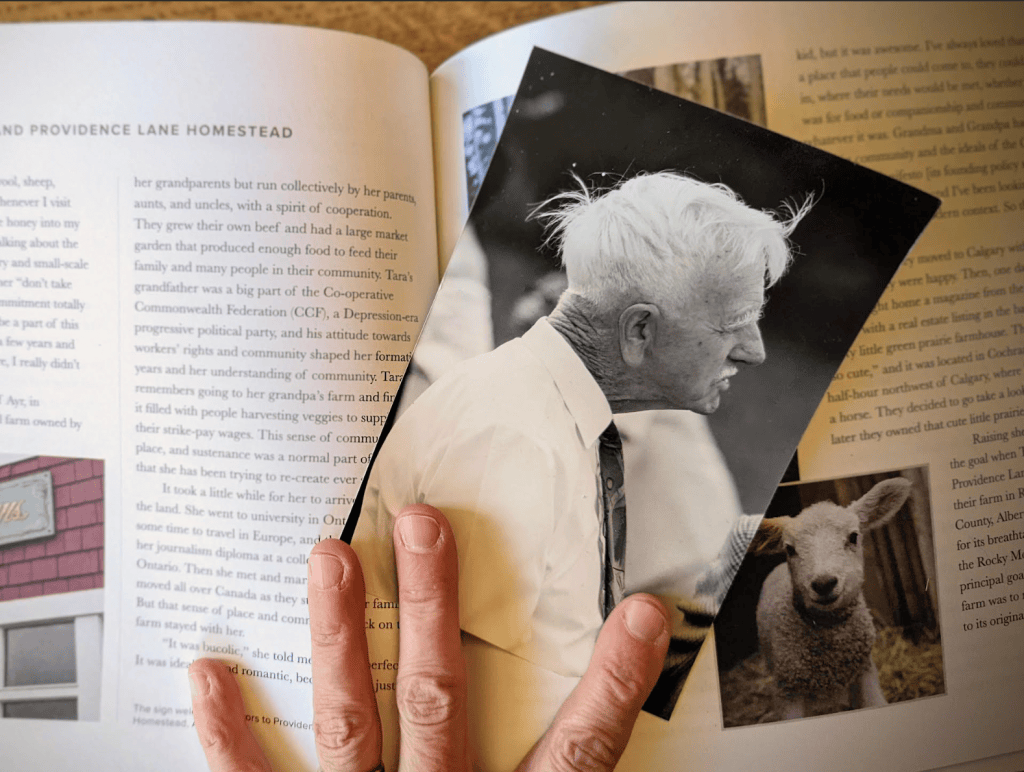
When Grandpa spoke about his father, he didn’t tell me about anxiety or depression. He didn’t have those words. He simply said, “He didn’t handle it well.”
I’ve been to John’s farm, the old house with its yellow brick and long, rutted driveway. I can picture in my mind the kitchen windows that looked out on to the fields behind, the barn just a little to one side, a heap of greyed-out boards with ladders that soared up and away to the shadowed roof. I find myself wondering about everyone else who lived there, then. I wonder how they all moved around the house and yard, how they got through their days’ work.
Most of all, I wonder about eight-year-old Harold.
In the intervening years since Grandpa first told me that story, we have learned to see John, to talk to and about John. We have become much more comfortable with his story.
It’s time we started talking to Christina and Harold, too.
This is a Living post, a post to share my thought processes, my experience and the philosophy that underpins our activities here at the homestead. It is not a how-to, “expert advice” or meant to reflect a wider experience than just my own, on my farm, here with my sheep.


Leave a Reply