Bill 22 is now law. While I’m still supportive of the update to Alberta’s Animal Welfare and Protection legislation, a critical piece of the puzzle is mi$$ing.

Back in April, when Alberta first introduced its long-overdue overhaul of the Animal Protection Act, I wrote about what the proposed changes might mean for farmers and animals.
At the time, I thought Bill 22 was, broadly, good legislation. I still think that. The new law expands what counts as animal distress, gives officers more tools to intervene before a bad situation becomes a catastrophe, strengthens bans and prohibition orders and enforces them across provincial lines, increases inspection powers and raises maximum fines for violations from $20,000 to $250,000.
Excellent.
But when I first wrote about the (then proposed) law, there was a problem.
Bill 22 had a lot of scary-looking teeth but no more eyeballs, no more hands and, as far as I could tell, no more money.
And here we are. It’s July. Calgary is awash in denim, politicians are swaggering through Stampede grounds flipping pancakes and Bill 22 has passed. And while Alberta is busy putting on its hat and boots and reminding the world that this is cattle country, I think it is worth asking a very simple question.
Where’s the money? Where’s the muscle?
Lawyers, Guns and Money
With apologies to Warren Zevon, that is the whole thing, really.
Lemme put it to you like this. If the Province of Alberta decides something should be illegal, doesn’t it seem logical that the Province of Alberta has the responsibility to make sure the law can be enforced?
Not theoretically, not when a charity has a particularly successful fundraising campaign, not when an officer happens to be available. The province — Alberta — made the law. The province — Alberta — needs to fund the human beings required to enforce the law. Period.
Frankly, this shouldn’t be a radical position.
Laws are not self-executing. They don’t climb into the truck, drive three hours down a gravel road, inspect the herd, issue an order, return to check compliance, gather evidence, arrange veterinary care, monitor a prohibition order or prepare a case for court.
That takes people. It takes real boots on the ground, not AI surveillance, not a data centre. Humans.
The new law does not merely increase fines. It creates new and expands existing mechanisms for corrective action orders, follow-up inspections, compliance monitoring and enforcement of prohibition orders, including orders issued elsewhere in Canada.
Those are good tools but they’re also WORK. A corrective action that sits in someone’s inbox for weeks on end is just a piece of paper — it might as well line the bird cage. A prohibition order that nobody can monitor is just a piece of paper — might as well use it for the grocery list.
A $250,000 maximum fine is a piece of paper until a case travels all the way from complaint to investigation to evidence to prosecution to conviction.
There is a distance between passing a law and protecting an animal.
That distance is measured in people, hours and kilometres.
He Who Has The Gold. . .
Across most of Alberta, enforcement of the provincial Animal Protection Act falls to the Alberta SPCA, a registered charity.
The SPCA receives government funding for some of its enforcement work, but says approximately 80 per cent of its overall funding comes from donors. Does that seem right to you? Albertans would find it a mite peculiar if enforcement of workplace safety legislation depended primarily on bottle drives, bake sales or raffle tickets. If our provincial government passed environmental rules and then told inspectors to hope people felt generous, we’d think that was bananas.
We do not generally expect citizens to make a donation before the machinery of provincial law can function. Why should Animal Welfare be any different?
Now, just so I’m crystal clear, this is not a criticism of the Alberta SPCA. Quite the opposite. Charitable giving has an important place in animal welfare. Donations can fund education, prevention, emergency assistance, public engagement and work the reaches beyond the minimum obligations of government.
But enforcing provincial law is not an optional charitable extra.
If Alberta creates the offence, Alberta owns the obligation to enforce it.
It’s Not Always Just Animals
I wrote recently about the particular barriers facing rural women trying to leave violent relationships. Some of those barriers are obvious — distance, isolation, money, housing, children and the peak risk period for women just after leaving.
But then, there are the animals. After I wrote that initial post, I received stories from women detailing their experiences — of being dragged out to the pasture where their partner fired shots over the heads of beloved horses, of being barricaded in the basement of their rural homes, unable to leave for weeks at a time. Of being cut off from the financial resources needed to pay for feed or veterinary care for heritage breed cattle. Of working stock dogs beaten to death in front of them.
For a rural woman, “just leave” may mean leaving behind not only a dog or a cat but also horses, sheep, cattle, poultry — animals she may have raised, animals she may be financially responsible for and animals she has every reason to believe could be neglected, sold, harmed or used against her after she is gone.
The Alberta SPCA knows this.
In fact, some of the most important research into the relationship between domestic violence and animals in rural Alberta was commissioned by the Alberta SPCA. Its 2012 study, Inside the Cruelty Connection: The Role of Animals in Decision-Making by Domestic Violence Victims in Rural Alberta, drew on responses from almost 300 women and examined the role animals played in decisions about seeking help and leaving violent relationships.
The Alberta SPCA now operates a Pet Safekeeping Program specifically intended to help people affected by family violence leave abusive situations by providing temporary care for their pets while they enter safe shelter. In 2025, that program supported 29 clients and cared for 62 pets, with animals spending an average of 47 days in care.
That is animal welfare work. . . But it is also public-safety work.
It’s time we acknowledge that animal protection officers are part of a much larger rural safety network. The Alberta SPCA itself recognizes that animal welfare and human welfare do not exist in separate worlds. Its One Family Welfare department was created to help fill what the organization calls “the gap between human services and animal services,” including through work with people affected by family violence, homelessness and physical or mental-health emergencies.
Now, I don’t have the data to say how often an Alberta animal protection officer is the first professional to see evidence that something is badly wrong inside a rural family. That’s just one of the many things I don’t know. Whether it happens a lot, a little or somewhere between, it’s still structurally a possibility that matters. In an isolated rural farming or ranching home, the first person through the gate may not be a social worker or a shelter employee. It might not even be the police — it might be an SPCA officer because someone called with a concern about the livestock.
And if that officer has the time, training, institutional connections and resources to recognize that the animal standing in front of them may not be the only living being on that property in danger, then animal protection capacity has suddenly become something much larger than most of us imagine when we hear the words SPCA.
And this is NOT a theoretical concern. We already know concern for animals can delay women from seeking help or leaving violent relationships. We already know the Alberta SPCA operates a program intended to remove that barrier. We already know animal welfare and human welfare can arrive tangled together in the same file.
So when we underfund animal protection — when we rely on charitable donations to fund the gap — we may not only be making it harder to reach an animal, we may be weakening one of the threads in the net that catches vulnerable people, too.
Are you telling me we can afford to lose them?
Big Numbers
In 2025, the Alberta SPCA reported 2,940 investigations involving 16,532 animals.

Nearly three thousand investigations and more than sixteen thousand animals. The species numbers tell us something important about where a very large share of this work sits — 3,281 cattle, 3,079 sheep and goats, 2,059 ducks and geese, 1,726 horses and donkeys, 856 chickens and turkeys, 818 pigs, 450 elk and deer and 13 llamas and alpacas.
Using the Alberta SPCA’s own published categories, approximately 64 per cent of all animals investigated were farmed or agricultural animals. Include horses and donkeys in the large-animal workload and the figure rises to roughly 74 per cent.
Those percentages are my calculations from the Alberta SPCA’s published species totals; they are not percentages published by the organization itself.
Now, that does not mean 74 per cent of investigations were livestock investigations and that’s a distinction that matters. One dog complaint may involve just one dog but one cattle complaint might include 300 animals. Animal numbers don’t tell us how many files there were, how complicated they were, how many other agencies got involved or how long it took for that file to be resolved.
Which brings me to the next problem.
Missing Numbers
The Alberta SPCA’s public reporting tells us enough to know the workload is substantial but it doesn’t tell us enough to know what the workload requires.
We know there were almost 3000 investigations, we know how many animals were involved and we know — broadly — how many of those animals belonged to which species but we don’t know where in this enormous province they were located, we don’t know how far the officers had to drive or how long it took them to respond or whether it required multiple visits. I can’t tell you how many corrective action orders were issued, how many follow-up inspections were scheduled, or how many hours it takes to investigate one large herd compared to a companion animal.
I can’t tell you how many Alberta-origin prohibition orders are currently being monitored nor how many out-of-province orders are on the agency’s dockets.
I can’t tell you how much all of this costs.
The Gap
And, with the acknowledgment of the overlap between animal welfare and human safety, there are other questions. Like, how often do SPCA officers encounter rural/farming/ranching families in the throes of violence? How often are referrals made to human-service agencies? Or the reverse — how often do human-service agencies refer people to the SPCA?
How many rural women are unable to use the Pet Safekeeping Program because their animals are livestock rather than pets?
What happens to a woman who can find somewhere safe for her dog but not her horses? From the information publicly available, we don’t know and that, pigeons, is not just a transparency problem, it’s a FUNDING problem.
How do you know how many officers Alberta needs if you don’t know how much work those officers are doing?
You can’t. How do you know where to put them? How can you plan the kinds of training they may need? How do you know if response times are acceptable? How do you know if a stronger law is producing better outcomes. . . Or just a longer queue?
How do you know what the new law will cost?
Big numbers are good for annual reports but specific numbers are what you need to plan a system.
Cowboy UP.
This is Stampede week and just as every year since 1912, Alberta has put on her hat and pulled on her boots. The red-and-white branded flags are on every street light, the livestock trailers are lined up in the parking lots and the decorated street sweepers have followed all the horses and cows down 9th avenue doing, it must be said, the Lord’s work.
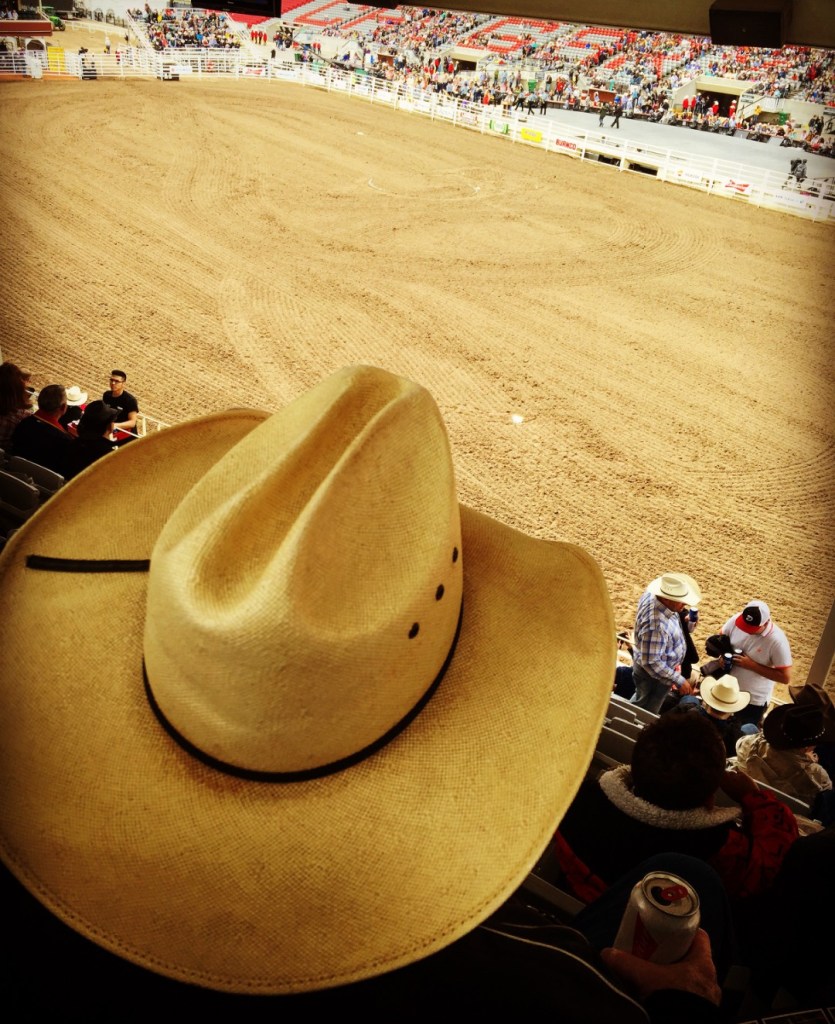
The bullrider waves his hat in the air, saluting the crowd after a long eight seconds. The stands roar with approval when the chuckwagons round the corner, the barns are filled with animals and farmers happy to talk about their life’s work. For 10 days every year, these are the sights we show the world to tell them who we are.
Fine.
I am a livestock farmer. I understand perfectly well that agriculture is more than an industry here. It is history, culture, economy and identity but if Alberta wants to wave its Ag flag, then agriculture-adjacent institutions — like the SPCA — need to be treated like infrastructure. They need to be funded like infrastructure.
Animal welfare enforcement is agricultural infrastructure. It protects animals, it protects farmers doing the work well and it helps prevent neglectful operations from gaining a financial advantage by cutting the costs of adequate care, building on the back of suffering.
And yes, sometimes, it may help a woman get out alive. Another farmer. One of us.
There will always be competing demands on the provincial budget but that’s not an answer, not for the province. Not for any of our elected officials. The Government of Alberta chose to pass Bill 22 — the right move. The Government of Alberta chose to expand definitions, chose to create new enforcement tools, chose to strengthen prohibition orders, chose to increase the responsibilities attached to enforcing Alberta’s animal protection laws.
Good moves all ’round.
So fund it. Fund it for real. Not with a one-time grant or a pilot project. Not by hoping Albertans donate enough money to keep the provincial laws functioning — I mean real, stable funding.
Hire and train enough officers, enough administrative and legal support, enough resources to cover a province this size, this “agricultural powerhouse.” Give our protection officers enough high-quality training to recognize when an animal welfare file may also be a human safety file. Fund it so that strong working relationships between agencies can be developed without fear of support being yanked.
And collect the kind of public reporting detailed enough to tell us what the work actually is and where it’s happening so it can be as effective as Albertans have every right to expect. Legislation without funding — without enforcement capacity — is not animal protection. It’s politics built on a piece of paper. It’s an implied promise — to Albertans.
And if the Government of Alberta is going to make that promise, the Government of Alberta needs to pay the cost of keeping it.
Otherwise? Well, we have a saying for that kind of thing around these parts.
All hat.
No cattle.
This is a Living post, a post to share my thought processes, my experience and the philosophy that underpins our activities here at the homestead. It is not a how-to, “expert advice” or meant to reflect a wider experience than just my own, on my farm, here with my sheep.


Leave a Reply