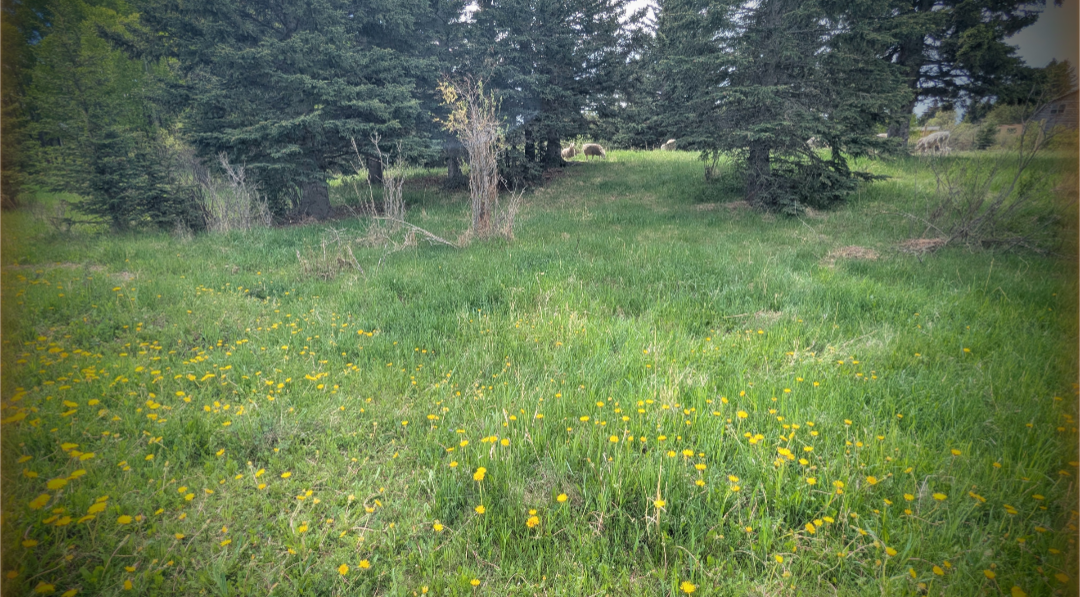
I am in the midst of a very unusual problem – for me. Since I got sheep, I’ve always been dealing with “not enough.” Not enough grass, not enough moisture. This year though, the weather gods are sending us all the water we’ve been missing. All at once. And my pastures have never looked this lush or this green.
It’s causing some problems.
If you spend much time around farmers, you’ve probably been treated to more than your fair share of weather talk. Canadians as a culture are fascinated by weather – I think it’s because so many of our varieties can kill you – but farmers take this to a whole new level. We are weather obsessed. I have four different weather apps on my phone, the chief value being that all their forecasts are different and so I get to choose the one I like best (or hate least, as the case may be). Weather is just another variable in our endless dance with Nature but these days, Nature is calling a tune and I’m struggling to learn some new moves.
As I sit at my kitchen table, I can hear the rain falling outside. It rained yesterday too. And the day before that.
It rained for almost three full days on May 31 to June 2 – we got 84.3mm. Since then and over the last week, we’ve had 76mm. The ground is saturated. The grass is verdant and green and growing faster than the sheep can keep up. They’re giving it their best shot to be sure – Border Leicesters are large-bodied animals and they like their vittles – but even our most ambitious critters are starting to wave the white flag.
And I’ve noticed something else – sheep that have been our steady eddies, that never rock the boat or give me cause for concern are starting to give me feedback that I can’t ignore.
Storytime!! Meet Maude
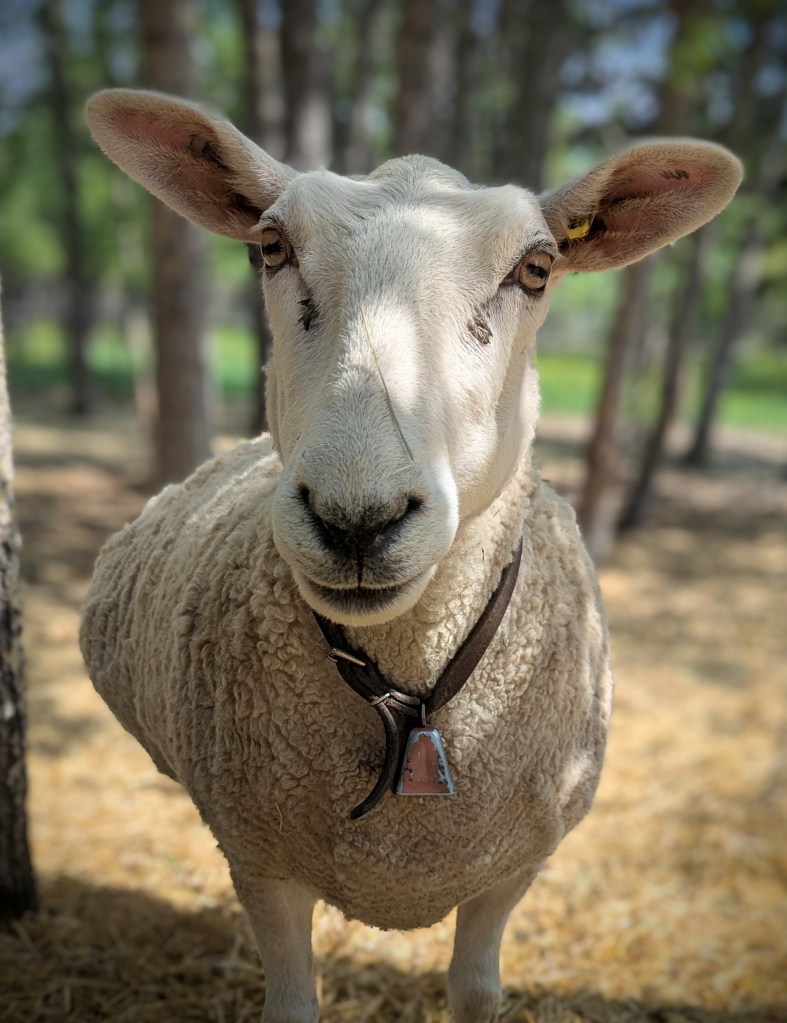
Maude is one of our OG Border Leicester girls. At just 6 years-old, Maude is in the prime of her life and has been one of our go-to girls. With the spirit to call the shots and the girth to back it up, Maude eats where and when and with whomever she likes. She’s a fairly secure lady and doesn’t throw her weight around lightly – she firmly believes in finishing any disagreements that get started however. I have watched her swivel her head and pin her ears at Banjo a time or two. At least he had the good sense to back up and start minding his own business. Maude clearly meant hers.
Maude isn’t shy about expressing herself. She has Opinions. She shares them. She is a very generous girl.
Several weeks ago – before the Big Rain – I noticed that after a day spent on a nice-looking quack and orchard grass mix, Maude was having some trouble settling in for the evening. She was sitting sternal but very upright, almost like a jack rabbit. Every once in awhile, she’d extend her neck and show me her bottom teeth. That’s generally a sign of pain/discomfort so I downed tools to watch closely. She’d shift, get up and stretch, walk a little ways and lie down again.
I was looking at a lady with an upset tummy. Generally, in livestock we call any abdominal pain colic but in sheep specifically, one of the reasons for abdominal pain can be bloat. Bloat can be a life-threatening condition – the rumen fills up with froth, rather like the head of a beer. All those tiny bubbles make it impossible for the sheep to remove them from the digestive process in the normal way of things – by burping. Often large, lavish burps that would thrill the heart of 10 years-olds everywhere – so the bubbles continue to accumulate. Left untreated and the growing mass of bubbles smother other very important organs like the lungs and the animal dies, essentially smothered by their bellies.
Maude didn’t appear to be in any danger but she certainly was uncomfortable. The treatment is straightforward – there are a number of OTC remedies as well as a recipe for an effective homebrew I’ve used from time-to-time. With a NSAID chaser, Maude eventually settled and all was well.
And then tonight, after a day on a different pasture – a pasture full to the brim of grasses but also populated with other highly-digestible forage like young aspen foliage, forbs and legumes – I caught a glimpse of Maude out of the corner of my eye. Lying on the straw in the barn, her eyes were closed, her neck extended and her long and elegant Border Leicester ears in a pronounced droop. Uh-oh.
Pasture Tales
For most of my tenure here on the homestead, I’ve been trying to figure out how to make pasture stretch. I’ve been sucking my teeth and worrying about drought, about fire, about hay for the next winter. In back-to-back (to back) years, the Spring rains didn’t come and so the tame grasses that populate many of our sheep pods – the brome, Timothy, Orchard and Kentucky Blue Grass – was spindly, sparse and headed out early. Border Leicesters are notoriously un-fussy when it comes to this kind of thing and will happily chow down on other plants, like asters, aspens, fireweed, willow and dandelions. We didn’t have to worry too much about overloading their systems – the biomass simply wasn’t there.
Well, not this year.
Learning As I Go
Maude’s recent round of tummy troubles has been very instructive. It has also been humbling. . . One set of skills, grazing in drought, isn’t instantly transferable when circumstances change.
Grazing ain’t the same game today as it was this time last year.
Of course intellectually I know this – everyone knows this – but sometimes we (I) can forget and fall into rote patterns. . . it takes a particular event to wake us (me) up and make all the pieces Tetris into place. Maude was that event so off I went to research.
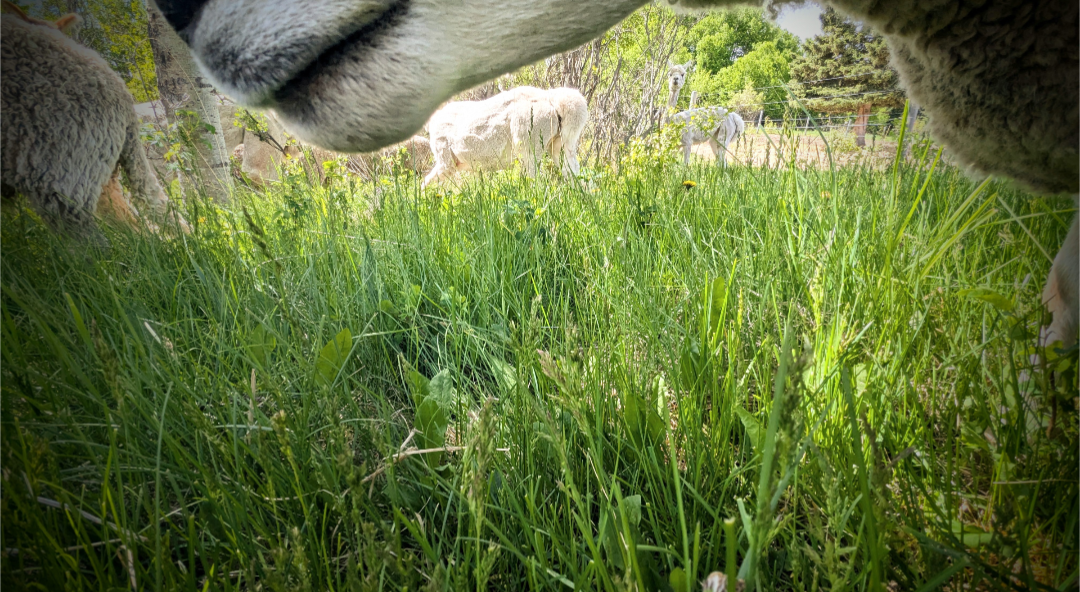
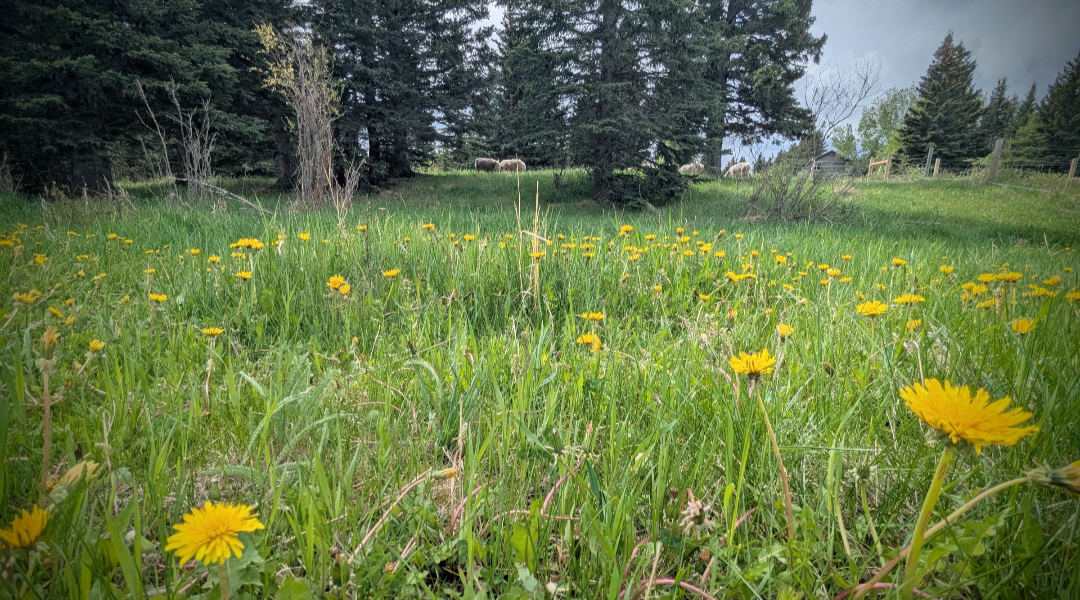
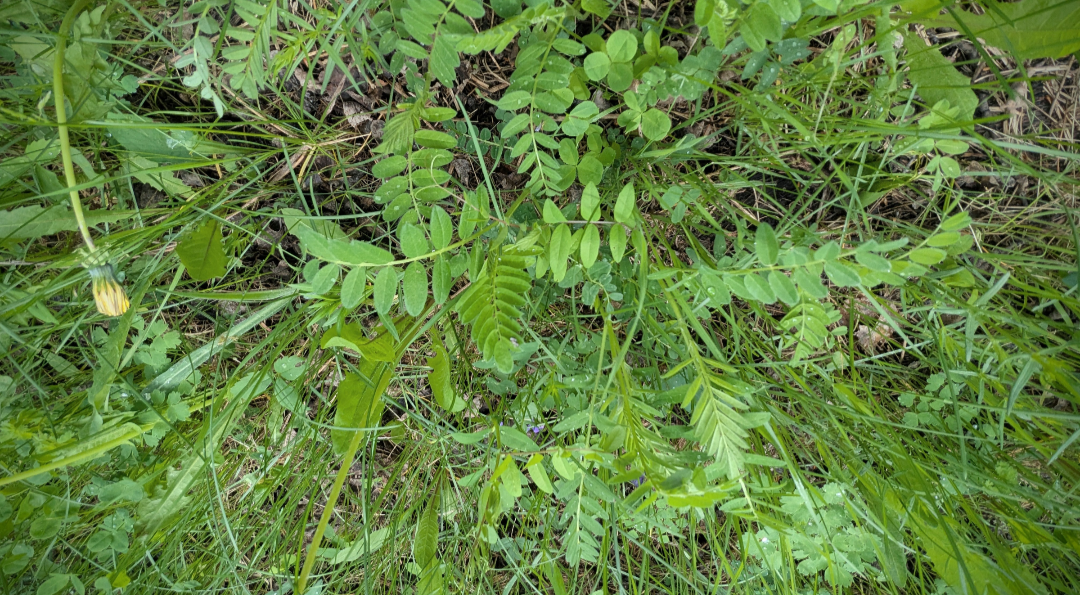
I quickly figured out that gut overload was causing the issues I was seeing – that part wasn’t hard. None of the other sheep seemed to be struggling quite the same way and though there were a few that looked a little uncomfy, no one was taking it as far as Maude. In her diva-esque way, Maude was giving me feedback – the pastures were too much for her. She couldn’t keep up – or rather, her rumen couldn’t.
With the problem diagnosed, the next issue was to figure out where I went from here.
Whatcha Got There?
Grass isn’t ever “just grass.” Like every living thing, it has its own life cycle and part of my job as a shepherd is to know how nutrition – or forage quality – and the life cycle of the grass species I’m looking at line up. That’s why when you’re reading online about different approaches to grazing, one of the questions you always want to ask first is what kind of grass are we talking about? Different grasses behave very differently. Grass is not a One Size Fits All thing.
Before we go much further, we need to discuss some basic terms.
- Dry Matter Digestibility. This is the word we use when we talk about how much of whatever the animal is eating can actually be used by that animal. Digestibility doesn’t measure tastiness, it measures usefulness. The higher the value, the more useful that forage is and the less is left to be pooped out.
- Neutral Detergent Fibre (NDF). This is the not-useful measurement. Generally, the higher the NDF is, the less likely it is your critters are going to eat that forage. This applies particularly to very stemmy/stalky grasses that are well into maturity.
- Palatability. Tasty!!! Highly palatable, highly tasty. Highly tasty generally means “graze it to the ground” for my sheep. Which is why we try and rotate them quickly when palatability levels (aka sugar. Even sheep have a sweet tooth) are high. Sugar levels tend to be highest in the active growing stage, before seed (AKA heading out).
- Crude Protein (CP). The building blocks for growing.
Most of the grasses in our pods are currently in the “actively growing” phase. Some are starting to head out – the Kentucky Blue Grass in the most recent pod to cause Maude internal distress has begun to set seed in one corner – but by-and-large, most of the grasses are still shooting upward, fuelled by all this rain. And that’s just the grasses. Other plants – like the vetch in that one photo in the gallery above – are tumbling through the pasture like toddlers on a sugar binge. We call this period “vegetative” and it means that the plant is throwing all its resources into growing so that it can set seed. For tame, cool season grasses in particular, this stage can be incredibly high quality – protein measurements can be over 18 per cent (very high as these things go) with relatively low NDF. It’s rich and it’s easy to eat.
So Maude went all-in. She’s always been an over-achiever.
Data! Let’s Look At The Data
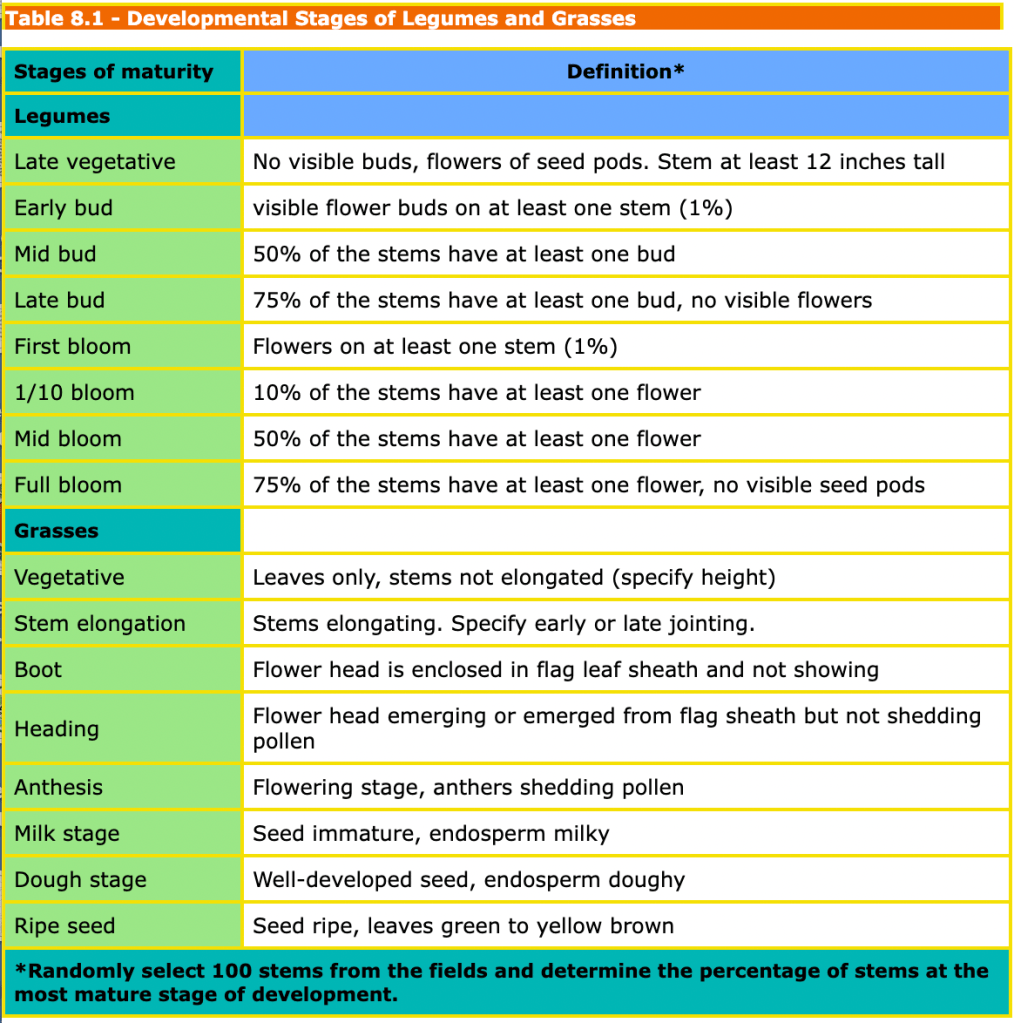
First, let’s look at the lifecycle terms and characteristics. If you wander down to your local greenspace, pasture or unmaintained parkland, you may be able to find samples of all of these stages at the same time. Different plants mature at different rates. This is important for nutrition because it can mean that peak nutrition is available at different times during the grazing year. We run into trouble however when our pastures are dominated by species that tend to mature at the same time – like many of our tame, cool season grasses. That’s certainly the case for some of the pods we have here where cool season grasses make up the majority of the grass community.
Here are some handy charts that break down the CP for legumes (like clover, alfalfa and vetch) and grasses. (For the source and a full explanation of the following charts, click here.)
You can see that the CP values and NDF values are moving in opposite directions. The higher the CP, the lower the NDF, relatively speaking. As a plant matures, it becomes less useful and less appealing.
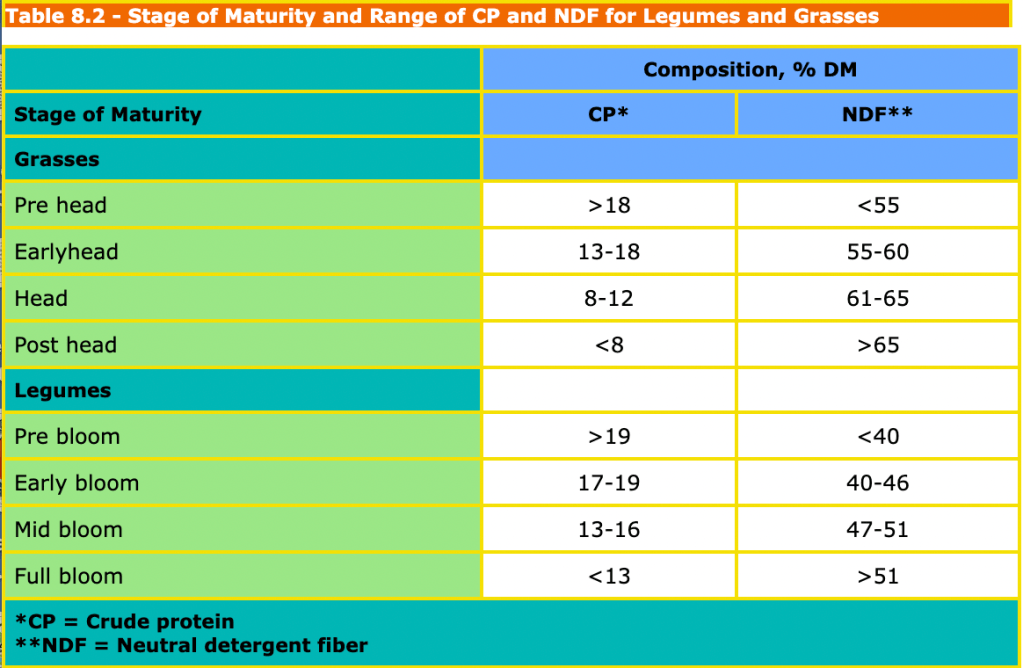
Now like I mentioned above, most of the pods in the area we’ve been grazing over the last few days are dominated by those tame, cool season grasses. A very few of the grasses have *just* begun to head out – they’re in the “earlyhead” stage. Peak CP. Low NDF. Our legumes are not blooming yet – also high CP and low NDF.
What we have here is an open bar and Maude? Well, she had herself a party.
Over-Served
If you’ve ever had a hangover from hell, you know the first thing you do is penance. “I will never do that again.”
Unfortunately for Maude, she must eat and if she’s given access to a pod in the lush stage of living – high on surplus water and an over-active seed bank bursting into glory like some kind of fertility ritual on overdrive – she will eat it ALLLLL. She is Bacchus unsupervised and she just can’t help herself.
I can’t expect her to be other than what God made her, bless her heart, so I have to step in. Because I know she can’t choose willpower for herself, I’m going to impose structure for her. Instead of packing her off for a 30-day stay at a closed rehab facility, I am going to pull her access. I’m sorry, Maude. It’s for your own good. No pods for you.
But a girl’s gotta eat, right?
Fortunately for me, last year when it came time to buy hay I purchased the remains of my neighbour’s stock. I have 16 1200lb round bales currently squirrelled away, more than enough to help Maude over the hump. Now, I’m not going to cut off her pod privileges forever, not while the grass is vegetative, not even for the rest of the week – just for today. For today, Maude and co. are just going to have to make do with hay. More than anything else, the cure for what ails her is more fibre. With the high levels of CP and low levels of NDF, Maude needs a bit more gristle in her diet and a day on hay in the home paddock will help. Depending on how things go, Maude and Co. may enjoy a regular “on the wagon” day every few days, at least until the biggest threat is past.
The irony is that hay is often treated as a failure of grazing management. In this case, hay became the tool that made grazing possible.
Not that she’s going to thank me for it. Sigh.
From the Fenceline
Maude is a victim of her own success. She’s a dominant ewe and she’s “entitled to her entitelments.” Unfortunately for her, her grandiose appetites are making her belly hurt which gives her shepherd the heartburn.
This year, the challenge is managing the rumen consequences for exceptional levels of digestibility in a flerd that, although cautiously and thoughtfully adapted to pasture at the start of our grazing season, can’t physically adjust fast enough to a growing season that’s metaphorically on fire.
Switching gears in my head – from a focus on stretching and preserving pasture to racing to try and keep up with pasture – has been an adjustment. I’m trying to take my cue from Maude and the rest of the sheep – I’m looking for clues and watching closely. I’m taking stock of every pod when we enter and making a note of which plants the sheep and alpacas target first. I’m inventorying the post-graze condition, getting an idea of which plants are preferred, which are avoided and I’m cross-referencing to see why that might be. I’m eyeballing poop, watching for rumination, putting hands on backbones and watching to see if anyone is racing ahead, falling behind or just nicely on cruise control. If things change, I want to catch it early so I can hit the books, check in with my mentors and adapt – no harm, no foul.
And while I’ve gotten reasonably good at managing in the tricky drought years – chose my sheep breed with drought/drier conditions in mind, actually – it’s a timely reminder that good stewardship means staying alert, staying responsive and accepting the feedback that’s being given.
And as for Maude. . . Darling, you’re cut off.
More Hay Resources
This is a Tending post — a practical look at our tools, methods, routines, and on-the-ground decision-making. It’s not a one-size-fits-all how-to, and it isn’t meant to substitute for local knowledge or professional guidance. It’s just what we’ve found useful and what we’re doing here on our farm, in our conditions, with our sheep (and alpacas), written down plainly in case it helps. For more about why we do things the way we do them, the philosophy that informs our process, you’ll find those posts in Living.


Leave a Reply