Late last night the news started to spread that Wendell Berry had died. Although perhaps not a household name outside particular circles, Mr. Berry was a giant in my world. A poet, a thinker/philosopher and a tireless advocate for the rural, the out-of-the-way and the wild. Now that he’s gone at the ripe old age of 92, what does a world without Wendell look like?
Wendell Berry looked like what he was — a farmer from a small place in Kentucky. He lived in the rolling hills, a son of a son of a son, his family working and walking those valleys and hillsides for generations.
He was described as a melancholy child. If his work is anything to go by, he was an observant one, a human given to close examination of not just his outside surroundings but also his internal landscape and, critically, all the many ways those two topographies overlapped, intersected and informed one another.
Wendell Berry was a man who understood the revolutionary act of staying put.
Parables
I didn’t know Mr. Berry personally. . . Everything I’m about to tell you is just my interpretation and my own experience. I can’t know what was in his mind but Mr. Berry wrote a lot. Like, a lot. While I may flatter myself by thinking what I do belongs to the same tradition as his, I do feel like our shared sympathies and interests, and the ways we choose to explore and express them, give me a bit of light to navigate with. Like two ships at sea — one vaster and more experienced, the other rickety, constantly bailing water and threatening to swamp at any second — even so I like to think that we might recognize one another.
Maybe.
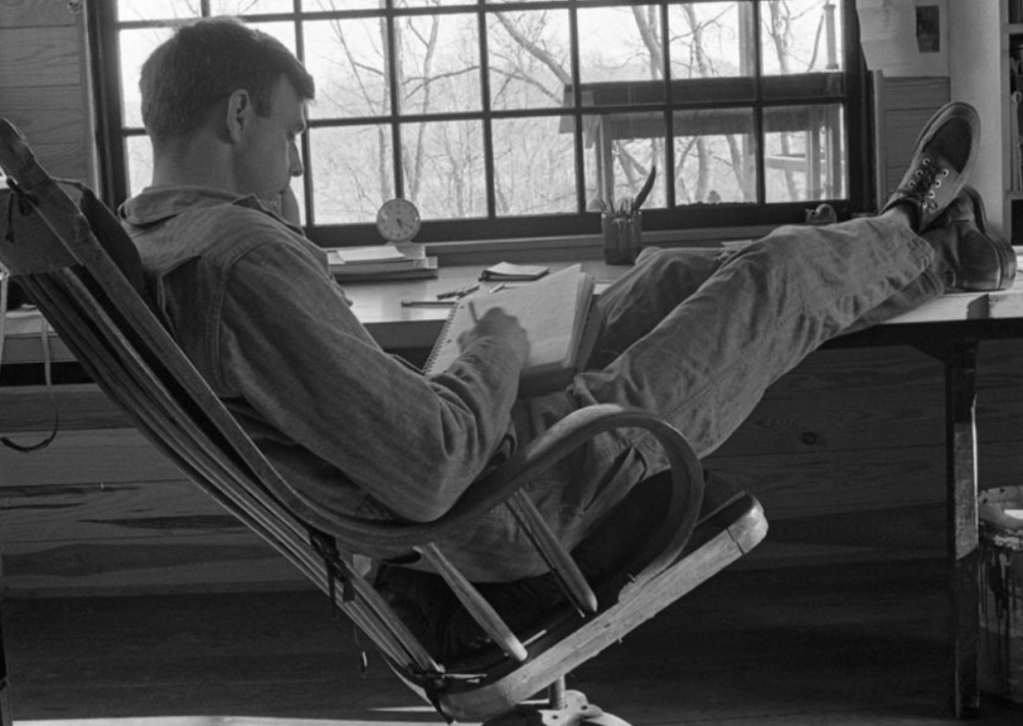
At any rate, I’m now sitting in my perch, two storeys above a busy world filled to the brim with scurrying, long-haired painters who are hard at work preventing my farmhouse’s inevitable slide into entropy. The tops of extension ladders bob past my window, the thudding sound of rollers on the wall shingles and voices in three different languages make concentration more than ordinarily difficult. I think of Mr. Berry in his cabin, without electric lights, seated at a simple desk and scratching away on paper with a pencil. Our respective worlds couldn’t be further apart.
And yet, reflecting on the man who gave us The Peace Of Wild Things, The Unsettling of America, The Gift of Good Land and so much more, the most obvious parallel is a simple one —
Wendell Berry was a shepherd.
A World Without A Shepherd
He kept Border Cheviots, if I’m not mistaken. A hardy hill breed, suitable for the wilds of a Kentucky home. I keep Border Leicesters, suitable for the wilds of a mountain foothills home. I think, though it may be a tremendous liberty to say so, that Mr. Berry would have appreciated my flock and stewardship. I know I valued his.
And as much as Mr. Berry wrote — poetically, sincerely and with tremendous passion — I don’t think, based on everything I know about being a writer and a shepherd, that he would have wanted the celebrity that came with his work. I suspect that, unlike many who find notoriety and fame, his attention turned rather to building a world that could — and would — go on without him.
What Remains
The work remains.
There is so much to be done. The work remains and rather than remaining in melancholy and sorrow — though they have their place and purpose — I am going to guess that Mr. Berry would, even as he grieved, go out and tend to his sheep. He would steward. He would walk in his fields and forest paths and he would observe and write by lamplight.
The work, always, remains.
Now that’s not to say we get on with it, soldiering on bravely like a troop of hardened stoics. I don’t think that’s what Mr. Berry did when he faced grief. . . I think he understood grief as a companion. Like the entropy of old farmhouses, it can be held at bay for a time, but eventually the best one can do is learn how to live within a world that is less than you’d like, more than you can handle and filled with such a blend of joy and disaster that separating the threads would be like sorting grains of sand on the beach — theoretically possible but quite possibly a waste of time.
For A Time
When despair of the world grows in me, I retreat to the place I belong. Unlike Mr. Berry, the world I belong to isn’t filled with the bones of my ancestors. The pool of shared DNA in my adopted province is very shallow indeed — I am a newcomer to these hills. But like Mr. Berry, I know to my bones that feeling of coming home, of sanctuary, of respite. I know, like Mr. Berry, that it’s in attention to the layers and beings and seasons and elemental forces of a place that transcendence is possible. Where Mr. Berry could follow on the generations of souls before him to offer his service, I can only offer my own fidelity. It’s not the same route, perhaps, but I do think our two paths, rather than diverging in that yellow wood, might actually converge — we belong because we practice.
There is something holy in the discipline of stewardship — there is sacrament. When we lift our eyes to the hills, when we find the injured sparrow hiding in the grass, when the lily throws her shining sunrise hues at us from the south-facing slope, when the aspens shimmer in a breeze, their leaves sounding like a thousand tiny ovations, I am lifted to heaven itself.
Perhaps, if I’m very lucky, I’ll meet Mr. Berry there.
For Now
I’m going to indulge in a flight of fancy and imagine I’m sitting across from Mr. Berry in that two-roomed cabin his uncle built.
It’s a lovely spot, this. Gentle, quiet and restorative. But does it help, being here? Is the pilgrimage clarifying? Does it answer our question — what do we do now?
Why don’t we ask him?
Mr. Berry is seated in an old swivel chair, one leg crossed over the other and wearing that beautiful cabled sweater — I’m making it blue. His fingers are tented in front of him, elbows resting on the chair’s arms and his expression is somewhere between pointy and genial. He’s pleased, I think. Perhaps even delighted.
A Vision
He’s already told us, you see. Mr. Berry already told us how to continue in a world without him — there is The Work.
If we will have the wisdom to survive,
to stand like slow-growing trees
on a ruined place, renewing, enriching it,
if we make our seasons welcome here,
asking not too much of earth or heaven. . .
. . . This is no paradisal dream.
Its hardship is its possibility.
~ Wendell Berry, A Vision
So go you and find yourself something to tend. Feed something. Repair something instead of replacing it. Make something instead of buying it. Visit someone. Go for a walk and then, stay.
Stay.
And do the work.
To read more about Wendell Berry –
The New Yorker, Amanda Petruisch, 2019
Red Canary Magazine, Dean Kuipers, 2025
The Marginallian
Library of America
This is a Living post, a post to share my thought processes, my experience and the philosophy that underpins our activities here at the homestead. It is not a how-to, “expert advice” or meant to reflect a wider experience than just my own, on my farm, here with my sheep.


Leave a Reply