It’s September 3 and I am sitting on the tractor, moving purposefully ahead at a slow-but-steady pace. In front of me, the forks are pushing aspen saplings forward as the tires roll inexorably over them. Behind me, the growling, crunching mayhem of a flail mower, hammers swinging in a clatter of shredding violence, splinter and beat the aspen saplings into matchsticks.
Doesn’t seem terribly regenerative, does it?
Welcome to Aspen Alley. This is a pod located on the north-east side of the regular grazing zones the sheep habitually visit throughout the year. As the name suggests, Aspen Alley is a parkland environment, a mix of tame and native vegetation and heavily shaded by enormous conifers. This is where our coralroot can be found, different species of aster, alpine vetch, field pea, yarrow, fireweed as well as wheatgrass and rough fescue. It’s home to owls — Great Horned and Great Greys have both been spotted here — foxes and bobcats as well as some justifiably timid rabbits. High in those trees, red squirrels make Clio the Guardian’s life a purgatory while Cedar Waxwings, Baltimore Orioles and even the darting forays of Small Brown Bats fill the open-air alleyways with activity. In the Spring, Aspen Alley is a cornucopia of green shades while Autumn brings with it shivering leaves the colour of loonies, aspens trembling in the barest breeze showering the ground with gold.
And yet here I am, purposefully mowing those aspens down. What gives?
Addition and Subtraction
This is a Tending post. For those of you who may not be familiar with the way things are laid out here in The Commons, Tending posts are reserved for discussions of how things get done – the nuts and bolts of what I do and how. Today’s post is a perfect example. Today, via Aspen Alley, we are going to look at what — grassland conservation — and how — reducing woody encroachment. Let’s unpack, shall we? We shall.
Aspen Alley, like a few other spots here on the homestead, wasn’t always this tangle of brush. Several years ago, Terribly Accommodating Jack (if you came to Open Farm Days, you might have heard me mention Jack. Jack has become a dear friend to me over the years and has, even when he thought I was being weird, been endlessly accommodating when it comes to helping me achieve my land management goals. Among his many sterling qualities, Jack is a heavy equipment operator and a dab hand with a forestry mulcher) brought his machine into these assorted scrubby bush zones and removed a lot of aspen — both saplings and mature trees. This had a dual effect — first, we removed a lot of potential fire fuel from the landscape and secondly, we opened up the canopy allowing more sunlight to reach the ground. This had the happy effect of permitting what sparse grass there was in these areas to grow.
We didn’t just mow everything down, I assure you. We were very thoughtful about what was removed. Jack had his guidance to leave anything with a diameter greater than 10 inches but to remove anything that looked diseased. He aimed to create not pasture but what is called in Appalachia “balds”, historically cleared areas at elevations where biodiversity from the surrounding woodlands and the open meadows mix-and-mingle. Now, proviso — I wasn’t trying to reproduce an Appalachian bald, our soils, climate and plant communities are entirely different, but I liked the principle; openings held within woodland rather than woodland removed altogether. That was what we were hoping to establish, open areas in the midst of our treed zones where all manner of organisms and beings might interact.
Before and After
Sometimes, Tending means adding stuff. And sometimes, Tending means taking stuff away. The trick, pigeons, is knowing when to do which.
After Jack’s initial foray into Aspen Alley, I watched carefully to see which species came back even as I threw around an organic seed blend I’d purchased that, I’d been told, would have excellent forage potential for my sheep. In the spirit of full transparency, this was six years ago and if I knew then what I know now, I might not have done that. I think if I was to get a mulligan, I’d probably spend a year in observation to see what nature brought back on her own but “Lessons learned” blah blah blah.
Gradually, even with the three years of drought that followed, the grasses in this pod crept through the now-exposed surface and became a very useful grazing zone, particularly in the early part of the season.
Now before you ask me, yes, I did indeed consider a range of options. I could have left this area alone and just let nature take it’s course. That’s often what a lot of “re-wilding” proponents advocate. I could have cleared it wholesale, rather than Jack’s strategic strikes. But our goal was building resilience and biodiversity, capturing and holding water, allowing the native plants to get a solid foothold AND providing a good grazing opportunity for my sheep. That’s a whole lot of expectation.
The one thing I didn’t consider — the actor that was probably the most common and effective tool in days gone by — was fire. Our property is only a half-mile wide though the parcel is long and narrow. With dry conditions and fairly-nearby neighbours, fire, though historically widely used by the Indigenous people of the plains, was not an option for me.
And now six years later, despite regular grazing presence from horses and sheep and their best efforts, those aspens were surging back. Besides the sheer density of the saplings, the sheep and alpacas had begun to balk at going into this pod because the aspen suckers had reached a sufficient height that my flerd of Nervous Nellies couldn’t see their surroundings effectively. Collectively, the flock was clustering around the opening to Aspen Alley where more regular foot traffic had kept the suckers low. Occasionally they would cast suspicious glances into the green wall but almost immediately they would retreat, “No thanks, Tara. We choose life.”
Message received.
Ch-ch-changes!!
With apologies to David Bowie.
I want to be clear — aspen isn’t “bad” just like willow isn’t “bad” just like Canada Thistle isn’t “bad” (no, it’s not. The presence of any plant on the landscape is information, not a verdict). In this case though, my goal hadn’t changed — I still wanted a mix of open-and-closed environments. My reasons hadn’t changed — I wanted a greater blend of biodiversity, a grazing opportunity and fire mitigation. And as much as I adore Jack, I can’t keep calling him to do my mowing for me. One tumble down a rabbit hole later, I emerged with a 72″ flail mower.
This would be my tool-of-choice, my Jack substitute. Although it’s not powerful enough to do the initial work Jack did, it would — at least theoretically — be able to maintain the work Jack did.
So on September 3, well after the sheep had last visited this pod and before a solid week of wet weather, I hooked up the flail mower and we trundled off to Aspen Alley. With typical frost dates in mid-September at our elevation (4400 ft), I thought we were likely too far along in the season for much of an aspen rebound to happen. With a gulp, I lowered the flail mower, took a deep breath and engaged the PTO. The mower howled into life and gradually a swath of cleared ground appeared behind me.
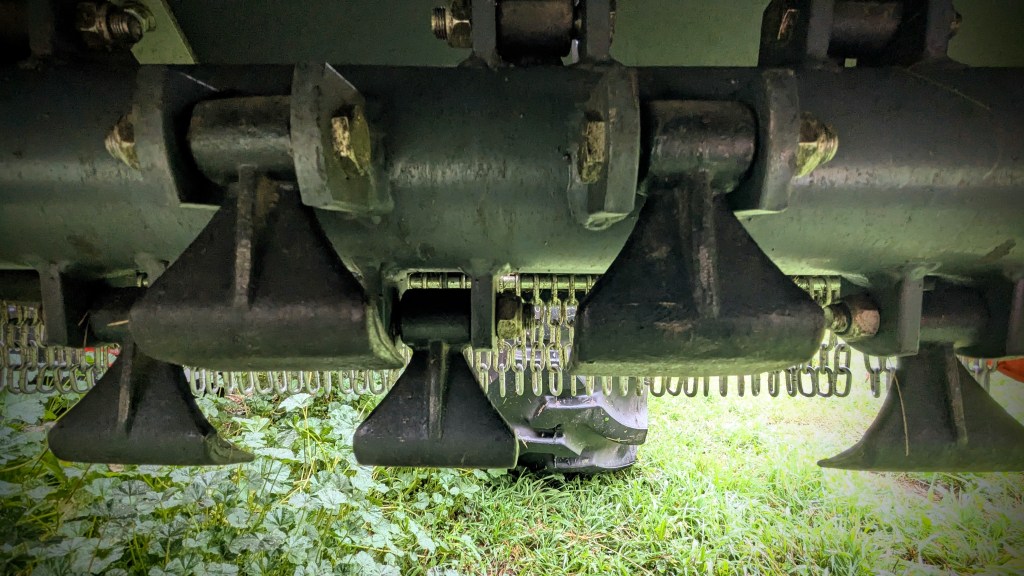
The underside of the flail mower. Those little dangly bits are called hammers. The whole drum spins and the hammers hit the vegetation reducing it to easily compostable mulch.
There was a lot to chew through. A couple of times I had to disengage the PTO and hop off the tractor to pull some bendy saplings out of the mower. As I walked around, I saw that the flail mower left behind a beautifully uniform mix of vegetation and shattered woody stems. Nudging it apart with the toe of my boot, I could see below it all a grassy layer — brome, wheatgrass, Kentucky bluegrass and more.
That was the interesting bit. The grass hadn’t disappeared under a tide of aspen suckers, it was still there and now the question was what it might do with light. Since most of the grass varieties — the natives and not-so-much — had already set seed, only time could tell me what might grow in this newly-churned surface.
It was never my intention to clear more than Aspen Alley. This was, after all, an experiment. I knew what the flail mower was designed to do but this was my first time running it so I wasn’t entirely sure what I could do. I wasn’t sure if, after an unusually wet Summer, the aspen would prove too whippy for mulching. I couldn’t be sure of the debris the mower would leave behind. I also didn’t know what would happen to our newly cleared area, suddenly open to the sky above and all the rain that was promised. Because of all the unknowns, I kept my ambitions small and confined my activity to Aspen Alley alone – the thickest thatch of woody encroachment but also sheltered (wise) and reasonably flat (very wise when you’re on an open-cab tractor).
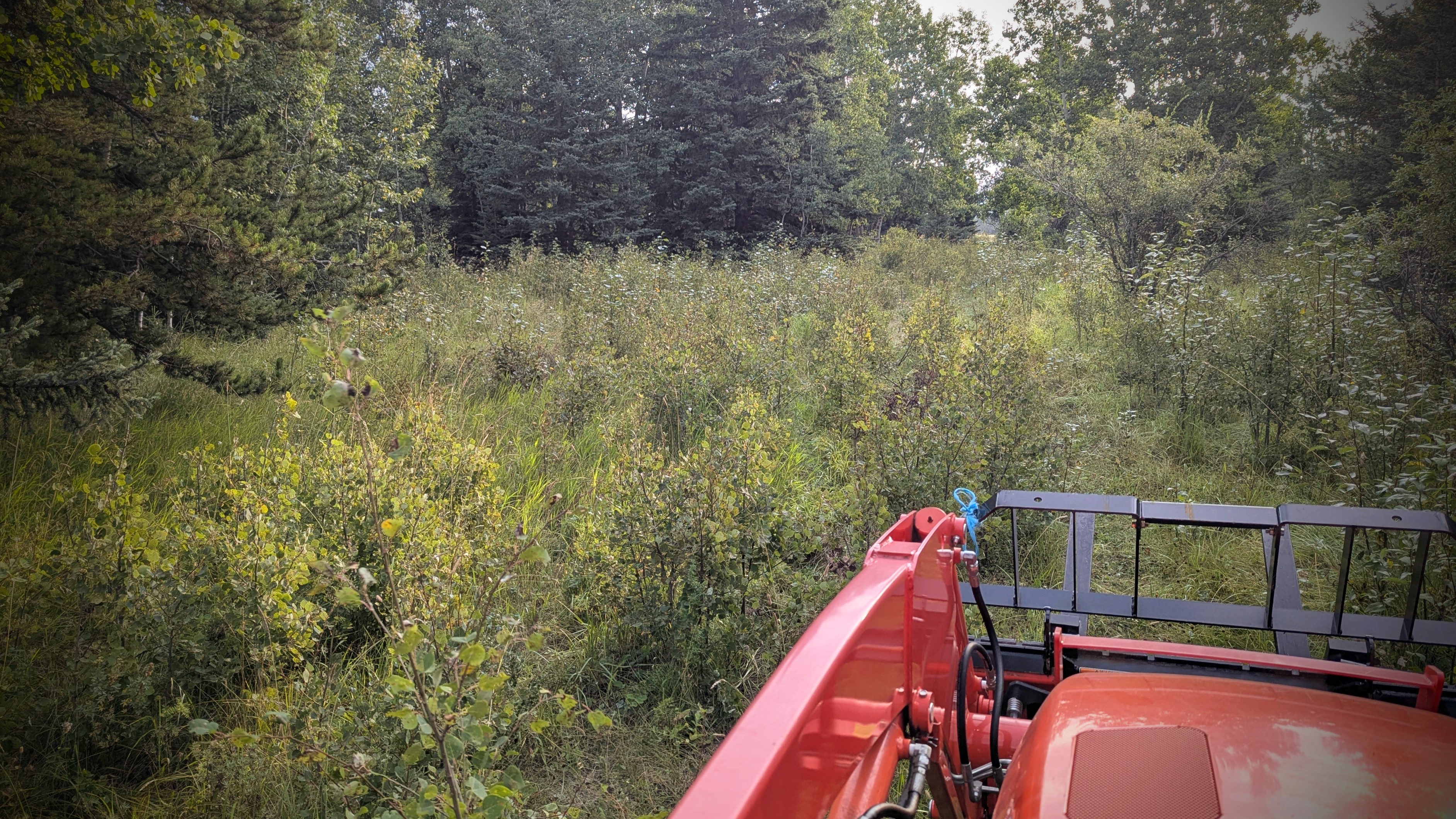
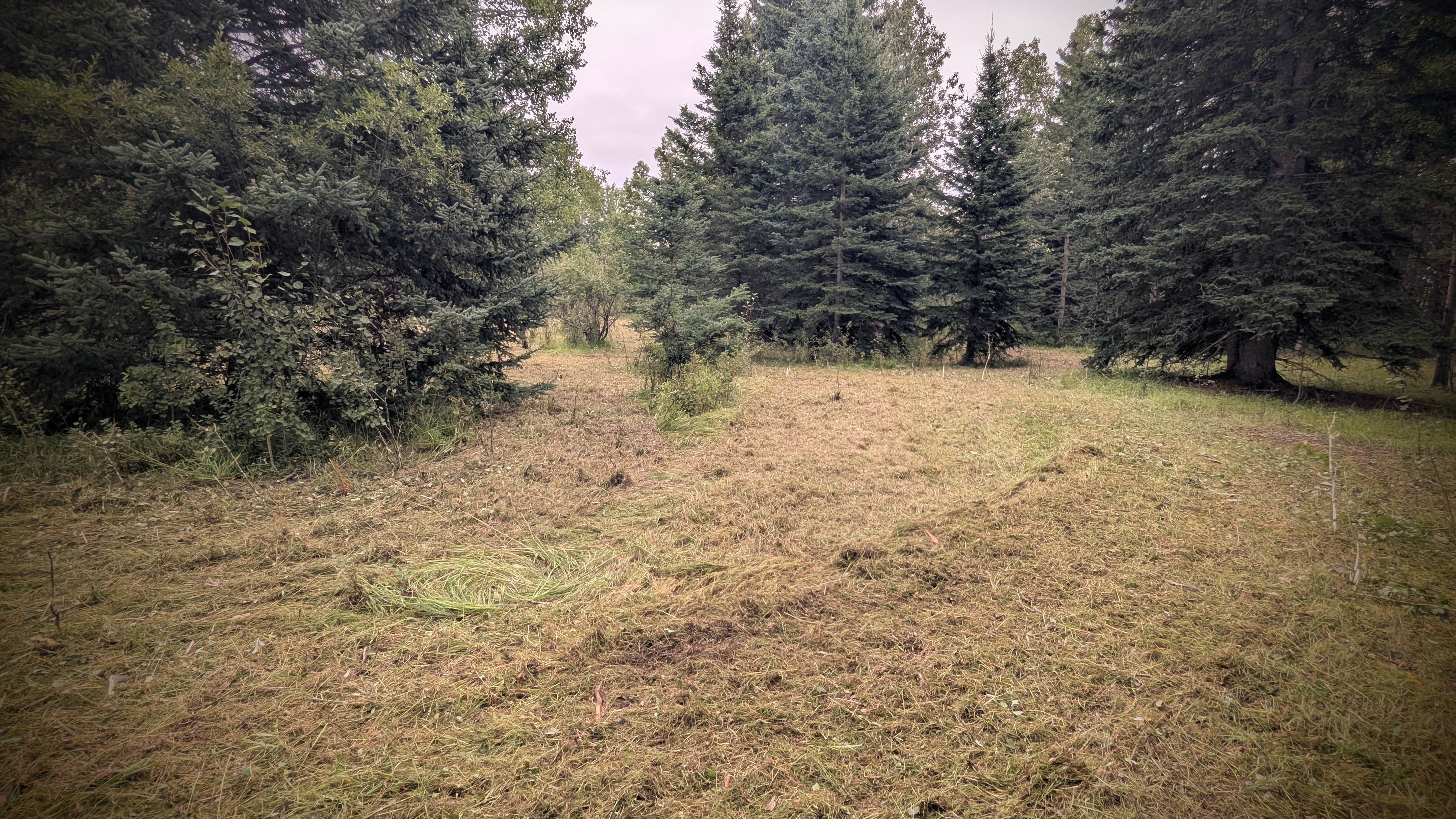
Before and after!
. . . So. . . Now what?
Well pigeons, now, we wait.
Observation – First, last and always
I’ve been reflecting on my biggest lessons from Grazing 2026. I think head-and-shoulders above them all is this: Observation is not a “step.” It is the management system.
Whether we’re talking animal husbandry or land stewardship, time given to observation is crucial. If someone were to back me up against a wall and demand a formula, the best I can come up with is that my best results happen when I give 70 per cent of any project’s runway to observation, 20 per cent to planning and 10 per cent to implementation. There’s often a lot of adjustment and recalibration that happens during that 70 per cent — I frequently have to check myself to keep from making assumptions or commitments I haven’t got any business making. Observation — true and objective observation — is a muscle and a discipline. The more you use it, the more familiar it becomes, the clearer the process appears.
Second lesson – small experiments are safer. Sure, I could have mowed the entire north side rather than just one small chunk of it. But within our northside pods there is such a range of conditions (that’s observation again) that if I’d done that, I would have been treating them as though they were all the same. Instead of that — and taking whatever I got as a result — I isolated my activity to one pod that had the best (as I see it now) conditions that would (theoretically) lead to the best outcomes. I’ll watch this area closely in the weeks before the s**w comes and I’ll see what, if anything, shifts in terms of regrowth.
From the Fenceline
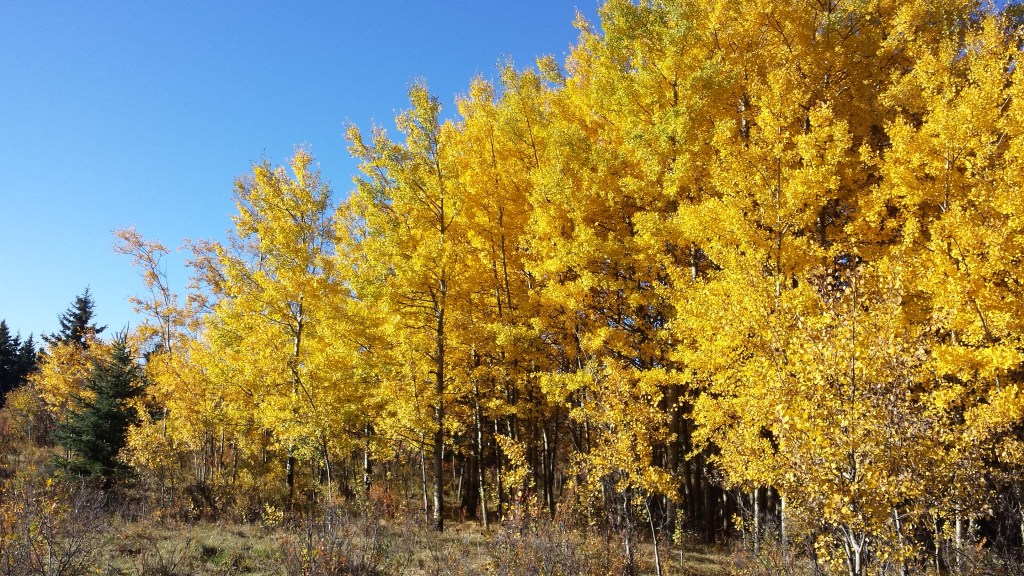
Obviously this isn’t the end of the aspen. It’s a resilient plant — an inspiration, really. The root system remains and next Spring, depending on conditions, I may well have a furious flush of new growth to manage. But those new suckers are going to be short and, crucially, tasty. The flerd has already shown a preference for tender leaves when they get the chance. My hope is to use enough grazing pressure to keep the suckers accessible without eliminating the aspen regeneration altogether. If I get the balance right, at least as far as Aspen Alley is concerned, I’ll work myself out of a mowing job (fine with me) and no one element will have crowded out everything else. It’ll be a pod in balance.
Aspen Alley is a mosaic of plant and animal life. In the six years since Jack originally opened it up, it had become a rich and layered environment of multiple plant and animal communities, as interlaced as the aspen’s cloned roots. And, according to my original and still-valued goals, that diversity is the point.
I want open spaces. I want shade. I want old trees and young trees. I want grass and browse. I want layers – all together, all at once and all the time.
Today I’m writing about our Aspen Alley experiment from my hidey-hole in the studio. The rain has been falling steadily — sometimes lightly, sometimes pounding – all day. It rained yesterday too. . . And the day before that. It’s forecasted to rain tomorrow. Depending on what the weather does, I’ll wander back to Aspen Alley in a week or two to see what, if anything, is happening. I’ll definitely let you know.
In the meantime, the rain is falling, the tractor is parked and the sheep are curled on the dry straw in the sheds chewing their cud and unaware of the change in one of their pods. They can wait for the grass. We can all wait for the sun to return.
Now is the season for waiting.
This is a Tending post — a practical look at our tools, methods, routines, and on-the-ground decision-making. It’s not a one-size-fits-all how-to, and it isn’t meant to substitute for local knowledge or professional guidance. It’s just what we’ve found useful and what we’re doing here on our farm, in our conditions, with our sheep (and alpacas), written down plainly in case it helps. For more about why we do things the way we do them, the philosophy that informs our process, you’ll find those posts in Living.


Leave a Reply