Recently a post came across one of my social media feeds. In it, the farmer was talking about some of the stresses they encounter in the work they do. So far, so good. But then they trotted out this phrase: “Unless you’ve lived it, you can’t understand it.”
. . . And my head exploded.
First some background. The post was being made with good intentions. The writer wasn’t trying to be exclusive or a snob. They weren’t trying to draw a line around their occupation because they wanted affirmation. They weren’t looking for thrown roses.
Nevertheless, intentionally or not, the writer highlighted something I am seeing increasingly across agriculture, something I actually discuss at some length in my book. What happens when one sector divides itself off from other vocations, skills or occupations?
Lessons From The Pandemic
It’s been a few years since those pandemic days when we were all ordered to stay home. In the days and weeks immediately after the quarantine orders went out, a new phrase began to percolate through the airwaves, “Essential Workers.” When I say “new,” I suppose I should clarify that what I mean is the scope of the phrase was suddenly, exponentially widened. Those of us who can remember specific public employee strikes — like nurses, teachers, air traffic controllers or front-of-office government workers — are familiar with “essential workers” as a concept. These are the folks whose work is deemed so critical to the social fabric that they simply can’t go MIA. Without these people, life-supporting social infrastructure goes AWOL and the risks to human health and well-being become too great.
However, when the pandemic happened, we suddenly saw that while teachers and nurses were most definitely essential workers, suddenly so too were grocery store employees, bank tellers, custodians and cleaners, kitchen and food delivery workers, warehouse employees, garbage collectors, meat packers and others not usually in the same mix of conversation. In many cases, these jobs are held by new immigrants to Canada, often making minimum wage. These aren’t the folks commanding top dollar salaries and corner offices, the ones we can ordinarily count on to ensure certain work-related discussions are centred in the zeitgeist.
The pandemic taught us that what we call essential and what we actually need to have a functioning society are overlapping, but not necessarily the same.
I’m quite sure that more-than-a-few folks were brought up short a time or two when they realized the person doing the job they’d barely noticed, possibly for years, wasn’t there.
Work, in so many ways, is itself essential. Previous to the pandemic, the way I measured work and value were very different from the way I look at them now. Before, I simply assumed the work would be done by someone sometime during the day. After the pandemic, I realized that “someone” had a name, a face and a story.
Instead of a function, I saw a person.
That’s no credit to me, I’m clearly as ivory-skulled as any other privileged-and-pampered human. I wasn’t trying to be an idiot (I hardly ever need to try), I’d just. . . never given it any thought. However, when the world changed, it was like I suddenly remembered an older version of myself, one that hadn’t gotten so side-tracked or absorbed by my own personal concerns, someone who actually saw humans again.
Community, Curiosity and Work
While I think it’s natural and even to a degree beneficial for people in similar lines of work to have opportunities to commiserate, compare notes, support one another and share their experience, I think it’s also important — critically important — for those communities to remain open and inviting to people who are currently not part of that specific tribe.
Understanding doesn’t necessarily require identical experience.
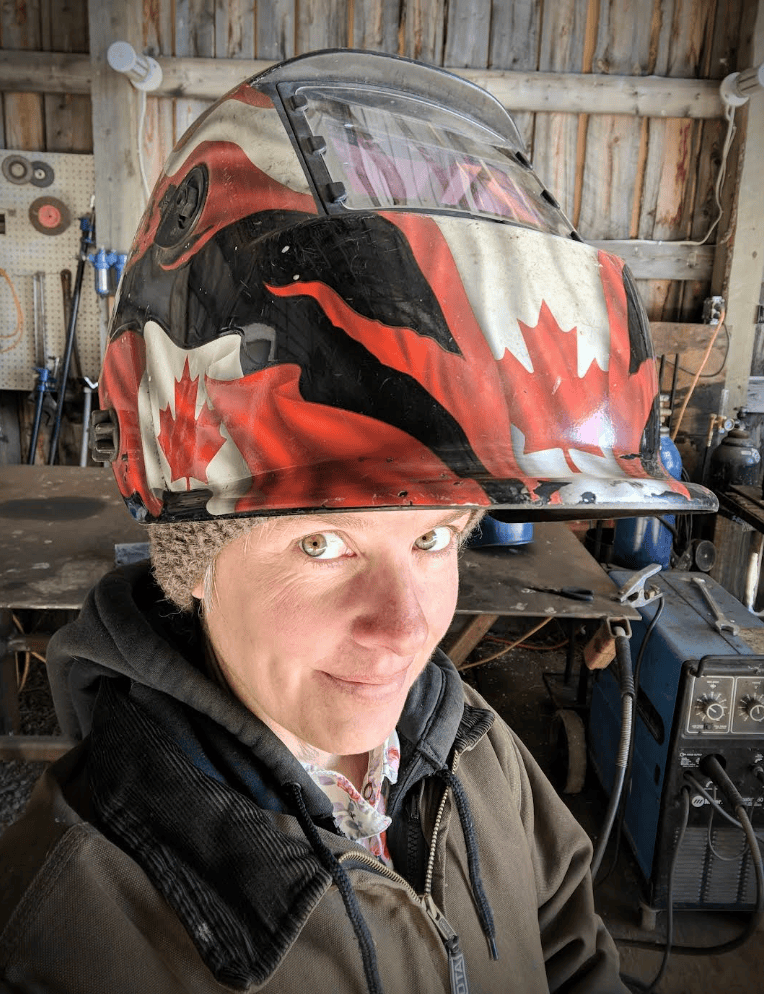
I have one set of experiences that come from farming. But I have other experiences that come from things like mothering, years of cross-country moves, journalism or growing up in a working class, blue-collar family in southwestern Ontario.
There’s not one person reading this who isn’t also a walking, talking collection of experiences.
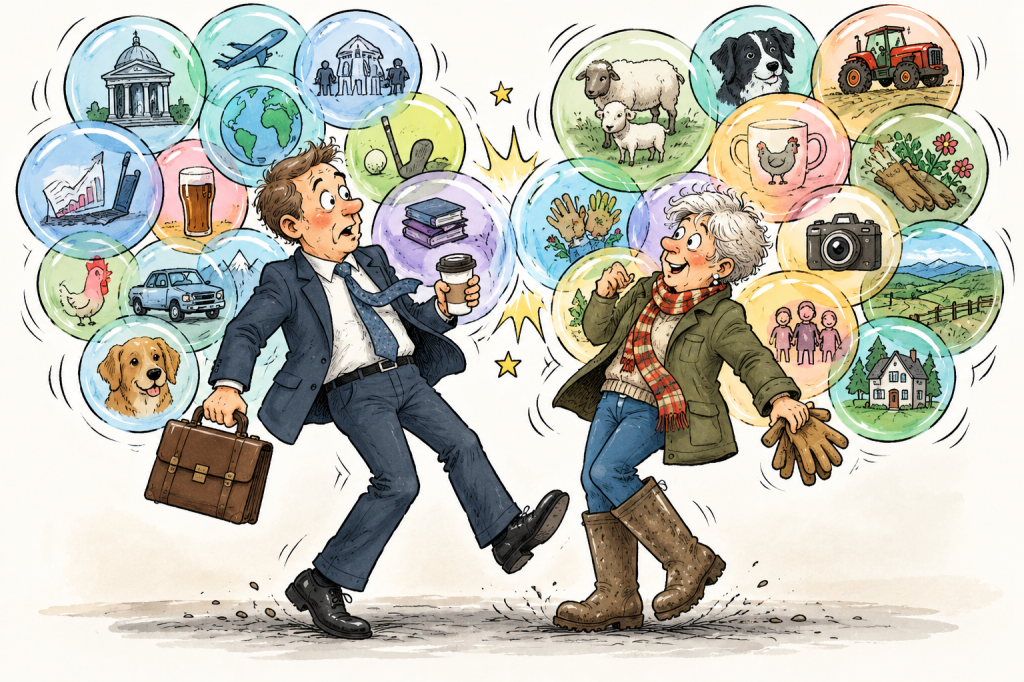
When you take a moment to look at them collectively, it’s obvious that humans are ambulatory jumbles of Venn diagrams — we’re bubble people!! — each of us carrying, kicking along or hanging on to a crowd of overlapping, jostling spheres of experience. It’s what makes us who we are. And further, it’s what makes us interesting.
The Older I Get. . .
I have two sons. They’re both fantastic humans but they’re radically — wildly!! — different from each other. It’s mystifying to me as their mother. One of my sons was very driven. The other took a more. . . casual approach to life. One of them had enormous expectations for himself and — this is just my observation you understand, he might phrase it very differently — was relentless about achieving his goals. He was focused and intentional, he was going to be a musician. He made sacrifices, he did the extra work, he excelled. He was passionate from the moment he picked up a bass. That was his world.
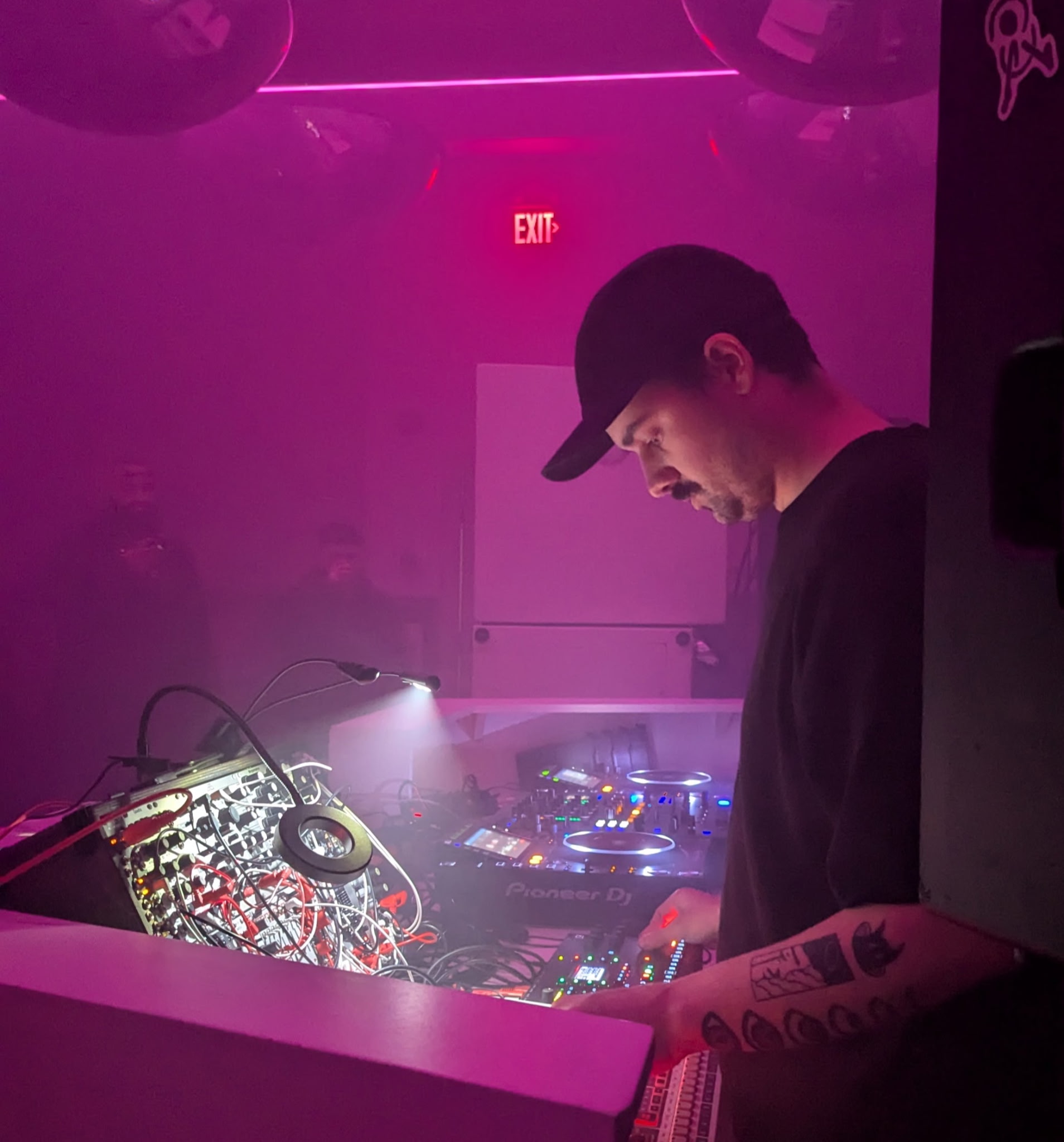
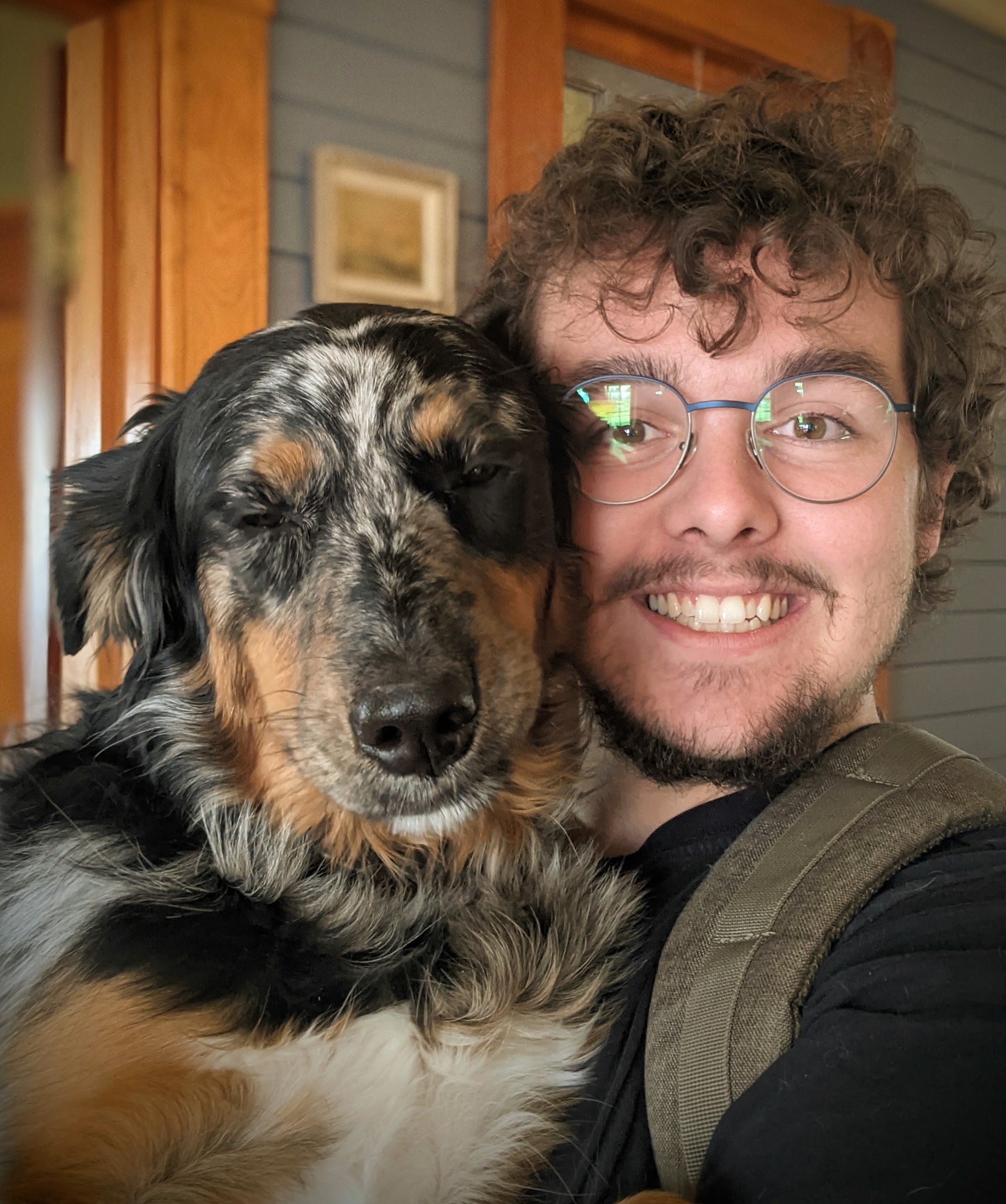
These are my two sons – The Musician on the left and The Foreman on the right. And also Rosie.
Photos shared with permission.
My other child didn’t have the same kind of intensity, bless him. It’s just as well, if he’d been like the elder, I don’t think we would have survived the pressure cooker. My second child was a dabbler, a “this-and-that-er”. He was a gifted athlete but a lackadaisical student, spent some time in Australia, spent some time in the tundra. Along with his constant companion, a multi-coloured mutt named Rosie (my beloved grand-dog), my youngest child generally believed life was going to treat him well and for the most part, so it seemed. . . even when he was far from home mixing peanut butter with ramen noodles on a mattress on the floor in some ramshackle house I wouldn’t use to house my chickens. He called it “Thai inspired” and that image is, bar none, the best way I can explain his radically different approach to life and to experience.
The point is, my eldest child’s work is an extension of his passion for music and making music. He is among the rare birds who can find purpose in their work. My youngest finds purpose outside of work and works to support his passions. In my immediate family, I see the push-and-pull of this tension with and between work and purpose play out daily.
When we ask other people about what they do — that thing that they will likely spend 80,000-90,000 hours of their life doing — and why they do it, we are being given an opportunity to share in their world, for just a few minutes. It’s a privilege. No, more than that, it’s an honour. Whether they arrived early at their passion, knew from a young age what they wanted and then worked single-mindedly to achieve that goal or whether they fiddle-farted around for years and collected a lot of anecdotes that make them fun at parties, keeping an open mind and an open heart when it comes to work is, I think, one of the best gifts we can give ourselves.
Choosing to see where my bubbles overlap with your bubbles — and where your bubbles are wildly different from anything I’ve ever encountered — is what makes us fascinating. Sitting down over a cup of coffee and listening to a 70-something year-old rancher with busted knuckles and rope burn scars up his forearms can be as interesting to me as Reg who drives a school bus or Greg, the award-winning journalist. On the surface, there’s very little to connect this almost-53 year-old shepherd with Lisa-from-Mississauga who rampages through the Toronto International Film Festival line up every year, Kim the book-and-craft loving Vancouver publisher, Shirley the retired MRI technician or Christian, the long-haired ultra-girly Instagram influencer and photographer who posts regularly about her shaggy Highland cows.
Except that we all work. And we all have reasons and stories to tell about how and why we do the things we do. There’s humanity in that. There’s wisdom in that. We’re all in that.
That’s what community is.
From the Fenceline
Work — whether we fell into it as my second son or pursued it as with my first — is the common link. Curiosity is the thing we can use to demonstrate our respect for that work.
For farmers, there is an added consideration. Oftentimes, I hear farmers — as in the post I referenced that opened this column — bemoaning the lack of knowledge the public (our customers) has about what we do. For us, it makes real economic sense to ensure that people who might be interested in supporting our farms know exactly what it takes to do the things we do which can help explain why we ask the prices we do. Without this critical information, the story is incomplete and the public, perhaps understandably, chooses a lower price that doesn’t require a backstory.
If we — intentionally or not — draw a line around our work and tell people outside that line “If you’ve never done it, you won’t understand” aren’t we making it harder? Doesn’t this kind of thing discourage the very curiosity we need to connect our community members? Would, perhaps, a different perspective offer new potential?
There is a profound difference between saying “You don’t know what this is like,” and “Come. Let me show you what this is like.”
The first is a boundary, the second, an invitation. Extending the invitation doesn’t require the invited to have their own matching bubble — it’s more than likely there are a dozen ways their life experience overlaps with ours, without it.
And in all this there is a reciprocal demand — as farmers, we can’t ask other people to be curious about what we do if we aren’t willing to be curious about what they do. Curiosity, as a building block of community, must be a two-way street. It’s no fun to be in a one-sided conversation, absolutely nobody likes that.
Finally, the pandemic taught us that some of the markers we’d used to value work and by extension, the people doing it, were woefully inadequate. Far too many people were overlooked until our circumstances shifted. While “If you’ve never done it, you wouldn’t understand” may be objectively true (my cousin is an emergency room charge nurse. I absolutely canNOT understand her world), they can be extensions of that pre-pandemic headspace, another way of drawing lines between us even when no division was intended. I may not understand how an emergency room functions but I do understand a mother’s distress and how that must be dealt with lest it become an impediment to healing — I have experienced the same with my sheep. When we begin treating our experiences as something that separates us rather than something we can share, we lose opportunities to understand one another. That’s something Bethany and I can talk about.
Given everything we’ve seen in the days since the pandemic, it might be the wiser course to welcome those who may not share our direct experience but whose experience can directly open the door to understanding. I don’t think these artificial divisions serve us, particularly in a world where the gaps grow wider every day.
It seems to me that if you really want to be counter-cultural — think Joy Division in a Captain and Tennille world — then open the doors between your worlds. Share your experience. Ask questions and look for all the myriad ways we are alike, regardless of our particular circumstances. When it comes to a vibrant and resilient community, curiosity may be among our greatest currencies.
This is a Living post, a post to share my thought processes, my experience and the philosophy that underpins our activities here at the homestead. It is not a how-to, “expert advice” or meant to reflect a wider experience than just my own, on my farm, here with my sheep.


Leave a Reply