A couple of weeks ago I was at the Campaign for Wool Canada’s annual conference in Calgary and I had the opportunity to talk about wool classing. That got me thinking. . . What do other wool-producing countries do? What do we do? How do the two compare? And most importantly, what would a truly Canadian wool classing system look like?
Before we begin, we better get the terminology out of the way. What is wool classing? And how is it different from wool grading or wool judging?
Better strap in, pigeons!
The Terms of Engagement
Wool classing, grading and judging are related but not the same. The terms are often used interchangeably, but this, I think, is a tell-tale sign that we have lost the depth of expertise that is needed to truly pursue a made-in-Canada wool value chain. Let’s try and untangle them so at least we’re all starting on the same square.
In a general sense, what we’re talking about is the process of sorting raw fleece into lots which share the same characteristics – or range of characteristics – so those lots can be streamed or marketed to customers who are looking for those specific attributes. There is no truly standard global set of definitions or criteria, each wool-producing country has their own based in large part on the types of wool they have. Some countries have developed a formidable depth of expertise in different kinds of wool – for example, the Australian Merino industry is particularly knowledgable about fine wools – and their classing systems can reflect that specificity. The chart below gives you an idea of how each country broadly classes wool but we’ll dig into some of the details in just a second.
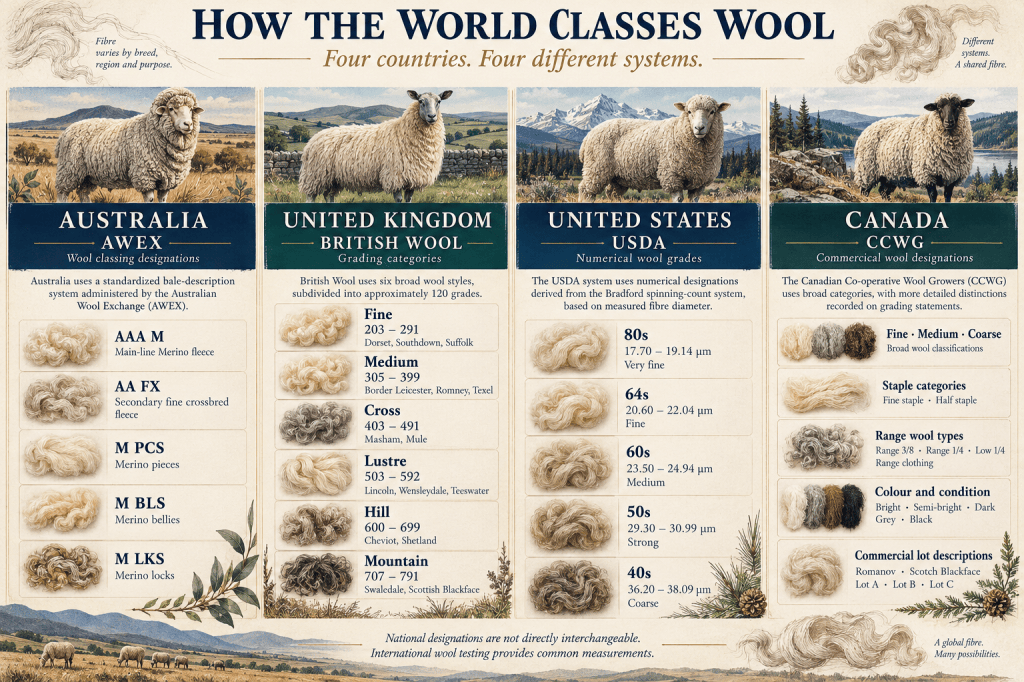
Sources: Australian Wool Exchange, British Wool, USDA Agricultural Marketing Service. I wasn’t able to find a specific guide similar to these for CCWG.
Now, as you have no doubt read through each source above and absorbed the information (you clever thing, you), no doubt you’ve noticed that the Brits make reference to wool grading while the Australians talk about wool classing. “Tara,” I hear you say, “I thought you said those were different things?? What gives?”
I’m going to try to explain this, but I’m still learning the ins and outs myself. Big breath. Ready? Right.
In Australia, with it’s vast territories, expansive flocks and long distances between farms or sheep stations, wool classing has evolved over generations to streamline the wool value chain and largely takes place at the farm. The certified Aussie classer is highly trained to use their expertise to sort the farm’s fleeces into consistent lines, prepare them according to Australian Wool Exchange (AWEX) standards and then get them baled and on the road to the sale location.
Wool grading, as practised by British Wool, is much the same fundamental exercise, but generally happens after wool has been delivered to a grading depot. Individual fleeces are assessed against an established national system of grades before being grouped with other fleeces of similar characteristics. Wool bales on the auction floor in this system may have fleeces in it from many different farms but they will all have very consistent traits.
Both approaches use standardized criteria but they’re standardizing slightly (very slightly) different things. In Australia, AWEX has established rules for dividing a farm’s clip into lines. The British system takes in all the area fleeces and then assesses them using national standard to determine where individual fleeces should go.
Imagine it this way. In Australia, the classer examines a particular farm’s wool clip and decides how many bins are needed to sort those fleeces into reasonably uniform groups, following established national standards. In Britain, the grader already has a prescribed set of bins, each representing an established wool grade, and sorts individual fleeces into whichever bin they belong.
The Australians have some discretion over how many bins they need for a particular clip while the British are sorting fleeces from many different farms into a common set of bins. Essentially, they’re both doing the same work just at slightly different points in the journey from sheep to sweater.
I hope that makes sense. Ouch. It’s very noisy in my head right now.
Understanding the difference between the Australian classing system and the British grading system can give us the needed foundation for deciphering what’s happening in North America. In Canada, historically CCWG has adopted something much closer to the British system – wool is collected at centralized depots, graded according to spec and then sent abroad. The Americans have more of a hybridized approach – sometimes they do their work on the farm, sometimes at a central facility. In both Canada and the United States, due to the loss of not just technical skills but also physical infrastructure – we simply don’t have the same locations we used to have when textile production played a bigger role in our economies – we are often forced into a more ad hoc practice. We have to do what makes sense given our regional limitations.
Finally, wool judging is the evaluation of a fleece against a competition criteria for the purposes of show. The fleece may be sold at the end of the show but it’s primary objective is exhibition. There is some overlap – a wool classer or grader could be a wool judge but a wool judge would have a harder time stepping into the classer or grader’s shoes – but the objectives and competencies are not the same.
Low Standards are Still Standards
Which brings us to those ever-so-important classing/grading standards. How did they develop? What are they? Do we have any in Canada?
As we’ve already seen, in Canada, the historic knowledge holder for assessing fleeces has been Canadian Co-operative Wool Growers (CCWG). Talk to any sheep farmer or shepherd in the country, particularly those who’ve been at it a while, and you’re going to get a wide range of opinions about the historic co-op. Formed in 1918, CCWG came into being just as World War I was winding down. Wool was an important part of the Canadian economy at the time and the textile industry would go on to be a significant player until the mid 60s. By the late 70s and into the 80s, competition from synthetics had severely cut into wool’s market share and with the advent of free trade and an increasing focus on globalism, the Canadian wool industry all but died out.
Traditionally, Canadian sheep farmers would send their clip to one of several regional depots CCWG operated across the country (the closest to me is in Lethbridge while Carelton Place, in Ontario, is CCWG’s headquarters. I used to live not far at all from there. . . But strangely enough, until I moved to Alberta, I’d never heard of CCWG. Life is a funny old thing, sometimes). There, the clip would be graded which meant that in many cases, the farmer never did that work himself. The price of wool could vary tremendously depending on the grade and producers were rewarded for not just the wool itself but also its preparation. Fine wool didn’t necessarily bring a better price if it hadn’t been prepared well.
All this to say, the Canadian wool standards existed, and after 1918 were practically held by CCWG. Training in wool grading was initiated by the Canadian government but subsequently the co-op largely functioned as an apprenticeship with on-the-job experience over time.
So in Canada, while we’ve had wool standards, these standards haven’t really been available to the wider public. In practice, the only way to become a wool grader in Canada is to go to work for CCWG. In the absence of that professional development path, the best we have been able to do to this point is offer the occasional weekend training course. As you’ll see, this is lightyears away from the kind of professional and vocational opportunities offered elsewhere.
So let’s look at that. Just what is available elsewhere? In both the Australian and British wool systems, wool education is a highly-valued, accredited and well-resourced profession. There are six different institutes in Australia currently offering wool classing courses (take a look at one here). Course work covers things like:
- Fleece assessment
- Wool preparation
- Classing strategies – this is where the classer determines how many lines are needed for the farm
- Quality assurance – applying industry standards
- Clip documentation
- Wool pressing and Bale preparation
- Shed management – coordination of wool harvesting and personnel to ensure the best-quality clip
- Workplace safety
Generally, once a student has completed and passed the 12 modules (time commitment can range from 12 to 18 months), they will apply for AWEX registration. Their certification, once received, allows the new classer a registration number and unique, identifying personal stencil. The two certification steps are distinct – the course work provides wool competence, the AWEX acceptance and registration denotes that the classer is able to class wool according to the AWEX criteria.
In the UK, if I wanted to become a wool grader, it’s much like the historic apprenticeship role we’re familiar with from CCWG. . . but more. Generally, our would-be baby wool grader would join British Wool and complete a series of modules with an exam to test competency at the conclusion of each. The minimum time to complete the training is generally three-to-five years and – hold your pearls, sweetpea – the first female wool grader was hired in 2022. Wool Grading in Britain is not formally offered in college or technical/trade schools, it is purely through British Wool although, given the many years and generations of experience still active in the UK, there is a much deeper well of available expertise and training may be possible although professional acceptance/certification must be through British Wool.
When you compare what’s currently available in Canada to the certification routes overseas. . . To borrow from my terribly English (Lancashire!) Granny, “It’s chalk-n-cheese, innit?”
Put another way, were I to go to to Australia or the UK with my weekend wool workshop, they would rightly laugh me out of the building. If, however, an Australian classer or a British grader came here? Why, they’d be able to walk into any shed, shop, depot or on to any wool manufacturing factory floor and immediately provide the kind of in-depth expertise that is so sorely lacking.
Where Do We Go From Here?
In some of my earlier posts on wool, I tried to make the point that in order for Canada to get serious about wool, we need to be able to fill in the data gaps. At the conference, I put it to the attendees – I hope this part made sense – that at the moment, we have no idea if we can have a commercial wool industry because we have no idea what we’ve got. Manufacturers need to know what’s out there, farmers need to know how to manage their wool for maximum return and wool graders are the ones who stand between the two, a connection point that helps these two very different worlds understand one another.
In order to fix that missing middle bit, we need a curriculum that can guide both sides of the market – the seller and the buyer – to greater and better understanding which will, all things being equal, lead to better and more meaningful opportunities. That’s what the grader does.
What we need is a training program that is sound, thorough, reflects the reality of our geographies and sheep flocks (we have a lot of different kinds of sheep in Canada, much as they do in the UK so any prospective graders will need to be able to be familiar with a wide range of fleece types and characteristics), emphasizes health and safety as well as animal welfare and, so important, also provides an opportunity for new entrants into agriculture.
From the Fenceline
I know it can feel super-daunting to look out and see . . . absolutely nothing. No infrastructure, no customers, no domestic manufacturing for our own wool, no meaningful training opportunities. We can talk until we’re blue in the face but unless we are able to rebuild our capacity on these critical pieces, Canadian wool is never going to expand beyond a small – but vibrant! – artisanal niche. While I love every single knitter, spinner, felter and weaver I’ve met, I also know they can’t buy the country’s clip. Not that some of them wouldn’t try. . . Bless them.
If we’re serious about moving Canadian wool out of the doldrums it’s been consigned to, a relic of a once-proud history, building an internationally esteemed educational/vocational professional wool grading development stream is foundational. Frankly, it’s the low-hanging fruit. It’s the kind of thing Alberta Lamb Producers could do in partnership with, say, Olds College. For example. Ahem. There are even grants for that kind of thing. You’re welcome.
Wouldn’t it be a dream to know that Canadian-trained graders are walking into Australian sheep sheds (or British wool depots) and, once they’ve introduced themselves to everyone, said sorry a few times and rolled up the sleeves on their buffalo-check shirts, got right in there sorting and moving fleeces and looking every inch like they could hold their own?? Just imagine, one day you walk into some dusty Australian shearing shed and you can hear The Tragically Hip playing on the radio while a voice that clearly hails from Truro or Woodstock or Massey or St. Boniface or Didsbury, yells out these magic words,
“Strong crossbred, good length, plenty of lustre. Put that in the main crossbred line, bud!”
This is a Tending post — a practical look at our tools, methods, routines, and on-the-ground decision-making. It’s not a one-size-fits-all how-to, and it isn’t meant to substitute for local knowledge or professional guidance. It’s just what we’ve found useful and what we’re doing here on our farm, in our conditions, with our sheep (and alpacas), written down plainly in case it helps. For more about why we do things the way we do them, the philosophy that informs our process, you’ll find those posts in Living.


Leave a Reply