Perhaps you read my recent post about how I’d go about making Canadian wool a viable value chain. I had a wonderful exchange with a lady named Dianne and it got me thinking. Maybe it would help, I thought, if people could see what I’m talking about. So let’s take a look.
It’s Wool Month (October is a Month of Many Things, as it happens) and so in honour of wool month, let’s expand a little bit on the post I did a week ago “S**t Or Get Off The Pot”. I’m looking ahead to the Campaign For Wool Canada’s conference on Wednesday and this’ll give me a chance to run through some thoughts. . .
Average?? Who You Callin’ AVERAGE??
Canada doesn’t currently collect much in the way of information about our domestic wool clip. I went digging and discovered that StatsCanada decided that 2024 would be the final reference year for the wool count . . . So now we have even less. Delightful.
In order to make sure we’re all starting from the same basic square, let me help lay out the Big Picture.
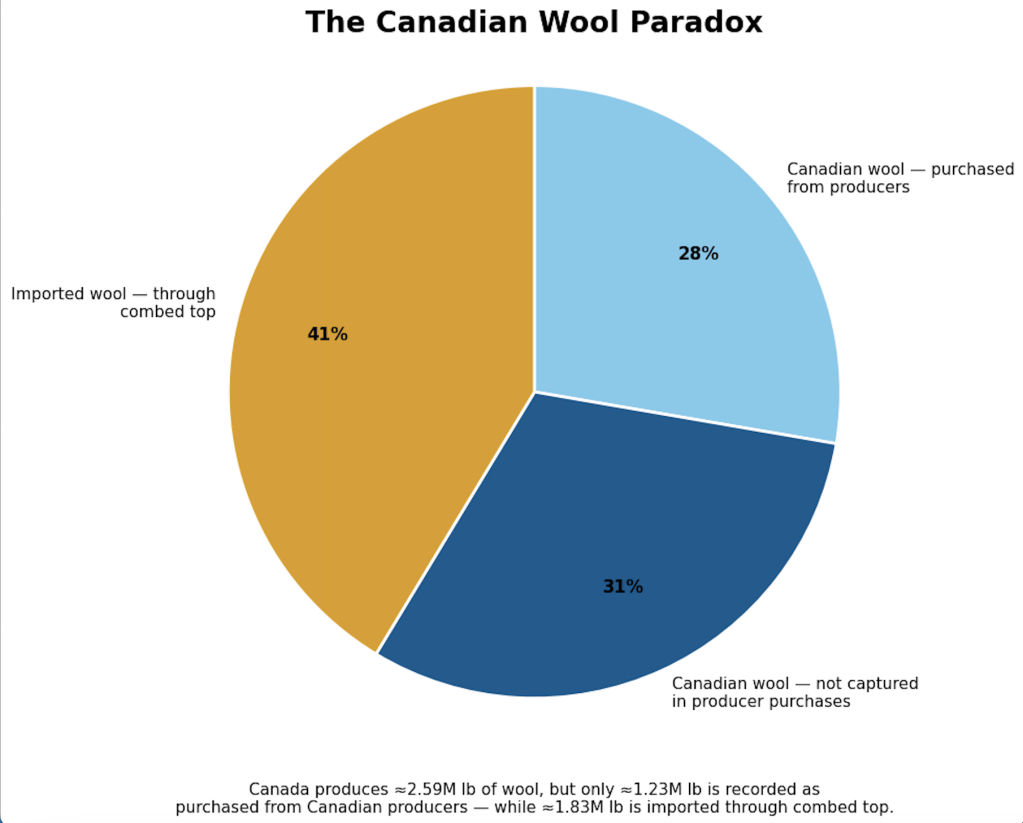
Lookit my pretty graph! Here we have (in blue) the total Canadian wool clip — an estimate based on the number of sheep across the country. Averages, they’re not my favourite but they can be useful. At any rate, we have about 2.59 million pounds of GREASY wool (wool before anything else is done to it — it’s not scoured or processed in any way, this is raw wool) floating around annually.
But look! What is the gold on yon pretty pie chart? I’m glad you asked. That’s the wool we import. I wanted to clearly show the relationship between the two. . . What you see in gold is everything from scoured wool to combed top (it does not include anything like yarn, textiles or other finished goods). Canadian sheep farmers grow about 2.59 million pounds of the floofy stuff, of which only 1.23 million pounds gets purchased somewhere along the way. . . The rest is unaccounted for. It just >>poof!<< vanished. Ok. Not actually — it’s out there somewhere. But it’s not accounted for — some of it was sold privately, some of it was bought by other small businesses or crafters, some went into the chicken coop and some is rotting on the barn floor. We don’t know which went where. Nobody does.
Meanwhile, Canadian manufacturers import 1.83 million pounds of wool from other countries, countries that can provide a range of processing services for a price Canadian manufacturers are willing to pay. So there are businesses and they’re buying wool, that’s clear. . . . Just not from here.
Missing Numbers
It’s not just about price. While that’s a critical number, there are other numbers that have to come before that one when it comes to a Canadian wool supply chain. Those numbers are part of what makes up something — I have really only just learned — called supply data. Put a pin in that, it’s important.
Why don’t we begin by taking a look at what we do know about the domestic wool production? In a side-by-side comparison, we can see that we actually know more about the wool we import than the wool we grow. The gaps become. . . glaring.
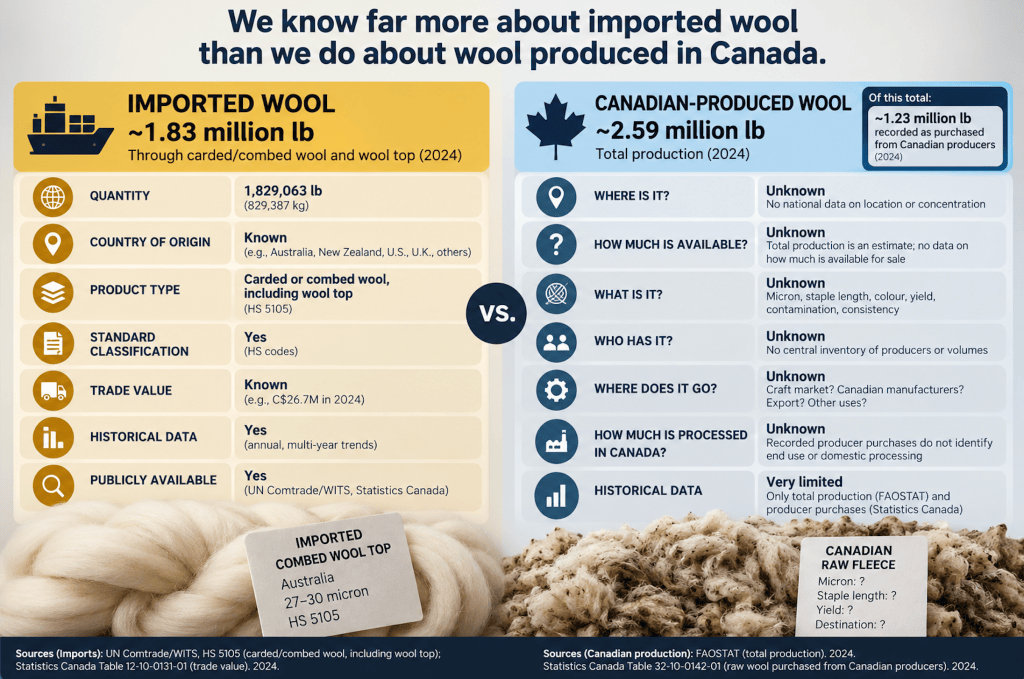
When it comes to wool in Canada, we’re operating in a black hole. We have breed averages but even in my own small flock, I can tell you that those averages mean nothing. Less than nothing. Once you add cross-breeding — as many commercial flocks are — then the variability really starts to climb. From individual to individual, the range can be enormous which has real consequences for processing. Relying on breed averages is a recipe for a wool industry on life support.
What we know about the imported wool is far more useful to potential manufacturers investing and building production lines. And seeing it side-by-side brings into stark contrast everything we don’t know about wool in Canada. Huh.
More Numbers
To see how important this supply data is, let’s walk an imaginary production line and pretend we’re a Canadian manufacturing company. We buy wool and we’d love to buy Canadian wool instead of the Australian wool we’re currently importing. We manufacture a product with a defined specification — let’s say boot liners — so we need fibre within a particular micron range, staple range, colour, preparation standard, contamination tolerance and volume because, for our manufacturing process, we need consistency. Like every business everywhere, we want our customers to be happy and we want them to come back as customers because they know we can reliably supply what they need. As a result, we are very particular about the wool we’re going to purchase — not just any wool will do.
We could go to the Canadian Co-operative Wool Growers (CCWG) but the vast majority of their wool (90 per cent) is shipped out of country, they have a supply issue. We’ve been watching that organization for the past few years and frankly, we’re not getting “reliability” vibes. But we saw the pie chart so we know there’s wool out there. We take ourselves off and decide to speak to a provincial sheep organization in the hopes that they might be able to get us the information we’re looking for. We’ve got our wallets in our hands, we’re ready. Let’s say we call the offices of the good folks at Alberta Lamb Producers.
“Good morning!” we say. “We need 40,000 lb of white wool between 27–30 micron, with X staple range and no more than Y contamination. Where can we get some?”
>>crickets<<
Huh. We go to Saskatchewan, Manitoba, Ontario. . . the answer is the same — those crickets are getting a workout. Unfortunately, no one can tell us where the wool is. No one can show us appropriately stored wool classed according to micron, staple length and colour. It’s almost like the provincial sheep organizations have let the wool ball slip right out of their hands. . . No, surely not. That can’t be right, can it?
Well, alrighty then. When we think back about it, we remember that the wool we used to get imported, even if we had to wait almost two months for delivery, was reliable and consistent. We knew exactly what we were getting — it was all there in the manifest. One-stop shopping. . . The Australians made it easy.
Ok. So there are some gaps. A few data points gone MIA. Just how much data are we talking about?
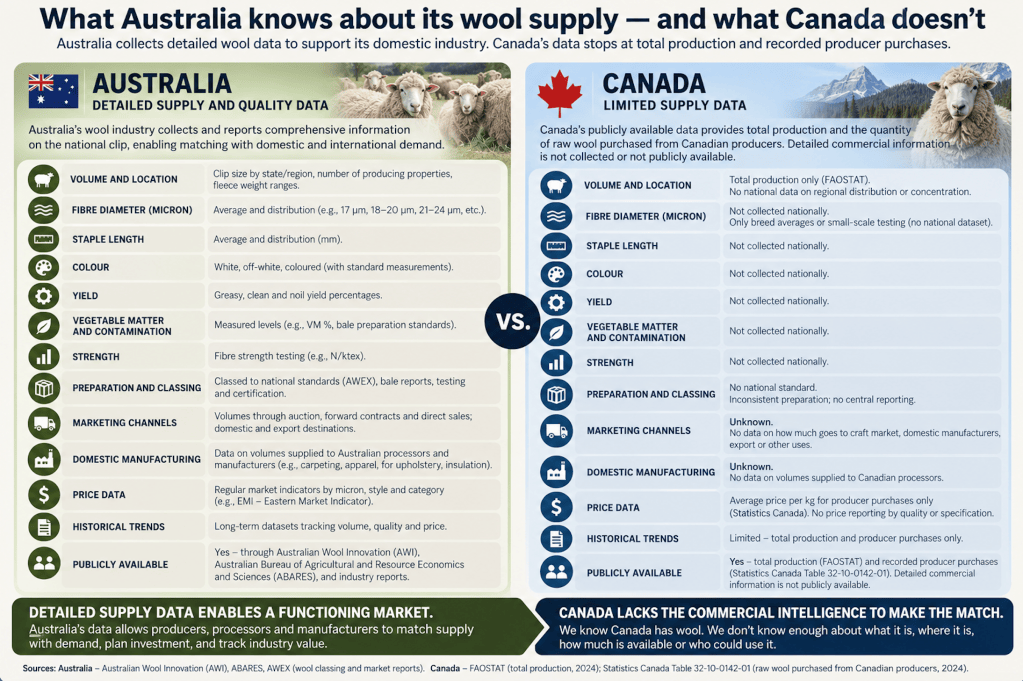
Good heavens.
When it comes right down to it, the total lack of reliable, commercially useful supply data (see? I told you we’d come back to it) for Canadian wool means that, as an imaginary wool buyer, we couldn’t buy Canadian wool even if we wanted to. We can’t find the product. No one can tell us where it is. No one knows how much there is. No one can tell us where to find the micron and length specifications our beautiful boot liners need. We don’t really have a choice.
So . . . Now What?
For the industrial processor, Canada isn’t really an option currently, Dianne was 1000 per cent right about that. The very first step in getting that to change — before anything is built — is getting our wool infrastructure to the point where we know where the wool is, how much is commercially available, the condition it’s in and its specifications.
That’s Job One.
And this, I think, is where the generous Dianne and I were talking past each other in the comments on my last post. Dianne — very reasonably — pointed out that provincial sheep organizations do in fact know where many of their producers are and what breeds they’re raising. That’s great.
I’m not arguing with her about that, what I am saying is that information isn’t useful to our imaginary boot liner manufacturer. That wasn’t the question he asked.
Whether Farmer Dale raises CVM or Farmer Iris raises Suffolks isn’t the point, really. It’s useful information but it isn’t commercial supply intelligence. Our manufacturer isn’t buying sheep, he’s buying 40,000 pounds of white wool between 27 and 30 microns, within a particular staple range, meeting a particular preparation standard and delivered reliably and in sufficient volume and consistency to keep his production line humming.
Can Canada supply it? Don’t know. Maybe, maybe not. And that, pigeons, is where the opportunity lies. That’s a problem we can solve — hallelujah!! We love a solvable problem!!
Start Here
Notice what I’m not suggesting. I’m not saying, “Hey! Let’s build a giant scouring plant and hope wool shows up!” This is not an “If you build it. . . ” scenario. Kevin Costner is NOT going to come jogging through the corn field. I’m not saying we should ask farmers to produce wool for some as-yet-undiscovered wool market. I’m just suggesting that maybe we should figure out what we’ve already got.
Know Thy Clip
Map it. No, not every sheep or every fleece. And we don’t need another list of breeds and producers. We need a commercial inventory. With the numbers up there that Australia has.
Where is the wool? How many pounds are actually available? What’s the micron? Staple length? Colour? Yield? Vegetable matter and contamination? How was it prepared and stored? When is it shorn? And — critically — is this producer willing to commit it to an aggregated commercial lot? Reliably, year-after-year?
Suddenly our Boot Liner Guy can ask for 40,000 pounds of 27–30 micron white wool and instead of crickets, somebody in Alberta or Saskatchewan or Manitoba can type a few things into a database.
“Yes. I think we have 63,000 pounds that’ll meet your specifications.”
Cue Happy Boot Liner Guy.
But let’s not stop there! Let’s do the same thing from the other direction.
What wool are Canadian manufacturers already importing? What specifications do they require? In what volumes? In what form? Raw? Scoured? Carded? Combed top? What do they currently pay? What would Canadian wool have to look like — physically and economically — for them to try it?
And then we put those two datasets beside each other. On the one side, farmers with wool and no data gaps. On the other side, lots of Boot Liner Guys.
Well, hopefully.
Find The Match
So maybe there aren’t that many.
Maybe our wool is wrong for some of the manufacturers currently importing wool . . . Maybe processing costs kill some opportunities stone dead. Maybe some Canadian wool will never be worth transporting commercially and makes far more sense going to gardeners or chicken coops.
That’s okay. It takes all kinds to make a world, my Mum says.
But right now, we just don’t know enough to say.
We’ve spent years asking how we can create a market for Canadian wool when we don’t actually possess enough information about the wool we’re trying to market to know whether a market already exists.
Before we build anything, we need to fill some holes. Let’s spend some time doing that.
UPDATE: Alberta Lamb Producers is currently writing their updated strategic plan (the current plan expires in 2027). The province of Alberta offers something called the “Emerging Opportunities” program specifically targeted at “projects producing significant company growth and sector impact.” Industry organizations, like ALP for instance, are eligible. What might the program be looking for? Emerging Opportunities is specifically aiming at initiatives that “explore market opportunities and directly address barriers to export and new market access.”
Hmm. Might be something there.
I’m heading to the Campaign For Wool conference in Calgary on October 7th. I’d love to see you, hear your ideas and to get an even clearer idea of where the wool sector might be headed. It’s exciting times right now in the global conversation around wool. I sincerely hope Canadians will be part of that growing excitement and that we’ll be able to get our poop in a group before we get too much further behind. We’re a resourceful bunch! I’m sure we can do it. I hope to see you there!
For more on the Canadian wool sector, check out Anna Hunter’s book, “The True Cost Of Wool.”
This is a Tending post — a practical look at our tools, methods, routines, and on-the-ground decision-making. It’s not a one-size-fits-all how-to, and it isn’t meant to substitute for local knowledge or professional guidance. It’s just what we’ve found useful and what we’re doing here on our farm, in our conditions, with our sheep (and alpacas), written down plainly in case it helps. For more about why we do things the way we do them, the philosophy that informs our process, you’ll find those posts in Living.


Leave a Reply