Once upon a time, wool as a raw material was ubiquitous. Nowadays though, wool is a sliver of the textile/fibre landscape. There are many advocacy groups – both local and national – who are trying to revitalize wool and have been holding meetings and conversations FOR EVER.
And I don’t know about you but I am getting tired of it.
My recent post about Arlene Dickinson’s Facebook post was just another bullet in this particular gun. I’m an excellent teeth gnasher and I’ve been feeling mighty fangy about all of the discussion and no real on-the-ground movement. We could go on talking . . . or we could make change.
I’m not saying we should stop talking altogether, I am saying it’s past time for action. It’s a point I want to drive home at a conference (more talking!!) coming up next week here in Calgary hosted by Campaign For Wool Canada, the offshoot of the British organization established by that hapless fellow in London who swans around in carriages and such. Called “Canadian Wool Conversations” (tickets are still available), the conference is billed as a chance for various parts of the wool value chain to get together, discuss obstacles (argh!) and build more connection. Full disclosure, I’m on the “Cultivating Capacity” panel.
Now, as the conference hasn’t happened yet, it may be that more than chit-chat will come out of it. Let us hope. But recently I was sitting across the table from my good friend Shirley Harvey from White Spruce Heritage Farm in Manitoba and, while I was whining, I started to get an uncomfortable feeling at the back of my head where my personal set of snarky voices live. They were getting restive and, as they tend to do, started jabbing at my conscience and muttering “Do something about it,” “Alright hot shot, but can you do any better?”, “Anyone can complain, that’s for babies” and finally, a particularly pointy voice said, “Shit or get off the pot, Tara.”
Personally, I think that last one might be the ghost of my Grandad, Stan. He had an extraordinarily low level of patience for unproductive talk, as I recall.
At any rate, I grudgingly cracked open my laptop and started pulling together all the bits and pieces I’ve gathered over the years since the sheep first arrived on the homestead back in 2019. It took almost the full day. Then late last night while keeping half an eye on North of North (the amautis are TO DIE), I started to pull it all together. When a battering chinook wind woke me up before 5AM, I realized I had gone about it the wrong way (I have to learn to pay attention to one thing at a time), and so I scrapped what I’d done and began over again.
And here we are.
This Is What I’ve Got (So Far)
With my eyelids at half-mast early this morning, I decided that rather than try to build to a particular product, what I needed to do was build to a raw material that businesses could take to a consumer product. A finished product, for my purposes, could come later. I also decided to — as I laid out in the Dickinson post — ensure that resilience was woven in from the jump. The proposition I’m going to put in front of you is intentionally sacrificing some efficiency for greater resilience, so that no one part of the organization or the skills or the results rest in the hands of one human. Or a small group of humans. Knowledge, ownership and participation is intentionally diffused throughout.
One cup of coffee in and things were looking decidedly brighter. I headed out to do chores and thought some more, came back in and started scratching around for funding opportunities.
And this is where I landed.
The Proposition
But first, a proviso;
I don’t think Canadian wool needs any more advocacy.
Canadian wool needs a functioning development system that can turn thousands of disconnected and unaccounted fleeces into a predictable and consistent raw material that businesses — some of which don’t yet exist — can turn into consumer products. Canadian wool also needs skilled regional processing capacity and multiple durable markets. That’s the proposition. That’s what I’m getting to.
Not yarn.
Not carpets.
Not insulation.
Not mattresses.
Those things may come, indeed some of them are already here, but in order to truly move Canadian wool, we’re going to have to lift our eyes from the craft market and focus on the commercial/industrial customer. In my chats with people like Brand Felt, I know that these folks want large volumes of clean wool that has been sorted, graded, measured and weighed into consistent lots that can then simply fold into their existing manufacturing streams. We’re talking about aggregated wool that may vary in its farm of origin but has the same length (staple), micron count, cleanliness and quality. It has to be streamed into production lines that can then turn that wool into whatever it is that company makes.
So the product I’m working toward is just that — a consistent and clean raw material. Because the upcoming conference is in Alberta — and so am I — I’m choosing to limit my scope to Alberta. Let’s roll up our sleeves and begin.
Step 1 – Wool Intelligence
Where is Alberta’s wool?
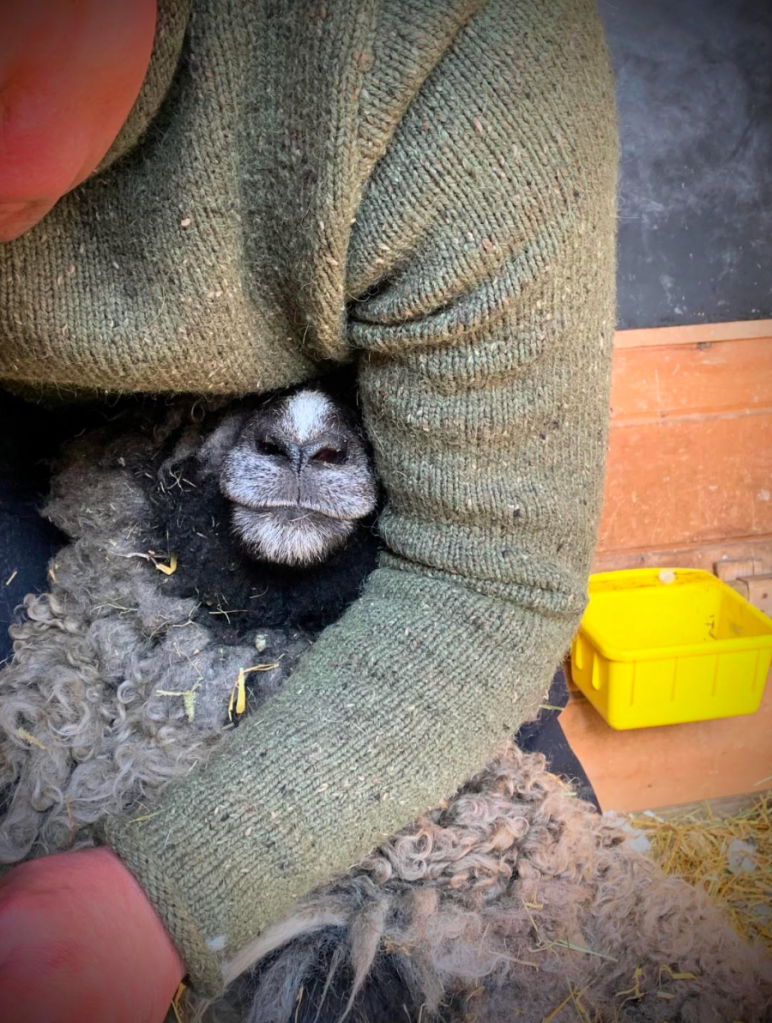
Where are the sheep farms currently raising wool animals? What kind of wool? Down-style? Longwool?
Alberta isn’t as large as Ontario but she’s plenty big enough. Where are the sheep farms, what kind of wool do they have, what are they currently doing with their wool, what skills do they already have when it comes to wool handling, how clean or not are those fleeces and how often do they shear?
I dunno.
Do you?
So this is job one. We have to map out Alberta’s wool producers. We need to know where they are — geography matters, pigeons — so that we can work out where our regional hubs have to be (more on that in the next point). It may be that there are clusters that would allow central meeting points. We need to know what kind of wool Alberta has — our sheep farms may look very different from those in Ontario. We need to know which breeds are out there, not because we can stream from the breed (though there are some mills that do focus on breed-specific yarn offerings) but so that we can get an overall idea of the potential options that may exist.
The ultimate goal for Wool Intelligence is a credible annual clip forecast and a map that lets a processor – or a potential investor – know exactly what Alberta can supply.
And yes, this costs money. Some potential grant options might include Olds College’s Centre for Innovation, Results Driven Agricultural Research (RDAR) or Alberta’s Sustainable CAP programs.
Step 2 – Regional Aggregation
Now that we know where everyone is, our trusty volunteers (stop poking me, Stanley!!!) can make some solid decisions about establishing regional hubs. For the sake of everyone’s sanity, let’s begin by choosing one area that has a fairly high number of sheep farmers. We’ll look at the map we’ve just spent months pulling together and put our thumb on a community that is centrally located and has storage capacity.
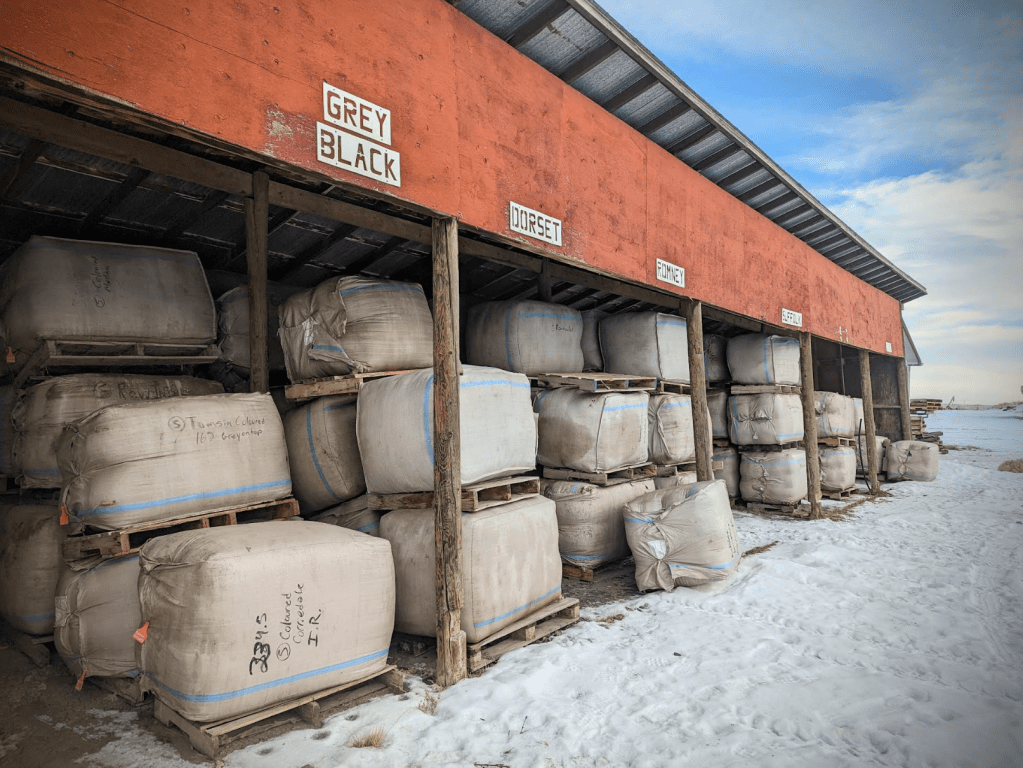
At our snazzy new pilot project hub, trained volunteers will meticulously record each participating producer’s information (for later traceability), weigh, class, bale and store each lot that comes in. Gradually, each lot will be combined with others that have the same consistent characteristics. We’ll keep those categories broad enough to be capturing a good volume of fleece but narrow enough to be useful to commercial processors.
And who exactly is going to help to pay for these mythical rented premises in our centrally-located town? I think possibly Community Futures Alberta might be willing to at least look at it. Otherwise, individual municipalities or counties might be worth approaching. I am a firm believer in just asking. You never know where just asking can get you.
Step 3 – Training
Now lest you think I didn’t hear you howling about “trained volunteers” above, I did so. And this is where we’re going to talk about that. It’s true, we have lost so many of the skills needed to truly reinvigorate our wool system here in Canada. Even among sheep farmers, the ability to skirt wool fleeces has dropped precipitously. My friend Shannon from Traceable Textiles has gone to many farms in and around the Edmonton area to help sheep farmers assess their wool, skirt it and pack it for storage. We need to spread those skills — Shannon can’t do it all. So we’re going to build a pipeline . . . Just not the usual kind.
We’re going to build a skills pipeline and we’re going to focus on shearing, wool handling, classing, testing, mill operation, machinery maintenance and product development. No, not all of these skills will be useful for my particular goal of a consistent raw material but all of these are essential skills for building a full value chain and if we’re teaching anyway, we might as well teach it all.
In some cases, some of this material already exists and we don’t need to reinvent the wheel. In others, we will have to build it from the ground up. In every case, we will need multiple people in each role, rather than multiple roles for each person — therein lies a brittle fatal flaw.
For our nascent system to work, knowledge and skills must be diffused throughout. Concentrating too many skills in just a few people over the long term is a weakness and that must be addressed from the jump.
And this is where we can look to potential partners in the post-secondary world for skills development. Perhaps trade associations (like millwrights) might be useful in helping to secure funding and warm bodies. Perhaps arts colleges, technical or agricultural colleges might have some willingness to partner. Perhaps there are individuals who are already active in associated industries who can provide some level of funding or training options, mentoring opportunities or other kinds of skills training supports I can’t think of just at the moment.
Step 4 – Market Development
And we’re back to clipboards, cold calls and spreadsheets.
We need to talk to manufacturers in Alberta. Who’s building bedding, insulation, nonwoven or felted textiles, carpet, yarn, knitwear, workwear, weed suppression, oil cleaning-up stuff or biomaterials?
Some of this stuff is already out there. Do we know what these individual companies are looking for? Do we know what their specs may be? Do we know if they’d even be willing to buy Alberta wool if we could fulfill their requirements? If Alberta-based companies are willing to buy Alberta-based wool, is it possible they might be willing to partner at some level in the work we’re doing here? Hey, Arlene . . . Whaddyasay??
We’re going to need more than just a pat on the back though. I’m talking about Memorandums of Understanding (MOUs), letters of intent, trial orders and agreements which will define what infrastructure is actually needed.
Which brings us to. . .
Step 5 – Building Capacity
This is the sexy part!
Once we’ve got a demonstrated supply and a clear demand, then we can definitively identify where the gaps may be. Talk to sheep producers and you’ll get a range of answers – “We need scouring capacity.” “We need more shearers.” “We need more mills.” “We need technical skirting/grading skills.” Over it all, you’ll hear “WE NEED CUSTOMERS.”
So in order to get to that last one, what do we actually need — what does the data tell us? We’re going to need to build a business case for this stage of the process so that investors can clearly see the opportunity in front of them. We’re going to make it as easy as possible for those folks to say “Yes!” Think like a Dragon (Arlene???)
In a perfect world, investment is going to follow the wool we have contracted, sorted, graded and stored in our centrally-located facility on its way to our collection of credible customers who have put their signatures on purchase orders as part of our pilot project.
Whew!
And who, you will no doubt ask, is going to help with all this?? I have some thoughts. Alberta has the Emerging Opportunities Program, the Value-Added Program, Community Futures, as well as private individuals.
Private individuals, you say?
I’m so glad you saw that.
Step 6 – Co-operatives For The Future!
Okay. I know what some of you are going to say. “We HAD a co-operative. They’re a total tire fire. Why would we do that again?”
You’re right. However, there are many other co-operatives out there that actually do function – and function well – for their shareholders. Think of the co-operative structure as a real viable opportunity for community buy-in, a funding AND a revenue stream.
Let’s consider some Alberta-based co-operatives:
A well-designed co-operative has the capacity to ensure the kind of resilience we (I) wanted from the beginning. Each developing regional hub can essentially repeat the steps outlined and solve the problems that are most pressing for their members in their regions. If one regional hub is poorly run, farmers can transfer their business to another one. Co-operatives could work together to coordinate logistics that might be too challenging for one co-op on its own. They can be loosely affiliated — as in the Fibreshed movement or a franchise model – or they can be linked more firmly, as in the Servus Credit Union model, essentially operating like branch offices. It would be up to the Alberta producers to decide.
Albertans, I’ve noticed, really like being allowed to make their own decisions.
From the Fenceline
The goal here is NOT one enormous wool mill in the Texas or New Zealand mold. Canada is a vast country with far fewer sheep farmers than either the United States or itty-bitty New Zealand drifting around at the bottom of the world. Their solutions will not work for us.
The goal is a resilient network of informed, skilled and farmer-owned regional hubs, multiple processing routes, a skilled workforce with multiple markets so that should any one part of the system fail – if any business, buyer or organization lights a match – it can’t take the whole sector down with it.
Canadian wool is a valuable resource and for it to become important to us once again, we need to move on from only talking and move into some constructive doing. This is just my thoughts, the map I’ve been drawing in my head. I’d love to hear your thoughts and views.
It’s time to shit or get off the pot.
Yes, Stan. I think everyone heard you. You can stop that now.
. . . Jeez.
Read my full “Shit Or Get Off The Pot” plan, click on the link!
This is a Tending post — a practical look at our tools, methods, routines, and on-the-ground decision-making. It’s not a one-size-fits-all how-to, and it isn’t meant to substitute for local knowledge or professional guidance. It’s just what we’ve found useful and what we’re doing here on our farm, in our conditions, with our sheep (and alpacas), written down plainly in case it helps. For more about why we do things the way we do them, the philosophy that informs our process, you’ll find those posts in Living.


Leave a Reply