You may have heard of terms like “rotational grazing” or “continuous grazing” or even “adaptive grazing.” A lot of the time, these labels get used interchangeably but, as in most things, the devil is in the details.
They are not the same. So what do I do here? What kind of grazing is the “right kind” of grazing?
Let’s nix that idea right off the jump. There is no one “right kind” of grazing. That doesn’t exist. If you’re hoping I’m going to tell you what you should do. . . I’m afraid I’m going to disappoint you.
Whew. I’m glad that’s out of the way.
Let’s Start With the Basics
Grazing is just a word that means “animal eats green things.” It doesn’t have to refer to grass though that is often the forage most people are talking about — on a remote island off the coast of Scotland, the sheep eat seaweed. It doesn’t refer to one kind of critter either — alpacas, cows, horses, sheep, bison/buffalo, wild animals or domestic livestock, they all graze.
Grazing isn’t limited to the location — grazing can happen anywhere there is available leaves or twigs to eat. It happens on ranches and farms; in the back country; on every continent except Antarctica (does plankton count?); on public lands and private holdings; in fields, forests and lawns.
One reason these terms get confusing is that they aren’t all describing the same thing —some describe how animals move, some describe the relationship between people and landscape and others describe tools that can be used inside almost any grazing system.
Grazing is a wide-open world to explore! Having said that though, there are a couple of terms that refer to specific types or systems of grazing and that’s what we’re going to talk about here.
First up! Let’s have some broad categories. I like a broad category, myself — it’s terribly inclusive.
Our first category is what I’m calling a “Landscape-based Traditions.” This includes things like Pastoralism, Transhumance and Hefted grazing systems. Our second is “Movement and Management Systems” which would be things like Mob, Rotational, Continuous and Adaptive grazing systems. Our final category is “Ecological Tools and Goals” and you’ll see this isn’t a grazing system at all—it’s a collection of tools and goals that can be folded into many different grazing systems. Let’s get into it, shall we?
We shall.
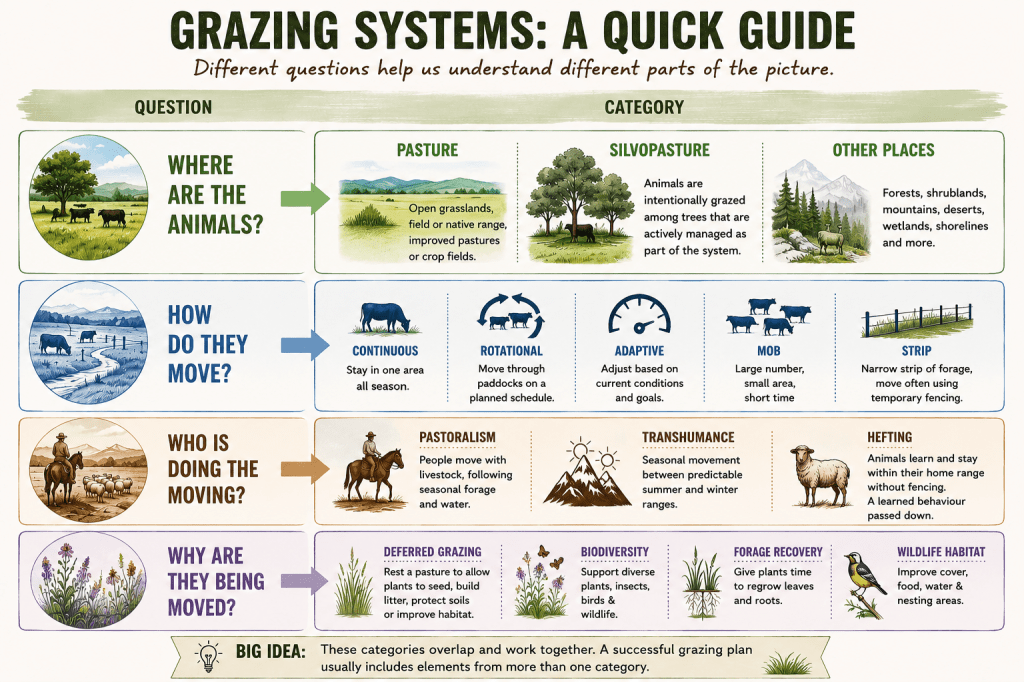
Here’s a handy little guide to help you get oriented. As you read, refer back and see which elements of which systems and tools plug into which categories. You’ll see overlap abounds. Enjoy!
Landscape Based Traditions
I have to start this section with a disclaimer. I am not a tradition-centric kind of girl — I have a healthy respect for tradition because it gives us a starting place but in the main, I tend to think that “tradition” often is just code for peer pressure from dead people. Tradition, when it is used to resist healthy evolution and growth, is best avoided I think.
Having said that, these kinds of grazing systems are still in use today even after thousands of years. At least part of the reason for that is because they work. While I may not kowtow to tradition as a rule, I’m not an idiot either. If it works, it works. Traditional knowledge isn’t right because it’s old, traditional knowledge is right because it works.
- Pastoralism
You’re going to hear me banging on about pastoralism this year because 2026 is the International Year of Rangelands and Pastoralists. Generally, pastoralism is defined as a grazing system where people move with their livestock across the landscape, following seasonal forage and water. It is still in use today in places like Mongolia, Kenya, Kazakhstan and elsewhere. Movement is driven by landscape, not fences. - Transhumance
This is the seasonal movement between predictable grazing areas — typically lowlands in winter and mountains in summer. Practiced in places like Spain, Italy and Switzerland, Dr. Fred Provenza has written extensively about this approach. Unlike the nomads of the eastern steppes, the routes the animals take in these locales is largely the same, year after year. - Hefted Grazing
If you’ve read any of James Rebanks’ work, you may already be familiar with Hefted grazing systems. Lambs learn their home range from their mothers and naturally stay within it without fencing (O! Tis but a dream!). It’s most commonly associated with the uplands of the UK and isn’t easily transferable as the “heft” is a learned behaviour passed down through generations. Once the geography changes – the sheep move to new geography — the heft bond is broken.
Movement and Management Systems
In Canada, most of the grazing systems you encounter are going to fit roughly into these categories more than the former. That’s not to say there isn’t some overlap (about which, more later) but in a general way, these are the terms you’re going to find.
- Continuous Grazing
The farmer kicks the cows out in the Spring and brings ’em back in the Fall. Very straightforward. The goal here is simplicity and low labour — both in terms of time and expertise. The positives is that this system is generally easy to manage and requires minimal fencing (just boundary fencing. If you’ve recently had any fencing done, you will appreciate minimal fencing) but the challenge here is that animals may repeatedly graze their favourite plants or places which can often lead to the overgrazing of desirable species and leave others underused. - Rotational Grazing
I’m sure you’ve heard the term before — it’s very much the buzz these days. In a Rotational system, livestock move through a series of pastures or paddocks on a planned schedule. The producer’s goal is to allow previously-grazed paddocks time to recover (to let the plants in those pastures regenerate through photosynthesis and root development). The plus side is generally better forage utilization than in a continuous grazing system but in a purely Rotational system, fixed schedules don’t always match up with changing weather or plant growth. - Adaptive Grazing
In this system, there is a lot more onus on the farmer/producer to understand not just forage availability but to also balance that changing dynamic against animal performance, pasture health, biodiversity goals, soil health and water cycling. It is a highly-responsive approach that allows producers to course correct on the fly should drought, rainfall, plant growth or other ecological/environmental goals/considerations change. Stock density, paddock size, timing and recovery periods are adjusted continuously based on current conditions.
With so many balls in the air, an Adaptive system emphasizes adaptability and resilience however the flip side is that producers have to spend quite a lot of time building expertise across a number of fronts. For those not born into farming families with deep roots in specific locations, this kind of knowledge can be hard to access.
Ecologlical Tools and Goals
- Deferred Grazing
When a producer practices Deferred grazing, they will intentionally rest a specific zone or pasture for part or all of a grazing season. This is done to allow plants to flower and set seed, build litter, protect wet soils, improve beneficial habitat or restore ecosystem function. It is NOT “never grazing,” Deferred grazing is “not now grazing.” This system was one of the tools policy makers encouraged to rehabilitate highly-degraded soils in the Canadian prairies and American Mid-west after the Dust Bowl years.
Deferred grazing can be a tool producers who practice any of the previous systems may use. - Mob Grazing
You may have heard this term in places like Australia and New Zealand but that may have more to do with the fact that in the vernacular, farmers in these countries refer to any group of animals as a “mob” — where we might use herd or flock, our cousins say “mob.” That’s not really what we’re talking about here.
Mob grazing is when very large numbers of animals graze a very small area for a very short time before moving. Producers may do this to encourage a high level of trampling, particularly on rank (overly mature) grasses to ensure good seed distribution and even utilization. Following an intense Mob grazing session, the pasture is typically rested for an extended period of time. Again, like Deferred grazing, Mob grazing is more of a tool than a philosophy — it can be used well or poorly. - Silvopasture
Although Silvopasture isn’t a grazing system per se, it’s a grazing environment and can be a useful tool so it gets included here. In a Silvopasture system, livestock are intentionally grazed among trees that are actively managed (this isn’t just kicking the critters into the bush) as part of the production system. You may have heard of pigs grazing under a managed stand of oak trees as in Clarkson’s Farm — that’s a Silvopasture system, a very old approach to grazing/foraging that has been in use around the world for thousands of years. Goals in a Silvopasture system are to include shade, diversify income, improve/maintain wildlife habitat and improve soil health. - Strip Grazing
Animals are given a narrow strip of fresh forage each day (or several times a day) using temporary electric fencing that is adjusted as needed. I see it quite regularly here when herds of beef cows are given access to barley fields after harvest to “clean up” and reduce waste.
What’s Going On Here?
Here at the homestead, I am trying to choose systems and tools that reflect our geographical realities (4400 ft elevation, on the shoulders of the Rocky Mountains, annual average rainfall of 22 inches, soil type shallow loam over glacial till) as well as more site-specific considerations. Half our property is comprised of native grass prairie, a landscape we are working hard to protect. We also have some natural and seasonal riparian areas, an abundance of endangered bird populations and too many wild ungulates to count, some days. My poor fences.
Anyway, taking all those factors into consideration, I’ve more-or-less landed on a few systems and a couple of tools.
First off, we take a largely Adaptive approach. This has meant my winters are spent in full-on learning mode, talking to anyone and everyone I can about the kinds of details I need to know. I collect data like a fiend. I am developing my own “citizen science” network of experts and mentors who can help me interpret the data I find — everyone from agronomists, grazing specialists, wildlife biologists, archaeologists, veterinarians and nutritionists, animal behaviour specialists. . . the list goes on. It is a project that, I have no doubt, will take the rest of my life.
Secondly, we use a lot of Deferred grazing, particularly this year when we’ve had so much rain. In order to maximize the resilience of the farm’s pastures and grazing pods, we are intentionally choosing to leave some of them untouched in the hopes that when the drought returns, those areas with their renewed and intact biological systems, will help us weather the dry years without too much drama.
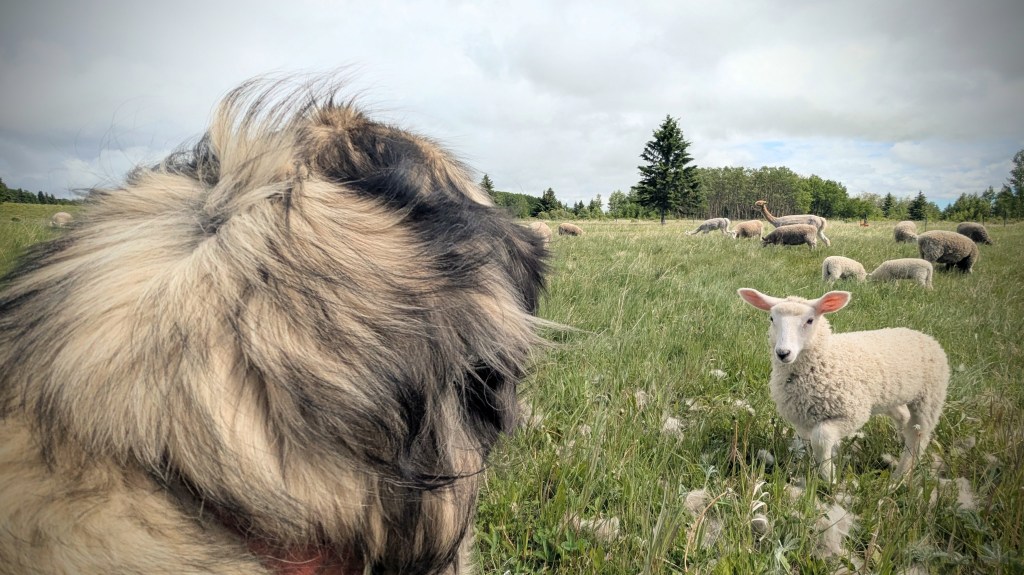
While I am not a Pastoralist in the true sense — the idea of spending weeks on horseback does not thrill me. Horses are lovely animals but I don’t much want to smell like one – I do borrow from that practice in that we do move following the forage, particularly in the more native parts of our property. Thanks to our robust Guardian dogs Clio and Brian, we are able to take full advantage of these zones with only minimal concern for predation though when we are in these areas, I don’t leave the sheep, just to be safe.
Finally, Silvopasture is one of our tools largely because if we didn’t make use of it, we would lose more than half of the grazing we have available. We are actively managing woody encroachment by the insanely vigorous aspen suckers and our sheep — heritage breed Border Leicesters — are as close to goaty as I think it’s possible for sheep to get. The flock does extremely well in these brush grazing pods and are more than happy to help strip leaves, particularly when the saplings are very young. . . and short.
From the Fenceline
Any grazing system can be the “right” grazing system pending a few criteria –
- What are the goals?
- What are the capacities?
When these two questions are thoughtfully, honestly and fully answered, any of the grazing systems or tools outlined above may be appropriate. Rather than asking a producer about their grazing system, ask them why they chose the approach they did — what are their grazing goals and which methods and tools did they use to achieve them?Most importantly, ask what metrics they’re using to gauge success.
No matter how or why or what anyone may claim or do, remember that these aren’t competing “brands” of grazing — they’re describing different aspects of how livestock interact with a landscape. A farm can use adaptive grazing while also practicing deferred grazing, and they might use strip grazing as one of the tools to accomplish those goals. That distinction often gets lost in conversation, particularly when marketing is the overall purpose.
For more about some of these land/grazing relationships or different approaches and experiences to grazing, please visit our Keeping page. You will find a range of resources, including first-person interviews, that will (I hope) be illuminating — I hope you’ll enjoy them as much as I did!
This is a Tending post — a practical look at our tools, methods, routines, and on-the-ground decision-making. It’s not a one-size-fits-all how-to, and it isn’t meant to substitute for local knowledge or professional guidance. It’s just what we’ve found useful and what we’re doing here on our farm, in our conditions, with our sheep (and alpacas), written down plainly in case it helps. For more about why we do things the way we do them, the philosophy that informs our process, you’ll find those posts in Living.


Leave a comment