I try my best to lay out our grazing pods so that we can get an even impact across the area. I’m also — not gonna lie — trying to minimize the amount of work I have to do. . . “Work smarter, not harder” amiright? But what makes sense to me – and is easiest – doesn’t always dovetail with animal behaviour.
Here on the homestead, we have exactly one pasture that is more-or-less decently flat, open and square. Everything else is covered in trees, brush, deadfall or pretty hilly. Since we’re working with what amounts to about 20 acres (at most) of grazed land, all that topographical variation means I spend a lot of time “going with the flow” when it comes to laying out our grazing pods. I don’t usually have the luxury of straight lines.
Except for in the Big Pasture.
Welcome To The Big Pasture
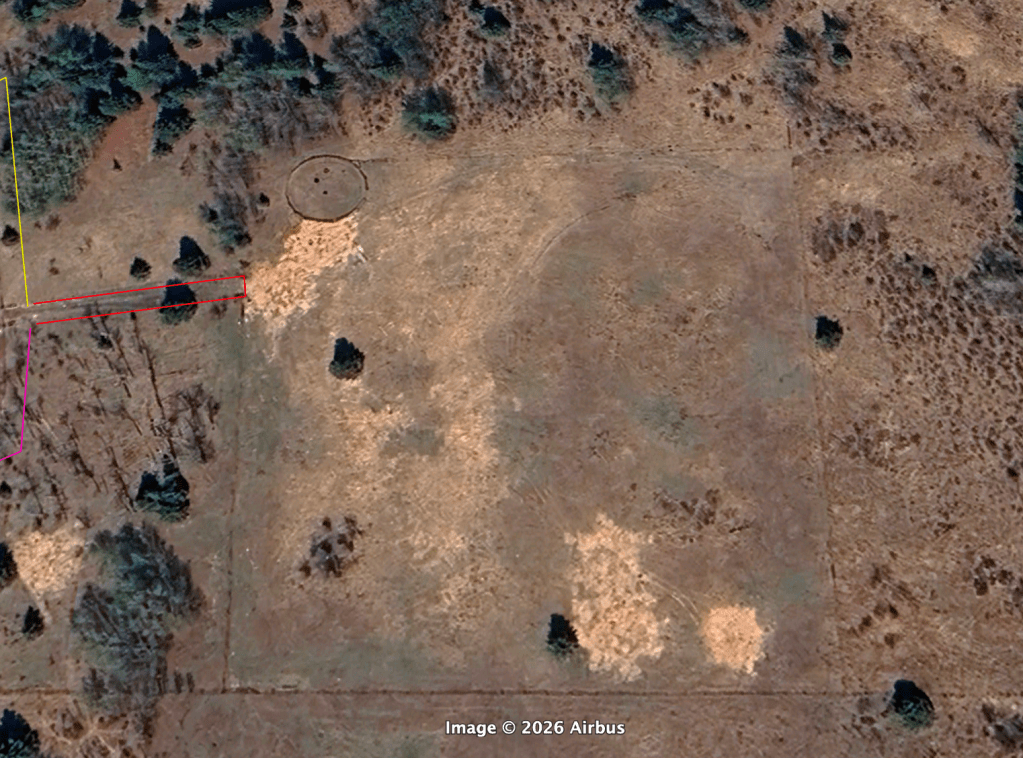
Isn’t it lovely? So nice and wide and open. So easy to get along with! So simple for pod layout!!
The Big Pasture, aside from its accommodating geography, is also the home to most of our cool season, tame grass pasture. The stuff that grows here are largely the non-native grasses — like brome, Timothy, Kentucky Bluegrass and some orchard types that have piggy-backed on some hay bales over the years. It’s a great source of early-season nutrition and our management goals here are a little different than they are for our native pods.
In the Big Pasture, what we’re chiefly focused on is spreading the impact. I design the pods so that they’re the right size for the number and type of animals we have — I want to see the sheep and alpacas mess up those plants, push them this way and that, nip the tops off, press seeds into the soil and generally turn the order of the Big Pasture into a small, messy landscape. Its thanks to this animal impact that soil regeneration, reseeding and any number of other useful biological processes — we’re talking manure, here — are evenly distributed and can do the most good. Huzzah!
The Work Begins
In my head, laying out the pods – and using our trusty Gallagher SmartFences — couldn’t be simpler in the Big Pasture. A couple of years ago, I struck upon a genius idea of using t-posts as grounding rods, SmartFence anchors AND mounting pole for our solar energizers. Talk about multi-tasking! I was so pleased with myself, I was beaming like a spotlight, you could have seen me from space. The genius of it was that I only needed to pound in one of the terrible t-posts, just a little to the east (right) of that lonely spruce on the west end of the pasture. I could just run the SmartFence around it like the hands on a clock — no muss, no fuss. Easy-peasy.
Like so.
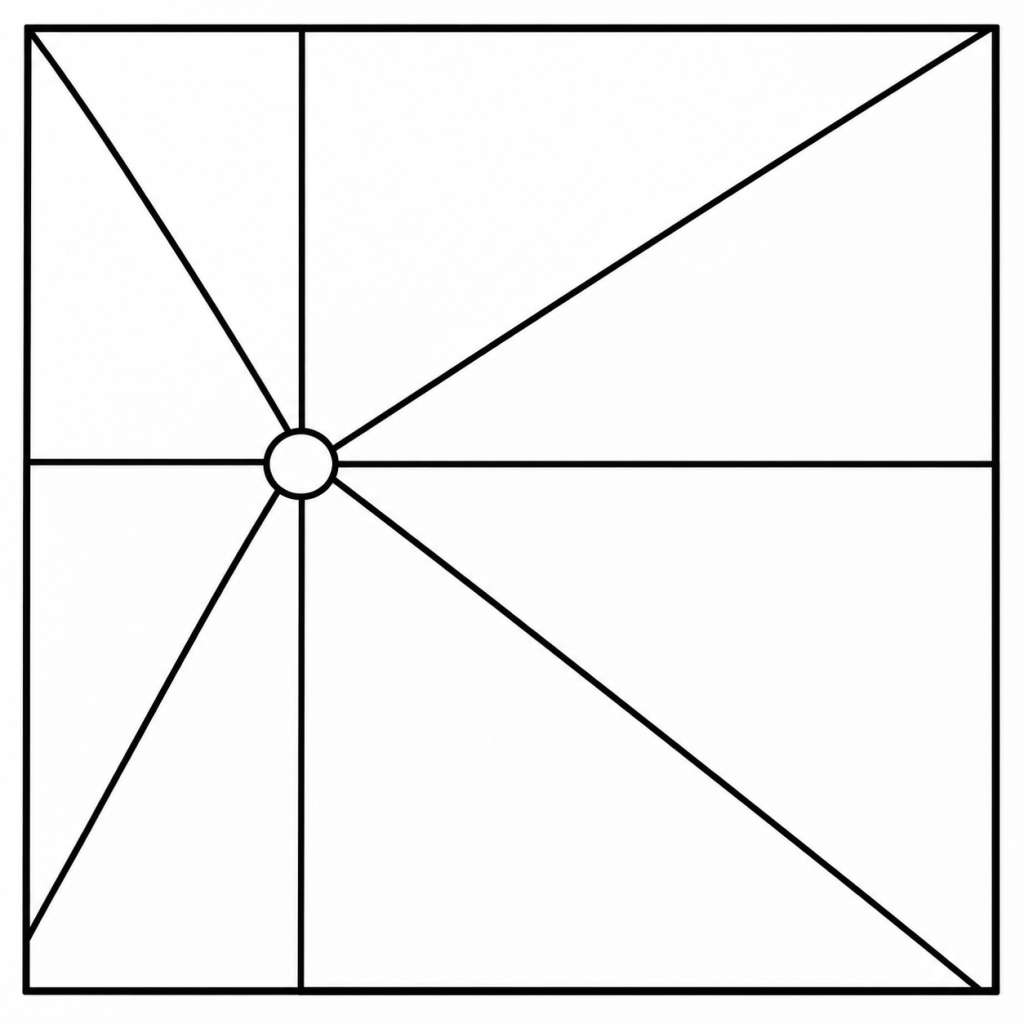
All this went swimmingly well (anything would have been better than what I’d been doing previously) until I noticed that in fact, the sheep weren’t actually visiting the new pods as I envisioned.
Hang on a second. That wasn’t the plan.
Not Team Players
When I divide the Big Pasture into wedges radiating out from a central hub — a neat little spoke pattern — I initially imagined the sheep spreading out evenly, every corner grazed, every bit of the pods feeling the impact of teeth or toes.
Turns out, not so much. I’m embarrassed to admit that I didn’t cotton on to it in the first year but on the second, I got suspicious and by the third year, I knew we needed to make some changes.
Time and again, the sheep were ignoring the far edges of the wedges. It didn’t matter what strategies I tried — I put out water, salt, mineral. I even sprinkled a bit of grain here and there, like some kind of ovine Easter egg hunt. Nothing seemed to change their minds. . . the places furthest from the hub remain lightly touched while the centre and broad middle sections receive most of the attention.
Accepting Feedback
The sheep had spoken.
I could continue to ignore them and just keep doing what made my life easier in the short-term but the homestead isn’t about the short-term. The homestead is entirely about the long view. I had information and it was up to me to adjust and adapt my approach. The sheep weren’t interested in change and the goals couldn’t change — those grazing goals are a fixed point. So with no other options, I had to change the strategy — it was the only switch left to flip.
I decided to experiment. For our first pass through the Big Pasture this year, I stuck to my central hub-and-spoke pattern. . . I guess I wanted to be sure the sheep hadn’t suddenly seen the light and decided to play along. Alas, no dice. Near the hub, everything was fully impacted but the further away you got, the less you could see any evidence of flerd activity. Okay. The pattern from previous years was unchanged.
For our second visit to Big Pasture, I decided to lay out the pods as blocks. No more easy-peasy pods for you, sister!
The Shape of Sheep
Believe me, I was sad to see that simple pattern go. Slugging through the tall grass with a SmartFence has been unfun.
But after a week, the verdict is in.
Turns out, when the pasture is divided into blocks — rectangles or squares, less elegant and a bit more awkward to fence — the flerd disperses throughout beautifully. Grazing becomes more even and impact is distributed more widely. Mission accomplished.
I find this fascinating.
The distance they’re traveling isn’t dramatically different and there’s no difference at all between the available forage. But that doesn’t change the observation — the shape of the paddock changes the shape of the animals’ behaviour.
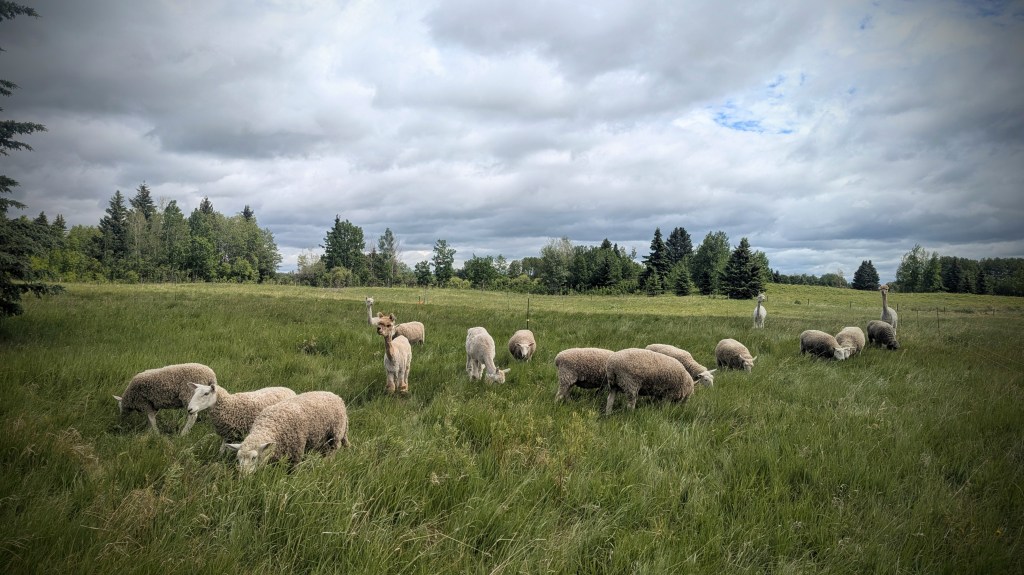
Now my job is to figure out . . . why.
I hate an unsatisfied curiosity.
I have a couple of theories. Perhaps the narrowing corners of a wedge feel like dead ends. Or maybe the hub becomes a social centre that’s difficult for some of our more dominant personalities to leave — as goes Maude, so goes the flerd. Maybe it has to do with the entry point — a place the sheep know is also closest to their exit point and my girls are big believers in minimal effort. I really don’t know for sure yet. At this point, all I can do is speculate about the reasons while concretely observing the results: the sheep are spreading.
From The Fenceline
Land stewardship is a conversation. I may make a plan but the land and the animals definitely have a vote — often, the deciding vote. If I want to work toward our goals — if resilience is what I’m aiming for — then no matter how inconvenient or unfun it may be, it’s to all our benefit if I listen.
Today, under low clouds and threatening rain, I watched the flock spread evenly through Pod 4 and thought, “You know Tara my girl, you’re getting that geometry lesson after all.” My imagination flitted back until I was sitting in Mr. Weins’ math class, watching in terror as his chalk moved across squares and triangles, ruthlessly bisecting them and pointing at a hieroglyphic equation while he cleaned his eyeglasses with his necktie. In my head, I can still hear the squawking in the cafeteria after class, “Like, WHEN AM I EVER going to USE that?! Seriously.” We nodded our heads, rolled our eyes and adjourned to the smoking area to console ourselves with a Dr. Pepper.
I didn’t understand it then — I don’t understand it now — but the lessons he was trying to pound into that Grade 10 geometry class are beginning to break through this particular cement-headed numbskull.
And what do you know? It turns out, geometry does matter and I did need to know that. Huh.
This is a Tending post — a practical look at our tools, methods, routines, and on-the-ground decision-making. It’s not a one-size-fits-all how-to, and it isn’t meant to substitute for local knowledge or professional guidance. It’s just what we’ve found useful and what we’re doing here on our farm, in our conditions, with our sheep (and alpacas), written down plainly in case it helps. For more about why we do things the way we do them, the philosophy that informs our process, you’ll find those posts in Living.


Leave a Reply