As we begin our look at agricultural barriers to entry for new or first-generation entrants in Canada, let’s start with the most obvious one – no, not land. I’m talking about what you know. . . or don’t.
Before we begin, let’s recap. I was recently asked the question, “Is Canada doing a good job building a resilient agricultural sector?” My answer was unequivocally, “No.” To understand why, let’s take a look at some statistics.
- 60.5 per cent of farmers are aged 55 or older
- 8.6 per cent of farmers are 35 or younger
- Canada lost 3,618 farms between 2001 and 2021; farm exits outpace farm entrants
- while one-third of farms at each agricultural census are new entrants, only half of these farms will still be in operation by the next census (every five years)
- Farm debt increased 14 per cent in 2025, the largest increase since 1981
- 4.1 per cent of farms account for 51 per cent of farming revenue
- Canadians import a majority of our fresh fruits and more than half our vegetables
- 79 per cent of Alberta’s farm family income comes from off-farm sources
- one-third of Alberta farm families are farming at a loss
Ok. So now that we’re all on the same page, let’s dig into . . .
The Knowledge Barrier — Introducing Farmer Jane
Let’s say Farmer Jane inherits her family’s multi-generational mixed farm. It can be anywhere but for funsies, let’s say it’s in Carstairs, AB. Jane is now the owner-operator of the farm — all the fields, all the equipment, all the critters, all the barns and any other related infrastructure. Thanks to diligence, prudence and hard work, her parents, also having inherited the farm from Jane’s still-living grandparents now happily living in a senior’s residence in the village, were able to sell Jane a vibrant operation with a reasonable bank balance, a lot of existing relationships and a ton of local goodwill. Jane’s family is well-known, respected and has spent generations and decades — long before Jane was born — building the kind of social capital that greases the wheels in small towns across the country.
Back in ’77, when Jane’s Grandpa had a stroke, neighbours hopped in their combines and took the harvest off. When Jane’s Mom was battling cancer during calving season, the local ladies’ United Church auxiliary took turns making the round trip into Calgary for her chemotherapy treatments. When times were hard back in the late ’80s, the local large animal vet was willing to work out payment plans that suited everyone — farm women stuffed his truck passenger seat with pies, biscuits and cinnamon buns by way of thank you.
And even more importantly, now that Jane’s the one calling the shots, when the old baler acts up, Dad knows just how to sweet talk it saving Jane an expensive fix. When a moody horse refused to get up in the stock trailer, it was Grandpa who told her to trickle a bit of water in the horse’s ear (yes, I’m told it works. No, don’t try this at home) saving Jane a vet call. And when Grandma, a woman with an incredible ability honed for decades to assess breeding beef cows, made suggestions about which bull to invest in, Jane was able to raise a fine calf crop.
Jane has access to not just her own experience having been raised on the farm, she’s also got two previous generations and all their acquired skills and experience at her beck-and-call. Jane has relationships — with vets, local lenders, neighbours and farming associations — that have been cultivated and tended by her family. If Jane has a question, there’s a good chance someone around her has an answer, someone who, when her family name comes up on the call display, will answer. Jane is a known quantity, not necessarily because of anything she’s done herself but because she comes from a family that has roots.
Far from “just a farm,” Jane has human capital — her own skills and experience in addition to what her parents and grandparents bring to the table. She’s got social capital — all those give-and-take relationships and goodwill built over generations. And Jane has institutional knowledge — the ability to navigate lenders, suppliers, auction staff, vendors, veterinarians, regulations and industry associations that make up today’s agricultural system.
The Knowledge Gap — Introducing Farmer Tara
Hi. It’s me. I’m the problem.
This part of today’s post is going to be stupid-easy for me to write. All I have to do is remember.
When I began farming back in 2019/2020, it wouldn’t be a stretch to say I knew nothing. I didn’t. Not anything. I remember calling my mentors Barry and Shirley and asking “Hey, so. . . are alpacas ruminants?” Seriously. I didn’t know how to take a temperature (I understood the theory but had never actually done it), didn’t know anything about hay analysis, mineral requirements, adaptive multi-paddock grazing, H-braces, sub-q vs. IM, how to back up a trailer, hoof trimming, entropion, vaccination schedules or what a Flehmen’s response might indicate.
I also didn’t know who to call when I got stuck in a snow bank; where to find straw bales that hadn’t been dosed with desiccant; how to identify tansy, Canadian thistle or foxtail; the nutritional difference between baleage, green feed and hay; cal/phos ratios or how to thaw out a frozen water line.
It’s not that I was stupid — all evidence to the contrary, I’m not stupid — it’s just there simply wasn’t anyone here to show me how. I made mistakes, I was wound up pretty tight, I’m sure I was an absolute joy to live with.
I lost friendships, lost sleep, lost weight, lost money, lost time. I hurt myself a time or two when I didn’t know a better way to do things and tried to do too much on my own. I was eager to learn, eager to excel, eager to work . . . But in those early days, all I really could do was the best I knew at the time, accept feedback, try again and make a different mistake the next time.
I wasn’t entirely without support back then — Barry and Shirley my alpaca mentors; Nikki Schieck, the generous shepherd who took so much time answering really stupid questions; Dr. Tara Risling and the staff at the local vet clinic; most of all, my husband Bob. Everyone was generous. Everyone was kind. Everyone did the best they could within the constraints of their own busy worlds. But at the end of each day, whatever happened, the weight and the responsibility, the ignorance and the mistakes. . . Those all belonged to me.
Even with all the lovely people I had in my corner, some days, I had never felt so lonely in my life.
No Heroes, No Bad Guys
Farmer Jane and Farmer Tara are just two different people. Farmer Jane hasn’t done anything wrong, she’s just inherited an invisible infrastructure along with the farm. When the tractor makes a funny noise, she has someone she can call. When there’s something definitely not a pair of front feet in the birth canal, she can gather knowledgeable reinforcements free-of-charge. When she needs a loan at the bank, she can go see some of the same faces her dad saw. And when the wheels fall off, as wheels will sometimes do, there is a community around her cheering her on.
What Jane inherited, I’ve had to build. For those of us who aren’t inheriting family land, relationships, knowledge or infrastructure, we have to spend a great deal of time, energy and money sourcing the very things that Jane’s family has spent generations acquiring. My timeline is measured in years, Jane’s in decades. For both of us, hard work is the common ground, the place our two venn diagrams overlap.
No one has behaved unfairly — quite the opposite — it’s just that in our agricultural system as it exists today, we reward inherited advantages.
For Every Problem, Let’s Find A Solution
As we’ve seen, Canada currently has more folks exiting the sector than entering it. Many of our new entrants to farming will not be in operation five (or less) years later. If we want a truly resilient agricultural sector, one which supports new farmers as they learn their way along; encourages innovation; creates opportunity; provides food Canadians actually eat and allows farmers to earn enough to live, then we need to deal with the Knowledge Gap. How might we do this?
I’m so glad you asked, pigeons!
At the recent Cultivating Resilience panel I was privileged to participate on, I tried to present one such solution — agricultural extension services.
Once upon a time, post-secondary institutions had extension services. These were departments within the university or college that specifically tackled issues that were important to the farming community and then made that knowledge available. They were like a one-stop shop for all things Ag.
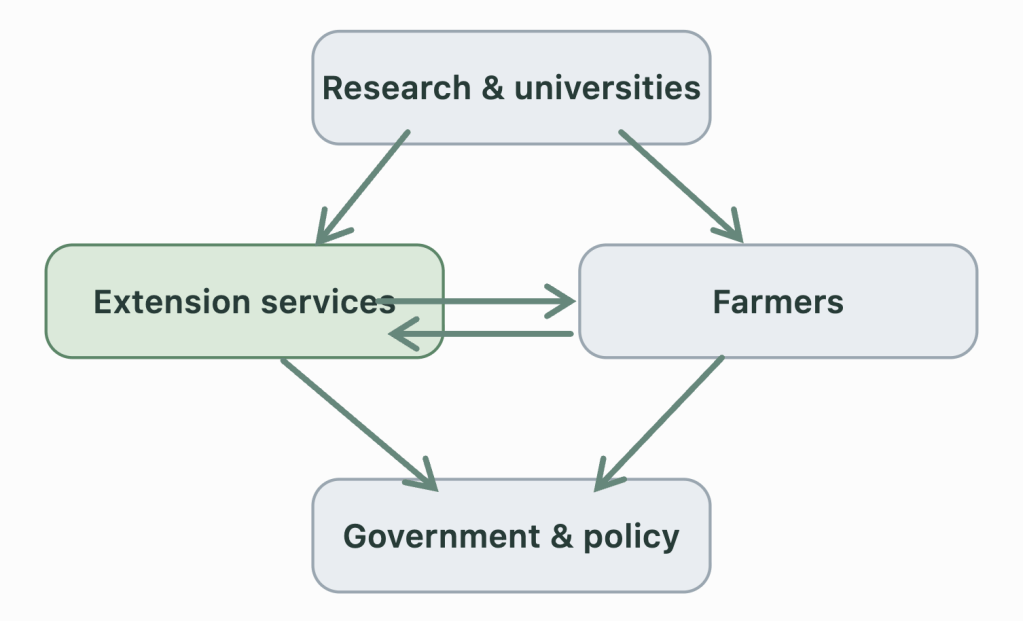
Extension services are still operating this way — more-or-less — in the United States. In Canada, we too once had extension services, bodies whose job it was to ensure that publicly-funded institutions made knowledge publicly available.
Extension Service Know-How
So what did extension services do? Basically, extension services provided support in a few key areas. Extension services —
- provided technical guidance. The practical skills of animal husbandry, agronomy, soil health, conservation and business management, among others.
- translated research/academic language. Taking the research and making it useful and practical in everyday terms for farmers, either with new trials or protocols.
- research feedback. Sometimes those trials identified new questions. Extension services helped to collect and organize that feedback to ensure that the next generation studies were as useful as possible.
- early-warning systems. Extension service agents were local and on the ground which made them instrumental in identifying new pests, disease or evolving scenarios before they had a chance to spread.
- community development. Farmers could get connected with other folks along their value chain, mentors, peer supports and training opportunities.
- public good. Whenever possible, extension services provided a forum and an opportunity for farmers and others in agriculture to get in the same room with policy makers, the public, consumer advocacy groups and more. With issues like food safety, animal welfare and environmental services (like water quality, soil health, biodiversity etc) very much top-of-mind for Canadians today, this seems like a made-to-order solution.
Alberta used to have extension services but like many things, funding for these essential supports has gradually been rolled back over the decades. Now, folks like Jane can access their own tried-and-true, built over generations networks. For me, I’ve had to build my own pseudo-extension service (and it’s particularly difficult with sheep as many of our ovine specialists aren’t local to me and tend to be thin on the ground anyway), funded with my own money and driven by my own concerns.
I’ve learned a lot, and quite a lot of it the hard way. And most of what I’ve learned is right here, on this laptop or somewhere on this website. It’s public, but it’s not exactly available. . . not unless you know where to look.
From The Fenceline
When extension services are publicly funded, the country is acknowledging that best practices produce benefits that spread far beyond one farm family. Reinvigorating our extension services, rebuilding them along the model the land-grant universities in the United States already demonstrate, would be a worthy and meaningful way to address the knowledge gap so many new and first-generation farmers encounter. It might save some of the sleepless nights, some of the worry and stress. If extension services were active and available, perhaps another new would-be farmer might be more willing and inclined to take the leap.
The public regularly makes demands of farmers — cleaner water, less chemical inputs, more emphasis on native ecosystem conservation, better animal welfare, reduced disease/bacterial contamination, greater food safety, improved soil management, better biodiversity etc — but the way things are currently, all those expectations are largely funded by the farmer. What supports exist are fragmented, often involve a lot of cumbersome paperwork, are geographically inaccessible or simply unknown.
For new entrants, meeting the increasing expectations of the public — in addition to learning all the new things they have to learn just to survive — is excessive at best and deeply hypocritical at worst. While everyone can agree that agriculture-the-sector is worth all the research and specialized programs, we don’t seem to put as much emphasis on ensuring those same resources actually migrate out of the institutions or offices and get into the hands of the person using them.
Extension services — robust, meaningful and publicly-funded — are one way Canadians can invest in truly resilient farms, helmed by capable and resilient farmers.
It’s one way we can put our money where our mouth is.
To Read Part 1 of this series — Barriers To Entry
This is a Living post, a post to share my thought processes, my experience and the philosophy that underpins our activities here at the homestead. It is not a how-to, “expert advice” or meant to reflect a wider experience than just my own, on my farm, here with my sheep.


Leave a Reply