Prime Minister Carney debuted the Food Security Strategy to much fanfare earlier this year. But in order to get those objectives met, Canada needs more farmers growing food that stays in our borders. What’s a new farmer to do when land prices are in the stratosphere? Are there policy levers that might help free up some of the land currently held? What might that look like?
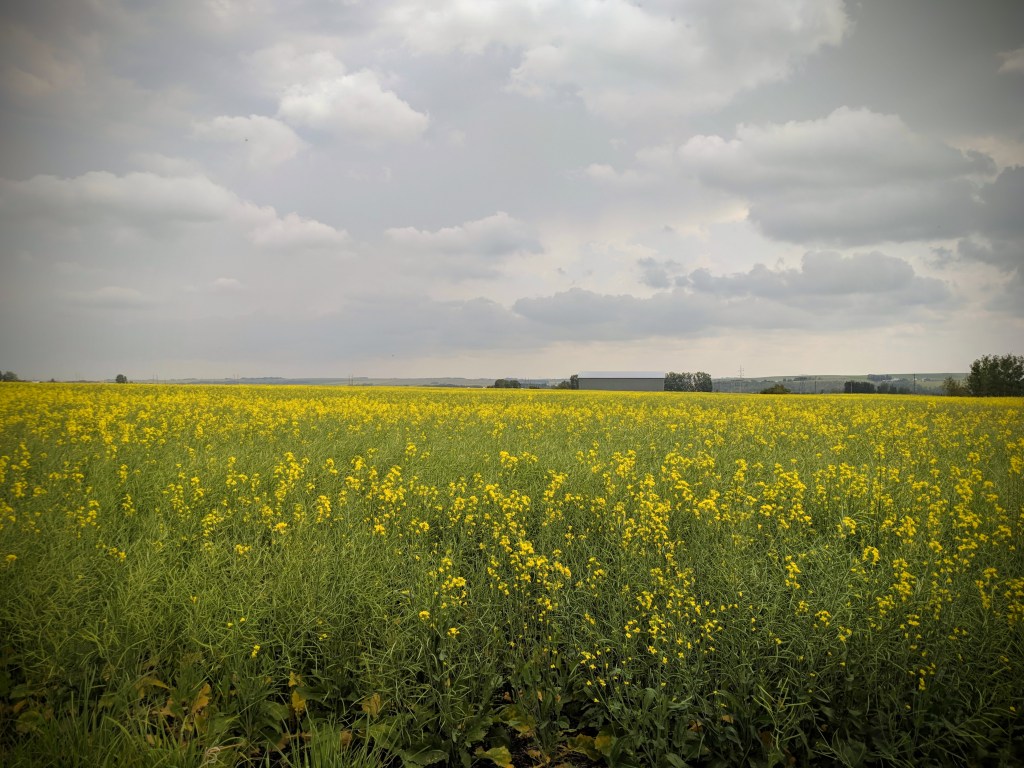
Before we begin, let’s look at the situation on the ground. As it were. Ahem.
- About two in every five Canadian farm acres were rented or leased in 2021. That’s 63.5 million acres, including leases held by government or crop-share arrangements. Measured by farm (rather than by acre), 44 per cent of farms reported renting or leasing at least some of their operating land.
- In Saskatchewan, land owned by large private owners — a category distinct from the investor group — more than doubled in five years. Researchers found 36 owners with 10,000 acres or more in 2018, a figure that jumped to 84 owners in 2023. Altogether, these holdings grew from 601,000 acres to 1.44 million acres.
- For B.C. farmers surveyed in 2024 with written lease agreements, the average term for those leases was 4.2 years. Reasonable Expectation of Profit (REOP) varies with farm operation and degree of leverage (that would be how in-debt the enterprise is).
- Only 12 per cent of Canadian farms report a written succession plan (ie., what happens to the farm as an entity when current landowner/farmer retires or dies).
- Nearly half of all Canadian farmers are expected to retire by 2033.
- Farmland values have gone up by 8.6 per cent according to figures released by the FCC. That puts farmland — as an investment — in the same category as high-value (ie oil-and-gas, mining, tech etc) S&P/TSX Canadian stocks.
In order for Canada to fulfill the mandate of the Food Security Strategy, we need new farmers participating in the sector. If only it was that easy! While there certainly appears to be plenty of people who’d like to farm, when it comes to one of the basics of farming — I mean land — it might as well be on Mars. For a lot of these folks, prices right here on Earth make farming about as accessible.
So what are we dealing with, exactly? What’s put land purchases out of reach? The answer, pigeons, is . . . complicated. Sigh.
Currently land prices reflect not necessarily the value of the actual parcel — the nuts-and-bolts of what it would be worth as bare land — but are influenced by what that land could return in the event it was sold. When prices go up for parcels A, B, and C, parcel D may also see a price jump. Modest annual increases can accelerate very quickly when something comes along to jumpstart the process. If land happens to be in reasonable proximity to an urban centre — and it doesn’t have to be a metropolis — the instigator might be a residential development, a data centre, a transportation hub or industrial project. Anything that puts land prices well out of range for farmers.
In a nutshell, the income a farmer might make from selling what they can grow on the land in question over the years of their operation is not the same as what someone else might be willing to pay for the same piece of real estate with designs for development — of some kind.
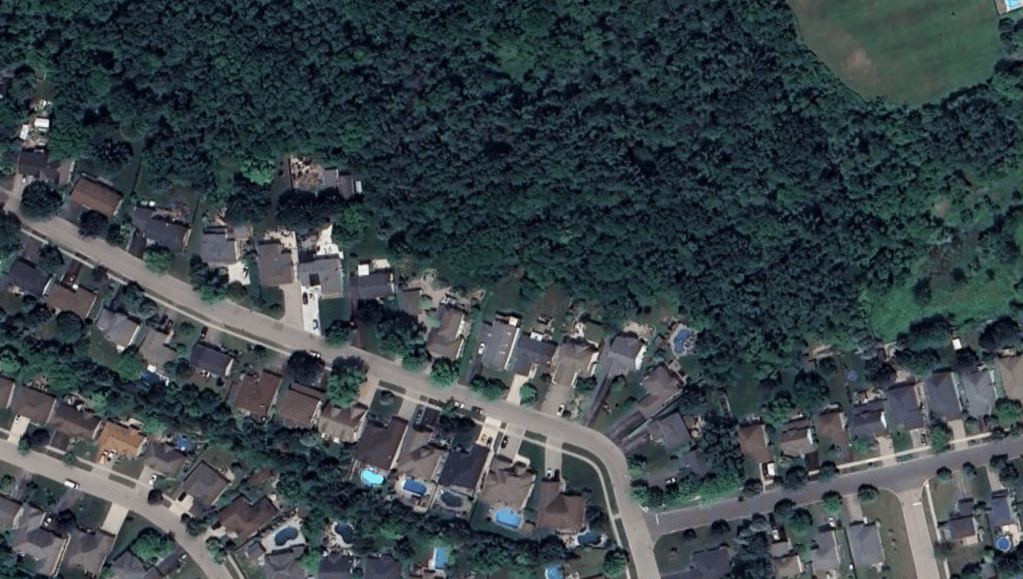
A case in point. This photo is a Google Earth view of the farm I grew up on in Waterloo Region in Ontario. The treed area is literally the only thing that’s the same from those days — it still belongs to my uncle. Everything else — the garden, berry patches, apple trees, heifer pasture, barn. . . all under houses, now.
Since the 1970s, my home region — deep in Ontario’s 401 corridor — has lost almost 53,000 acres of farmland to suburban development. (Now please understand, I’m not making a judgment call on whether or not that was the right or wrong thing. . . I’m simply trying to come to terms with just how much farmland has been taken out of agriculture.) That’s a chunk of land four times the size of the island of Manhattan and all from just one county. It’s a scenario that’s played out — repeatedly — across Canada.
But even when land stays — at least theoretically — available to farmers, it can be effectively out of reach, particularly for new entrants. Thanks to annually increasing returns (escalating land values before any other income has been derived from that land — like rental payments— about which, more later) land has become an attractive investment opportunity for businesses well outside even the most generous interpretation of “local.” Landlords may be private equity investors (like Bonnefield Financial with 133,000 acres across Canada), large landholders (like Robert Andjelic, currently holding 225,500 acres), corporations (like Avenue Living Asset Management with 87,000 acres in 2023). For the first-generation or new farmer — often without the capital, collateral or financial history lenders require — their “greener pastures” may only ever be in other industries.
How Did We Get Here?
It certainly didn’t happen overnight. In fact, much of our current situation when it comes to land prices has been — perhaps unintentionally — reinforced by agricultural policies. Publicly-supported crop insurance, existing tax scenarios, access to financing (we’ll talk more about the nuts-and-bots of financing in our final post of the Barriers to Entry series) can all benefit established players without creating opportunities for new farmers.
And where might we end up? With a system that currently rewards what amounts to a stockpiling of farmland, Canada has a decision to make:
Is our goal to protect the status quo — what amounts to an accumulation of wealth and assets — or is it to diversify the kind of food we grow as well as the farmer doing the growing?
Getting More Players On The Field
For arguments sake, let’s say you (like me) think we need more farmers doing the hard work of farming. How can we try and even the playing field? What policy options might we be able to use to get some of our would-be farmers off the bench?
I’m so glad you asked. Now roll up your sleeves. Let’s get controversial.
My First Big Idea — Crop Insurance. O yes, we’re about to go all sacred cow. What I’m proposing is introducing a progressively reduced public crop insurance subsidy (the part that comes from the Canadian taxpayer, not the part farmer’s pay into). Every region would decide on an appropriate base amount of land. For all land holdings above that base — rented or leased — the public subsidy would be gradually stepped-down and the land owner/renter would assume more of the expenses of operation. In my version, the limits would be applied to all land controlled by an operator — by themselves, any of their companies, any of their business employees/partners — so no one could avoid the reduction. Hopefully, with sharpened pencils, at least some operators would release acres back into the market for the simple reason that without the safety net of a full publicly-funded subsidy in the form of crop insurance, the math doesn’t math. (I have a fictional case study I did in an earlier post.)
Woof. How’d that go over?
Second Big Idea — Taxes!!
What if we were to apply increasing taxes to additional farmland purchases as an owner’s total holdings grow beyond that aforementioned regionally-appropriate base? We could build in safeguards to prevent large landholders from avoiding these limits through subsidiaries, partnerships or related companies. Once again, we are looking at total acres controlled by the landholder, no matter what name is on the title. To go alongside that, we can also provide some kind of preferential treatment for new entrants, family succession and reasonable expansion (again, determined by region) by working farmers. The goal this time is to prevent stockpiling — AKA consolidation — of land in just a few hands.
A nifty corollary to the purchaser’s tax scenario, we can tweak the capital gains tax for sellers. In our new tax regime (in for a penny, in for a pound. If we’re going to mess around with the Canadian Tax Code, we might as well get right in there) we can provide extra incentives to landowners who sell farmland to eligible working farmers, particularly existing tenants and/or first-generation farmers. Maybe sellers won’t be able to put quite as high a list price on the land they’re selling BUT they’ll be able to keep more of the money they sell it for.
Additionally, incentives don’t have to stand alone, they could be tied to long-term farming commitments — things that take years, sometimes generations, to establish. Think orchards, rebuilding soil, investing in riparian health or converting cropland back to native pasture. By pushing timelines — rather than land costs — we have a chance to build a policy that supports genuine agricultural resilience, ownership and community investment, rather than speculation.
Third Big Idea — Reinvest in Extension Services
Yes, I did talk about this a little (a LOT) in Part 2. But in this post, let’s develop a path where current large landholders can offset a limited portion of their land acquisition taxes by reinvesting into independent agricultural extension services. Not only would this provide some of the funding extension services would need for their annual operating budgets, landowners might also have an opportunity to meaningfully engage with other producers growing and doing things very differently in their region.
(Side note — just to be sure we’re all on the same page. . . contributions would not exempt investors from ownership restrictions. Sorry.)
Of course, any policy framework must be carefully designed to protect legitimate family farms, incorporated working farms, farmer-owned cooperatives and intergenerational succession. We want to decouple agricultural land from certain kinds of investment — those folks who are willing to pay more for land than a farmer can get for the crop they might grow there.
Nothing I’ve suggested here is intended to penalize current landowners. The goal is to gradually phase out the consolidation of land leaving more inventory for a new farmer to build equity and at a price point they can reach. By making huge farms shoulder more of the risk in their businesses, by making land less attractive to speculative investment, by offering enhanced benefits to selling to new entrants into farming and by providing a revenue stream for extension services and an opportunity for large landowners to reinvest in the subsequent generations, I hope that new and first-gen farmers might be able to see a play they can run.
Owning vs. Renting
Before we wrap this up, we have to talk about a kind of land tenure that is increasingly common in agriculture today. To rent? Or to buy. . . That is the question.
In 2021 (the most recent figures I could find), 44 per cent of farms rent land and 41.3 per cent of all agricultural land is not owned by the person who farms it. Renting is increasingly common scenario for all kinds of producers and I know there are many who would look at that and say, “Well, if they can rent land, then what’s the problem?”
Remember, we are prioritizing a discussion here of Barriers to Entry — the things that keep new entrants from coming into an industry or sector. In this series, we’re not talking so much about the folks who come from families where land is already held. In many cases, new entrants aren’t going to own land at all.
So does renting land work for them?
It can. . . but just as in all forms of real estate, there are a few factors to discuss. So let’s look at a chart!!
| Issue | Owning | Renting |
|---|---|---|
| Getting the land (assuming bare land) | Purchase price, down payment, financing and transaction costs. | Rent, associated legal costs, and any required deposit or advance payment. |
| Infrastructure | May need to install or repair fencing, water systems, electricity, barns, irrigation, storage and handling facilities. Buying land doesn’t guarantee these are present or usable. | May need the same infrastructure, plus the owner’s permission to install it. The agreement must establish who pays, who owns it and whether the farmer can remove it or receive compensation when leaving. |
| Starting production | Equipment, tools, livestock or plants, seed, feed and supplies—all additional to the land purchase. | The same production costs still apply. Renting a field does not necessarily include equipment, buildings or services. |
| Money before the first sale | Must cover farm expenses, land payments and living costs while production gets established. | Must cover farm expenses, rent and living costs while production gets established. |
| Ongoing property costs | Mortgage payments, interest, taxes, maintenance and repairs. | Rent, plus maintenance, repairs, utilities and other costs assigned by the agreement. |
| Security | Greater certainty of continued access, provided financial obligations are met. | Depends on the agreement’s duration, renewal terms and conditions for ending it. |
| Long-term improvements | Keeps the benefit of investments in soil, pasture, buildings and water systems. | May lose the use of improvements before recovering their cost. Permanent improvements may remain with the landowner. |
| Building ownership | Mortgage principal payments build ownership; land values may rise or fall. | Rent pays for access. It does not purchase a share of the land. |
| Leaving or changing direction | Selling takes time and costs money; some investments may be reflected in the sale price. | Relocation can mean moving animals and equipment, dismantling facilities within a designated timeline and paying to establish infrastructure again. |
So yes, renting is an option — in some ways and for some cases, it’s a great option. For our new farmers, it may be the only option. (As always, get the lawyers involved, write it all down, never go with just a handshake deal, not even for family . . . especially not for family).
But does rented land provide the kind of resilience and security the Food Security Strategy has in its crosshairs? The answer has to be “That depends.” For farmers, the length of the lease must allow enough time to recoup costs associated with start-up, things like equipment, infrastructure, livestock, tools and feed in addition to the rent payments. Lease agreements that come with an “early exit” proviso may not provide much security for the farmer at all. Additionally, what happens to the farming enterprise if something happens to the landowner? Top tip: If you’re a farmer on rented land, spend the money on a legal agreement. Only 12 per cent of farms have written succession plans. Without a legal contract, you may not have a leg to stand on should your landlord up-sticks.
From the Fenceline
This has been a journey — we’ve covered a lot of ground. So to speak.
(Sorry.)
As I was writing this, one nagging thought kept coming back to me. Start-up costs are start-up costs, whether you’re starting a hair salon, a vet clinic or a farm. Every business has start-up costs when you’re brand new to the sector. Agriculture already receives more support in Canada than other business sectors (but less support than agriculture receives from other national governments). Why should farmers get any additional support? Why does the land barrier deserve any kind of intervention?
. . . What makes farmers so special?
The first thing we want to remember is that helping our hopeful new farmers overcome the land barrier needn’t come at the expense of the salon or the clinic. By rejigging current policies and programs (like taxation or crop insurance) it might be possible to reduce systemic barriers without dipping into the public purse.
Secondly, any policy changes need to be designed to minimize disruption for all Canadians, farmers or not. Farmers will (hopefully) be busy growing more and more of the food on Canadian plates and in Canadian cupboards. Canadians have a very particular interest in ensuring those cupboards and plates are adequately filled, no matter what’s happening around the world. A phased policy approach can move us all toward a system that brings more opportunity to a greater number of people while still transitioning away from institutional ownership. If we start now, we can make the shift gradual and accompanied by affordable, thoughtful financing options for working farmers.
In the next decade-and-a-half, aging baby boomers will be selling off land assets to the next generation . . . of what? Will this land be sold to the people who can grow the kinds of foods we need here? The kinds of foods that will make Canada less dependent on overseas trade and sprawling supply chains? Or will it be sold to investors who prioritize profits and have said the quiet part out loud,
The best risk adjusted return (on farmland) comes from owning the land, not operating it.”
~ Stephen Johnston, Veripath Farmland Partners
That’s where we are, that’s what Canada needs to figure out. We’re talking a crazy amount of land — around 120 million acres. That’s a Spain. That’s how much land is going to be in play as the Boomers pass their assets on. If we’re going to engineer a system that let’s more people on to the field before that grey tsunami hits we’re going to have to get our skates on. We have a deadline.
Now is the time Canada. There won’t be a better one.
Read Part 1 of Barriers to Entry — An Introduction
Read Part 2 of Barriers to Entry — The Knowledge Barrier
Don’t forget to check back for Part 4 — The Finance Barrier, coming soon. . .ish
For more on related subjects:
Finance In The Field, Katherine Aske (Alberta specific)
Learning Communities and New Farmer Knowledge in Canada, Julia M. Laforge and Stéphan M. McLachlan
2024 New Entrants Needs Assessment, B.C. Ministry of Agriculture and Food
This is a Living post, a post to share my thought processes, my experience and the philosophy that underpins our activities here at the homestead. It is not a how-to, “expert advice” or meant to reflect a wider experience than just my own, on my farm, here with my sheep.


Leave a Reply