Today, in the last of our “Barriers To Entry” series, we unpack the financial barriers for new entrants into agriculture. Let’s begin by looking at three fictional farms with three different financial challenges. Boil it all down and what we’re really looking at is one question — what does it mean to “succeed” in Canadian agriculture?
Is success the same thing as resilience? And what should we be supporting?
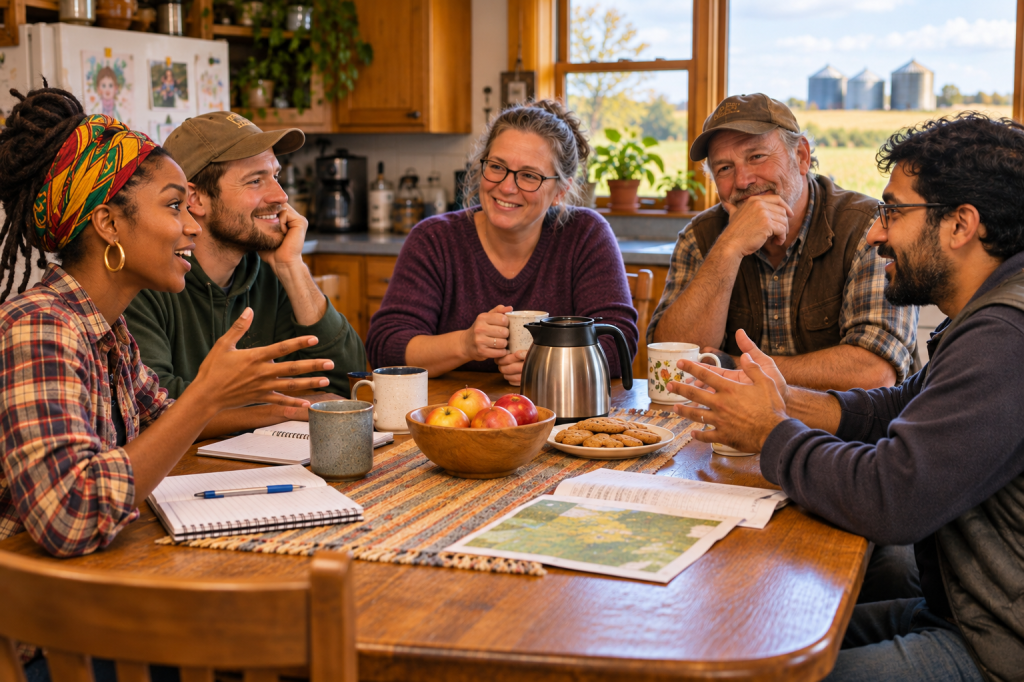
Today, I’m going to introduce you to three hypothetical (but still lovely!) farmers. Introducing Julia and Phil, Jameel and finally, Christine and Jake. Each of them have different situations but by the time you reach the end of this post, I hope you’ll understand why I’ve included them in this, our final Barriers To Entry post.
When we talk about barriers to entry, most often we’re discussing the obstacles that keep a person from getting into farming. That’s Julia and Phil. But as I continued to work on the post, I started thinking about all the obstacles that can keep a farmer from achieving their goals. For our Julia and Phil, we’re looking straight at what it takes to get started. For our second farmer, Jameel, we’re going to take a look at what’s keeping him from growing and Christine and Jake, our third farming family, will help us understand that for some farmers, particularly in our older generations, sometimes the obstacle “How do I stop?” becomes someone else’s “How do I start?” When you pull it all together, what do these wonderful folks tell us about a life in ag?
Let’s start with our first farming scenario.
The Price Of Admission
Julia and her partner Phil are young, ambitious and hard-working. They’ve both fallen in love with Community Supported Agriculture and have spent time working at different CSAs across the province. They’ve put their years of experience to good use and have spent many evenings pouring over the numbers and building a business plan that might one day see them with a CSA of their own, focused on a near-by inner-city neighbourhood identified as a food desert. The dream is a market garden, accessible by bus, so the locals can participate. They want to grow the kinds of fruit and vegetables the ethnically-diverse community enjoys eating. Julia and Phil have talked about experimenting with growing and drying different kinds of beans because that’s what their potential customers have told them are among the most popular protein sources in many of the area households. Julia harbours hopes of adding chickens and fresh eggs to the mix while Phil is passionate about the value of pigs in a regenerative farm.
After years in the trenches, neither Phil nor Julia want to build an empire. They’re not trying to take over the world. They’d also love to have children of their own one day, children who might grow to be as committed to local food security and social justice as they are. Currently they’re both working off-farm jobs and the plan is to keep one of them as they get themselves established.
Armed with spreadsheets, lists of potential customers, and that bullet-proof business plan, it’s time to start thinking about land costs, irrigation, equipment, maybe a green house? What about fencing, seeds and a reliable vehicle to make their deliveries?
They need money.
As it stands currently, most lenders in Canada tend to enjoy things like collateral, established earnings and demonstrated ability to repay loans. Julia and Phil have some savings and the relevant experience but their assets are limited and they’ve got zero agricultural financial history. But wait!! What about those government grants?
Um. Alberta’s On-Farm Efficiency Program offers eligible producers 50% cost-sharing on certain improvements. A $40,000 eligible project could qualify for $20,000 in government assistance. That sounds great, don’t you think? Sure, until Phil points out that in order to access that $20,000, they first have to find another $20K on their own.
Reading the fine print unearths another problem — to qualify as a primary producer, they’d have to be producing at least $25,000 worth of farm products annually. Impossible, they’re just getting started. Right now, $25,000 is the dream.
Julia and Phil are stuck in a familiar bind — they’ve got the plan, the market and the drive. The program that can make it all real exists. Unfortunately, it’s all out of reach.
And just so you don’t think this is an isolated example — the Resilient Agricultural Landscape Program also uses a $25,000 annual production threshold for individual primary producers. The federal AgriInvest program requires at least $25,000 in allowable net sales before a farmer can make a deposit eligible for matching government contributions.
Now, there are good reasons for eligibility criteria and requiring applicants to match dollars. Public money should be spent responsibly, and governments need ways to assess whether proposed investments are likely to succeed. It makes sense on paper. But think, just for a second, what these requirements actually mean for our would-be CSA farmers. To get any financial assistance, they first have to show that they’ve got the financial capacity . . . The same financial capacity they’re looking for help to develop.
It’s a variation on, “You can’t get a job without experience but you can’t get experience without a job.”
Now sure, they could borrow the money and accelerate their expansion plans to underwrite the new debt. They could also aim their guns at a larger production model that might satisfy the eligibility requirements but both of those choices move them further away from the carefully paced, financially responsible and personally sustainable business they’d envisioned.
Julia and Phil embody a dilemma — what happens when there’s capital, but no access?
It begs the question — is the agricultural sector in Canada currently set up to help new farmers get established in viable and sustainable agricultural businesses or is it encouraging them to assume greater financial risk just to qualify for start-up support?
The Cost Of Taking A Chance
Let’s move down the life timeline and we’ll get to know Jameel, a farmer with an already-established operation. Jameel is stuck. He can’t afford to grow.
Jameel is currently running a flock of 250 breeding Rideau ewes on his farm less than an hour outside a major metropolitan centre. A couple of years ago he took the plunge and began to direct market some of his lamb directly to an enthusiastic customer base. The remainder he consigns through livestock auction.
Jameel has worked hard, he knows his business and has put in the time to understand his production costs, animals and customer. Now, while things are stable, he’s got his eyes on expansion.
With another 100 head or so — maybe some Dorsets with their out-of-season breeding capabilities, that might be nice, he thinks — Jameel reckons he could spread some of the fixed costs across more animals. Keeping the lights on in the barn costs the same amount of money, whether there are 250 ewes or 350, after all. With more sheep, he might be able to take advantage of different marketing opportunities and increase revenue.
But. . . expansion costs money. There’s the additional land, the livestock housing, fencing, O! And a new handling system, some kind of data-collection or tracking software and Gawd, vet bills. And hay.
Consider his winter hay bill. Assuming good grazing conditions from mid-May through the end of October, feeding another hundred ewes just four or five pounds of hay per day over the remaining 196 days — with a 30 per cent allowance for waste — would cost in the neighbourhood of $11,200 to $16,800 at current prices (last I checked, between 10 and 12 cents/lb). That’s approximately 87 to 108 additional 1,300-pound round bales. And that’s before Jameel’s paid to transport the hay, paid for the feed analysis and his nutritionist, bought the required mineral, purchased supplemental feed or fed a single additional lamb.
A couple of weeks with his laptop and a frustrating round with lenders and Jameel knows that his projections prove he might improve his earnings but after years of experience with fluctuating livestock prices, feed volatility and knowing that more animals means more vet bills, Jameel is feeling uneasy.
What if he gets sick? The banks want their money on time, whether the lamb market is strong or weak. He could be puking his guts out but sheep still need feeding. He still needs to work out how to lamb out another 100 animals — he’s only got two hands and he has to sleep sometime. Fences still need to be fixed, feed bunks still need to be filled, pens still need to be cleaned out and the last time he checked, tractors ran on diesel, not wishes.
It all works beautifully on paper but his granny’s old phrase “Many’s the slip ‘twixt cup and lip” is haunting him. He knows that in real life, things are rarely so seamless. With no room for error, dancing on a knife’s edge of viability, one serious disruption could throw out everything he’s already built. He’s gambling with his own money.
He decides not to expand.
Jameel’s conundrum is that he has an opportunity but in order to realize it, he must be willing to sacrifice his own financial security.
Is Jameel a victim of poor business management? Or is his decision an entirely rational response to the financial risks involved?
The Price To Stay
Our third farm belongs to a family operating a mixed grain and cattle enterprise. They’re a successful second-generation farming family, not the usual Barrier to Entry candidate we’ve been discussing.
Christine and Jake bought the farm from Christine’s parents for fair market value a dozen years ago. They’ve spent the intervening time upgrading the aging barn, investing in new haying equipment and grain storage and even managed to take a vacation to visit Jake’s sister in Nova Scotia. With a hefty mortgage and an intimidating operating line-of-credit, Christine and Jake have drastically improved the farm’s value . . . but it’s come at the expense of their own retirement. They are the classic, “Rich on paper.”
For now, Jake is doing the farming while Christine teaches full time at the local high school. Jake is proud of the work they’re doing and the way his family pulls together but, especially as the kids get older, he can see some uncomfortable truths emerging. And top among them is that if it wasn’t for Christine’s job, they wouldn’t be able to keep farming. When it comes to the day-to-day cost of living, Christine is the family breadwinner . . . Some years, the bulk of the farm’s income has come from government programs, like crop insurance.
Christine’s teaching job provides a reliable salary, pension and health benefits — which came in super-handy when their 12 year-old needed several years of orthodontic work, Jake’s back needs attention or their 16 year-old needs glasses. Those benefits matter enormously to a household whose primary agricultural worker faces substantial occupational hazards.
According to the Canadian Agricultural Safety Association, 624 agriculture-related fatalities occurred in Canada between 2011 and 2020 — an average of more than 62 annually.
Jake is well-aware of the risks, he has that tricky back and a gimpy knee to remind him anytime he gets ahead of himself. At 56, he’s working 14-hour days, most days. Unless it’s harvest. Then it’s closer to a 20-hour day. Jake is exhausted and he knows he needs help. Christine knows it too.
There are two choices, as far as our farming couple can tell. Option 1, invest in labour-saving technology . . . but that means taking on more debt. Option 2, hire an employee . . . but the farm’s margins don’t comfortably accommodate another salary. And humming in the back of both their heads is the worry that with escalating land prices combined with what they’d need to realize from a sale, no one will be able to afford to buy the farm they spent so much effort, time and money to build. Having tied up so much of their money in the farm, they’re worried they’ll never be able to retire.
So Jake slugs back the coffee and heads out again to do most of the work himself.
Christine’s parents know the grind too well and step in where they can but her father is almost 80 with glaucoma. Every time Ed gets up into the cab, fatality stats scroll past Jake’s eyes. And while the farm remains productive, its ability to operate depends at least partly on earnings generated somewhere else . . . and a mountain of unpaid labour.
Statistics Canada’s 2021 Census of Agriculture found that 47.7% of Canadian farm operators reported working off the farm in 2020 while another Statistics Canada analysis found that wages, salaries and commissions were the largest source of household income for 45.9% of farm households in 2020.
Agriculture and Agri-Food Canada’s 2025 sector overview presents a revealing comparison: in 2021, families operating farms with annual revenues between $25,000 and $49,999 had average net farm operating income of approximately negative $1,700, while their average non-farm income was approximately $125,700.
Jake and Christine have production. They’ve built an enterprise that has real value. But the biggest chunk of their assets is tied up in infrastructure, land, family labour and a workload Jake might not be able to handle forever.
So let’s ask a question. What happens when Jake and Christine meet Julia, Phil and Jameel?
Let’s break out the coffee pot, throw some cookies on the table — I always think better when munching — and larp some scenarios. Whaddya say, pigeons? Could be fun.
The Cost of “Business As Usual”
All of our farmers have plans, experience, capacity and goals for the future. They’re in different branches of the agricultural sector with different business models and resources. They’re in different life stages with one group looking to get in, another looking to grow and our older farmers wondering how they’ll get out. If you draw it out, it looks like there should be lots of ways they might be able to help each other.
What if Jake and Christine rented land to Julia and Phil for their market garden CSA? What if Julia and Phil provided labour at Jake and Christine’s, giving Jake some much-needed support? What if Jameel’s customer base could add Julia and Phil’s CSA vegetables and eggs to their lamb order? What if Jake and Christine’s barn could be retrofitted for Jameel’s expanded sheep flock?
What happens when we stop looking at farmers as individual agricultural enterprises and start looking at them as equal participants in the agricultural sector?
All five of these folks are now sitting around the table in Jake and Christine’s kitchen. What are the possibilities?
1. They could share capital-intensive infrastructure.
A tractor, livestock handling facilities, refrigerated storage, delivery vehicles or other equipment might be useful across more than one business reducing the amount of money each farmer needs to raise on their own.
But, as anyone who’s ever been in any kind of longterm relationship knows, sharing ownership can bring some hefty complications along with it. In a farm context, that can be things like maintenance responsibilities, insurance, scheduling use, biosecurity protocols, liability coverage and what happens if someone’s life suddenly changes and they need to exit the relationship. The financial risk doesn’t disappear, it’s just spread out a bit more.
2. They could create markets together.
Jameel has an established direct-marketing business while Julia and Phil want to start one. They all see the potential for complementary products, shared customer relationships and lower distribution costs by pooling their resources.
But they also know that it has to do more than work in theory. Nothing is automatically more profitable or sustainable just because it’s blended. . . In fact, Jameel is worried about the additional paperwork, data collection and tracking that would be necessary — no one wants to spend most of their time at a desk and bringing in outside professionals to handle that work adds another cost to the business.
3. They could exchange knowledge and labour.
Christine and Jake have experience managing an established farm operation. Jameel understands livestock production and community-based marketing. Julia and Phil have CSA experience and an interest in diversified production. Potentially, they could all learn from one another. Possibilities for paid labour, mentorship, knowledge transfer and (my personal favourite) cooperative work are dancing in front of their eyes.
But here’s the catch: none of them has much spare labour to give away. In a system that’s already heavily reliant on free labour — Ed’s tractoring, Jake and Christine’s kids, Christine herself — unpaid cooperation needs to be treated very carefully. Without appropriate safeguards and clear communication, it can get exploitative. If we expect farmers to solve problems by being good neighbours, working together and increasing other forms of informal cooperation, aren’t we asking them to absorb even more of the costs of agriculture? Isn’t it just another way of making an unsustainable system even better at sucking up more of their labour?
4. They could develop a gradual succession arrangement.
Christine and Jake could lease part of their land or infrastructure with the goal of eventually transferring some of these assets to younger farmers, like Jameel, Julia and Phil. It could potentially help them recover some of the value of their investments. Julia and Phil could begin farming and Jameel could expand, all without assuming ruinous levels of debt that would come with purchasing a turnkey grain-and-cattle enterprise.
But these arrangements require legal agreements, appropriate financing and a fair allocation of risk. . . And Christine and Jake still need sufficient income to pay of their debts and then, hopefully, retire.
Taken together, our farmers each have most of what they need to establish a viable farming business but if they each continue to work on their own, they each run into barriers that prevent them from reaching their goals. There are real opportunities for collaboration and sharing risk, but also real risks if things aren’t shared equally.
So here’s an idea. What if we were to develop policies that make it easier for farmers to support each other? Funds to secure and setup shared infrastructure — like community-owned abattoirs or processing facilities? Or providing legal, tax and structural supports that facilitate inter-generational or succession planning outside of one farm family? Christine and Jake’s kids want to be an optometrist and an astronaut (at the moment — it’ll change) but Julia and Phil want to farm.
Currently, most of our policy focus has been on keeping the farm within the family. What if we switch our focus to keeping the farm within the community?
From The Fenceline
First, thanks for sticking with me. I know this is a lot.
What we have to ask ourselves is simple: can a truly successful farm business be separated from a resilient one? Our current landscape certainly provides some high-profile examples. But is that what we want? Is that good for Canada? Is it good for Canadian farmers?
Canada has a long, long history of cooperative enterprises, particularly in the Prairies. They may have fallen out of favour in some ways but the times, they are a-changin’ and it may be time to dust them off and gussy them up to make them relevant for a new generation.
Once upon a time, cooperation and community weren’t just about being good neighbours, it was about survival. Our farming case studies aren’t about enterprise failure, they’re not about lack of ambition or poor planning. The thing all three of our farming families share is orphaned potential.
In Canada, we have a business culture that tells farmers success comes with high production numbers and financial returns. . . but the means of attaining that version of success often depends to a high degree on farm families absorbing risk — personal, financial, relational — on their own. If a farm can grow food, take care of livestock and land, contribute to its community and operate responsibly and well, but doesn’t provide for the people doing the work, how — exactly — is that successful?
Julia and Phil have a business they cannot establish, Jameel has an expansion opportunity he can’t safely pursue and Christine and Jake have assets they can’t easily convert into retirement security. If we can put them around the kitchen table, some of those limitations can be reduced through cooperation but others will remain. Let’s consider building agricultural policy that tackles that problem. Instead of asking how to make each farm more productive, let’s ask how can we make it easier for farmers to work together? How can we minimize or eliminate those limitations? How can we share the risk and build resilience?
Now, I want to be clear about one thing. When we talk about agricultural resilience, we’re not talking about someone’s ability to absorb hardship and keep going. That’s an assumption I’ve read many times over the years. Agricultural resilience, for our purposes, is the ability to adapt, to evolve and respond to change, whether it’s generational, political, social or ecological. It’s about capacity, not just endurance. Resilience is having as many tools as possible to build something useful in the context you’re in.
I think Canada’s longterm farming resilience may depend as much on creating connection between farmers as it does on creating opportunities for individual farms. Think of it this way. Right now, our agricultural policy and resources are a silo — designed to flow vertically, within in a contained business, usually within one family. Instead, we could begin to design a system that acts a little more like a watering system — resources and supports flow from a primary source but are spread through various channels to many distinct, inter-connected businesses. It’s a different — but not new or unique — way of thinking about how money, land, equipment, labour and knowledge can be shared.
Success and business viability shouldn’t be reduced to the balance sheet alone. Success may not come down to the individual farmer willing to grind the longest in isolation. Resilient farms — a success by any measure — are possible when they’re deeply rooted in the communities that rely on them, the basic fundamentals of people, relationships, skills, time and money.
It’s time to get back to the basics.
To Read The Rest Of The “Barriers To Entry” Series:
Barriers to Entry — An Introduction
Barriers to Entry, Part 2 — The Knowledge Barrier
Barriers to Entry, Part 3 — The Land Barrier
Other Resources for you to explore —
Who Will Feed Us? — New Farmer Perspectives On Agriculture for The Future
Alternative Land Tenure Systems — “Agricultural Land Tenure Systems: Implications for Farmland Succession, Access, Governance, and Food Systems Transformation,” York University
Farmland Access and Tenure — National Farmers Union
Legacy and Succession — University of Alberta
This is a Living post, a post to share my thought processes, my experience and the philosophy that underpins our activities here at the homestead. It is not a how-to, “expert advice” or meant to reflect a wider experience than just my own, on my farm, here with my sheep.


Leave a Reply